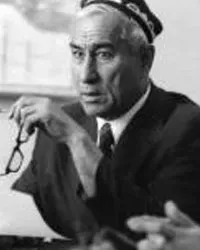
Uzbek geologist, academician of the Academy of Sciences of Uzbekistan; a researcher of loess rocks and engineering geology, director of the Institute of Seismology and laureate of the Beruniy State Prize.
- Occupation:
- Scientist, Geographer or geologist
- Lived:
- January 15 1910(78 years old) ♑ — March 12, 1988
- Birthplace:
- Tashkent
Biography
Gani Mavlonov (full name Gani Orifxonovich) was a geologist, an academician of the Academy of Sciences of Uzbekistan, and a researcher of loess rocks and of seismology. Born on 15 January 1910, he took part in the Second World War. He finished the Central Asian Industrial Institute in 1935 and in 1940–1941 worked there as dean and associate professor.
His scientific career unfolded at the Academy’s Institute of Geology, where he was a researcher (1946–1949), laboratory head (1949–1955) and then director (1956–1960). From 1960 to 1966 he ran the Institute of Hydrogeology and Engineering Geology, and from 1966 he was director of the Institute of Seismology. He earned the degree of doctor of geological and mineralogical sciences in 1955, the rank of professor in 1957 and membership of the Academy in 1960; in 1970 he received the title Honored Worker of Science and Technology of Uzbekistan.
Part of his research examined the genetic varieties of loess and loess-like rocks, along with their engineering-geological characteristics and physical-mechanical properties. In 1949 he split the Quaternary deposits of Central Asia into four periods according to age and plotted the areas where they occur on a map.
Following the Tashkent earthquake Mavlonov moved into seismology. The seismic microzoning map of Tashkent and its environs, and the updated 1978 edition of the seismic zoning map of Uzbekistan, were produced under his direction. A scientific discovery about changes in groundwater and gas composition during earthquakes is also credited to him.
He received the Beruniy State Prize of Uzbekistan in 1981 and died on 12 March 1988. A Tashkent street and the Institute of Seismology are named for him, and since 1990 the institute has housed a museum dedicated to him.
Education
- Central Asian Industrial InstituteUniversity · Tashkent · 1935
Career
- Institute of Geology of the Academy of Sciences of the Uzbek SSRResearcher, head of laboratory, director · Tashkent · 1946–1960
- Institute of Hydrogeology and Engineering Geology (GIDROINGEO)Director · Tashkent · 1960–1966
- Institute of Seismology of the Academy of Sciences of the Uzbek SSRDirector · Tashkent · 1966–…
Awards
 Beruni State Prize of the Uzbek SSR1981 · Uzbek SSR
Life path
- 1935Graduated from the Central Asian Industrial Institute
- 1940–1941Dean and associate professor at the institute
- 1946–1960Researcher, head of laboratory and director of the Institute of Geology
- 1949Divided the Quaternary deposits of Central Asia into four periods
- 1955Doctor of geological and mineralogical sciences
- 1960Academician; director of the Institute of Hydrogeology and Engineering Geology (until 1966)
- 1966Director of the Institute of Seismology
- 1978Led work on the new version of the seismic zoning map of Uzbekistan
- 1981Beruniy State Prize
- 1988Died
Works
- «Toshkent zilzilasi» (1971)