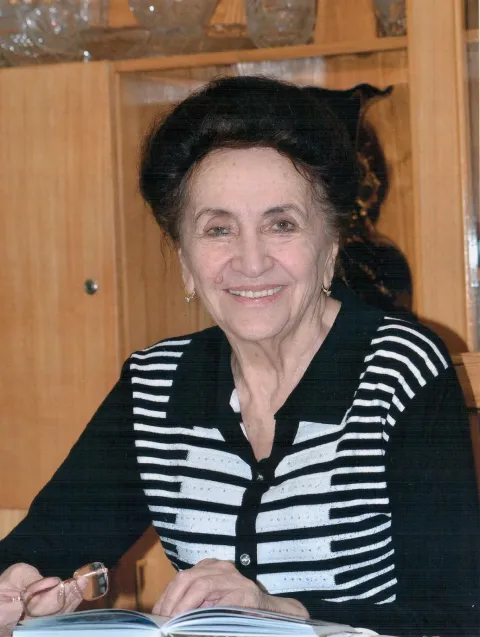
Naima Mahmudova
Physician and stateswoman: deputy health minister of the Uzbek SSR, chair of the republic’s trade union council, deputy of the USSR Supreme Soviet, doctor of medical sciences and professor.
- Occupation:
- Politician, Scientist, Legislator
- Born:
- August 10 1928(88 years old) ♌ — June 7, 2017
- Birthplace:
- Tashkent
- Father:
- Botu (Mahmud Xodiyev)
- Mother:
- Valentina Vasilyeva


Biography
Naima Mahmudova was born on 10 August 1928 in Tashkent. Her father was the Uzbek poet and public figure Botu (real name Mahmud Khodiyev); her mother, Valentina Vasilyeva, was a writer. Her father was repressed in the 1930s, shot in 1938 and rehabilitated in 1958.
She graduated from the Tashkent Medical Institute in 1951 and went to work in the sanitary and epidemiological service, first as chief physician of the Urgut district station and, from 1958 to 1963, of the Samarkand regional station. In 1963 she moved with her family to Tashkent.
From 1963 to 1971 Mahmudova was deputy minister of health of the Uzbek SSR. From 1971 she was deputy chair of the Uzbek Council of Trade Unions and from 1977 to 1986 its chair. She was twice elected a deputy of the Supreme Soviet of the Uzbek SSR and, in 1979–1989, a deputy of the Soviet of Nationalities of the USSR Supreme Soviet (10th and 11th convocations) for the Karakalpak ASSR, and chaired the health commission of the USSR Supreme Soviet. She was a member of the Communist Party and a delegate to its 26th Congress, and sat on the All-Union Central Council of Trade Unions, the Uzbek society for friendship and cultural ties with foreign countries and the Soviet Women’s Committee.
In 1968 she defended a candidate’s dissertation, “The historical development of therapy in Uzbekistan”, and in 1975 a doctoral dissertation on organising the medical rehabilitation and social adaptation of children with cerebral palsy in the republic. She became a professor in 1986.
From 1986 to 2000 she headed the department of social hygiene (from 1997 the department of general hygiene, social hygiene and health-care organisation) at the Tashkent Pediatric Medical Institute, and afterwards remained there as a consulting professor. She held the Orders of the Red Banner of Labour and of the October Revolution.
Naima Mahmudova died on 7 June 2017.
Education
- Tashkent Medical InstituteUniversity · Tashkent · 1951
Career
- Supreme Soviet of the Uzbek SSRDeputy (two convocations) · Tashkent
- Supreme Soviet of the USSRDeputy of the Soviet of Nationalities, head of the health commission · 1979–1989
- Tashkent Pediatric Medical InstituteHead of the department of social hygiene (1986–2000), then consulting professor · Tashkent · 1986–…
- Urgut District Sanitary and Epidemiological StationChief physician · Urgut District · …–1958
- Samarkand Regional Sanitary and Epidemiological StationChief physician · Samarkand · 1958–1963
- Ministry of Health of the Uzbek SSRDeputy minister · Tashkent · 1963–1971
- Uzbek Council of Trade UnionsDeputy chair (1971–1977), chair (1977–1986) · Tashkent · 1971–1986
Awards
Life path
- 1928Birth
Born in Tashkent in the family of the poet Botu.
- 1951Graduated from the Tashkent Medical Institute
Went to work in the sanitary and epidemiological service and until 1958 was chief physician of the Urgut district station.
- 1958–1963Samarkand regional sanitary and epidemiological station
Chief physician of the regional station.
- 1963–1971Deputy minister of health
Worked in the Ministry of Health of the Uzbek SSR and moved with her family to Tashkent.
- 1968Candidate’s dissertation
Defended “The historical development of therapy in Uzbekistan”.
- 1971–1977Deputy chair of the Council of Trade Unions
Worked in the Uzbek Council of Trade Unions.
- 1975Doctoral dissertation
Defended a thesis on organising the medical rehabilitation and social adaptation of children with cerebral palsy.
- 1977–1986Chair of the Uzbek Council of Trade Unions
Headed the republic’s trade union council.
- 1979–1989Deputy of the USSR Supreme Soviet
Member of the Soviet of Nationalities (10th and 11th convocations) for the Karakalpak ASSR; chaired the health commission.
- 1986–2000Head of a department
Headed the department of social hygiene at the Tashkent Pediatric Medical Institute; became a professor in 1986.
- 2017Death
Died on 7 June.
Works
- “The historical development of therapy in Uzbekistan” (1968)Candidate’s dissertation
A study of how therapy as a field took shape and developed in Uzbekistan.
- “The organisation of medical rehabilitation and social adaptation of patients with infantile cerebral palsy in Uzbekistan” (1975)Doctoral dissertation
A study of how medical and social care for children with cerebral palsy was organised.