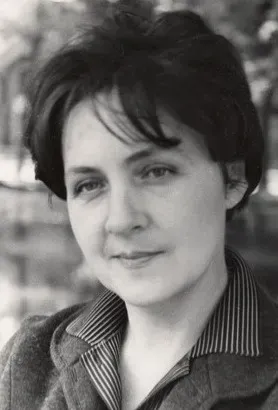
Biography
Nina Borisovna Nemtseva was born on 12 December 1926 in Ufa (Bashkir ASSR) into a family of office employees and spent her childhood in Beloretsk. In 1944 she graduated from the Beloretsk teacher-training college and taught at a school for about a year. After the war she came to Tashkent and in September 1945 entered the history faculty of the Central Asian State University, where she chose archaeology.
Among her teachers were M. E. Masson and G. A. Pugachenkova. As a student she spent four seasons with the South Turkmenistan Archaeological Complex Expedition and took part in the excavations at Old Nisa; her diploma thesis dealt with the round temple there. She graduated in 1950.
She then worked as an archaeologist in the monuments protection department of the Architecture Administration and ran independent excavations at the Gur-Emir mausoleum. From 1957 to 1969 she worked at the Special Scientific Restoration Production Workshop, in 1970–1971 in the archaeology department of the Institute of History of the Uzbek SSR Academy of Sciences, and in 1971–1988 at the Hamza Institute of Art Studies. In 1972 she became a Candidate of Historical Sciences.
Nemtseva devoted about ten years to the Shah-i-Zinda ensemble in Samarkand: her excavations uncovered the remains of the madrasa of Tamghach Bughra Khan and dated the beginning of the ensemble’s core, the complex of Qusam ibn Abbas, to the early 11th century. The oldest cultural layers she found in the south of Afrasiab allowed the origin of Samarkand to be placed in the middle of the first millennium BC, so that the city has existed for more than 2,500 years.
Another major project was the Karakhanid-era palace complex of Rabat-i Malik in the Bukhara steppe: excavations went on with long breaks in 1973–1975, 1977 and 1997–2001, and she led them throughout. She also studied the manor and castle of Baba-tepe near Termez, the Khoja Mashhad mausoleum-khanaqah and the Kok-Gumbaz mosque in Tajikistan, and the mausoleum of Khoja Ahmad Yasawi in Turkestan; in the late 1970s and early 1980s she carried out survey routes in the Syrdarya and Jizzakh regions for the Code of Archaeological Monuments of Uzbekistan.
From the mid-1990s she studied the complex of the mausoleums of Sayf al-Din Bokharzi and Buyan Quli Khan in Bukhara, and in 1999–2003 she was a senior researcher at the Institute of History of the Academy of Sciences of Uzbekistan. She wrote five books, several brochures and about 150 scholarly articles. She died on 13 July 2021 in Düsseldorf, Germany.
Education
- Central Asian State UniversityUniversity · Tashkent · 1945–1950 · Historian-archaeologist
Career
- Institute of History of the Academy of Sciences of UzbekistanSenior researcher · Tashkent · 1999–2003
- Hamza Institute of Art StudiesResearcher · Tashkent · 1971–1988
Life path
- 1926Birth
Born in Ufa (Bashkir ASSR).
- 1945–1950Studies at the Central Asian State University
Studied in the archaeology department of the history faculty and trained with the expedition at Old Nisa.
- 1950Monuments protection department
Joined the Architecture Administration as an archaeologist and excavated at the Gur-Emir mausoleum.
- 1957–1969Special Scientific Restoration Workshop
Took part in studying and restoring monuments; her excavations at Shah-i-Zinda and Afrasiab belong to these years.
- 1971–1988Hamza Institute of Art Studies
Continued her study of the architectural and archaeological monuments of Central Asia.
- 1972Candidate’s degree
Became a Candidate of Historical Sciences.
- 1973–2001Excavations at Rabat-i Malik
Led the excavations of 1973–1975, 1977 and 1997–2001.
- 1979Book on Shah-i-Zinda
Published a book on the ensemble, written with Yu. Z. Shvab.
- 1999–2003Senior researcher at the Institute of History
Studied the khanaqah complex of Sayf al-Din Bokharzi in Bukhara.
- 2021Death
Died on 13 July in Düsseldorf, Germany.
Works
- “The Shah-i-Zinda Ensemble” (1979)Book
Written with Yu. Z. Shvab and published in Tashkent.
- “Shahi Zinda” (album) (1987)Album
An illustrated edition on the monuments of the complex.
- “The Khanaqah of Sayf al-Din Bakharzi in Bukhara: On the History of the Architectural Complex” (2003)Book
A study of the khanaqah complex in Bukhara.
- “Rabat-i Malik, 11th – Early 18th Centuries: Archaeological Research” (2009)Book
Results of the excavations of the Karakhanid palace complex.
- “The Shah-i-Zinda Ensemble: History, Archaeology, Architecture, 11th–21st Centuries” (2017)Book
A summarising book on the history and archaeology of the ensemble.
- “Stratigraphy of the Southern Edge of the Afrasiab Site” (1969)Article
Published in the collection “Afrasiab”.