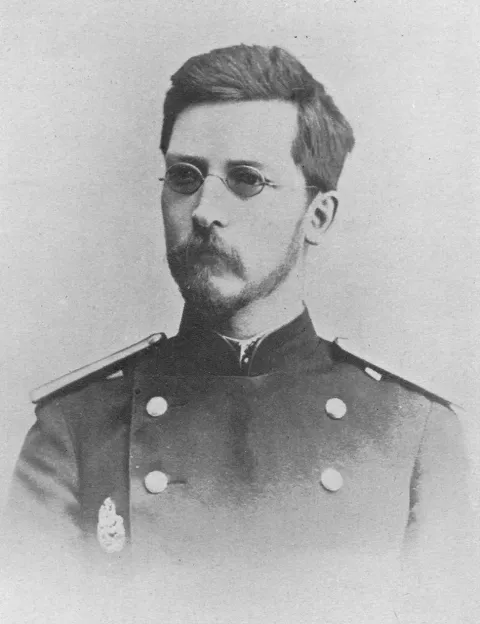
Biography
Pyotr Fokich Borovsky was born on 27 May (8 June in the Gregorian calendar) 1863 in the small town of Pogar in the Starodub district of Chernigov Governorate. He finished the Novgorod-Seversk gymnasium with a gold medal, began studying medicine at Kyiv University, and went on to the Military Medical Academy in Saint Petersburg, graduating with distinction in 1887.
In 1891 he defended a dissertation on tuberculosis of the bones and joints and was posted as a doctor to the military infirmary in Marghilan. In 1892 he was sent to Tashkent, where he headed the surgical department of the military hospital and its bacteriological laboratory.
From 1894 Borovsky studied the origin of the “Pendeh sore”, also called the “Sart sore”, a widespread illness in Central Asia (now known as cutaneous leishmaniasis). After about three years of work he established that its agent was neither a bacterium nor a fungus but a protozoan. He presented his conclusions on 23 September 1898 to the Pirogov Russian Surgical Society in Saint Petersburg and published them the same year in the “Military Medical Journal”. When the American James Wright described the organism in 1903 the discovery was long credited to him; Borovsky’s priority was recognised internationally only in 1932. His colleague K. Shulgin confirmed the observations and in 1902 was the first to suggest correctly that the disease is carried by night-biting insects. Borovsky also proposed a new method of suturing the urinary bladder.
After the revolution he helped build higher medical education in Tashkent as one of the organisers of the medical faculty of Tashkent University. From 1920 until his death he headed the chair of hospital surgery at that faculty and then at the medical institute that grew out of it, and in 1926 he served as dean of the faculty. He is also named among the organisers of public health care in Uzbekistan.
In 1927 he was given the title Hero of Labour and he also received the Order of the Red Banner of Labour. Pyotr Borovsky died in Tashkent on 15 December 1932 and was buried in the city.
A military hospital in Tashkent, the city’s medical college and the street on which the college stands bear his name.
Education
- Kyiv UniversityUniversity
- Military Medical Academy (Saint Petersburg)University · 1887 · Physician (with distinction)
Career
- Tashkent State Medical InstituteProfessor, head of the chair of hospital surgery · Tashkent · 1920–1932
- Tashkent Military HospitalHead of the surgical department and the bacteriological laboratory · Tashkent · 1892–…
Life path
- 1887Graduates from the Military Medical Academy
Finished the academy in Saint Petersburg with distinction.
- 1891Dissertation and posting to Marghilan
Defended a thesis on bone and joint tuberculosis and became a doctor at the military infirmary in Marghilan.
- 1892Moves to Tashkent
Took charge of the surgical department of the military hospital and its bacteriological laboratory.
- 1894–1898Study of the Pendeh sore
Searched for the agent of a disease widespread in Central Asia.
- 1898Agent of cutaneous leishmaniasis described
Reported the finding in Saint Petersburg on 23 September; the paper “On the Sart sore” appeared in the “Military Medical Journal”.
- 1920Chair of hospital surgery
Became head of the chair at the medical faculty of Tashkent University and kept the post until his death.
- 1926Dean of the medical faculty
Headed the faculty.
- 1927Title of Hero of Labour
Received the title and the Order of the Red Banner of Labour.
- 1932Death and recognition of the discovery
Died in Tashkent on 15 December; that year his priority in discovering the agent won international recognition.
Works
- “Materials for the Study of Tuberculosis of the Bones and Joints” (1891)Dissertation
A thesis on bone and joint tuberculosis, after which he entered medical service in Central Asia.
- “On the Sart Sore” (1898)Scientific article
The first correct description in the world literature of the agent of cutaneous leishmaniasis as a protozoan; published in the “Military Medical Journal”, no. 11.
Legacy
Borovsky’s work on the agent of cutaneous leishmaniasis later made it possible to address the epidemiology, treatment and prevention of the disease. A military hospital, a medical college and a street in Tashkent bear his name.
Era: Turkestan and early Soviet Uzbekistan- Described the agent of the Pendeh sore as a protozoan (1898)
- The American pathologist Wright described the organism (1903)
- Borovsky’s priority was recognised internationally (1932)