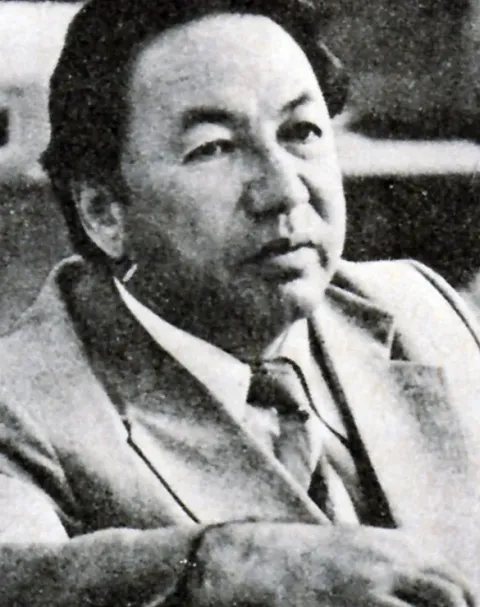
Biography
Sabir Rakhimovich Adylov (Sobir Odilov in Uzbek) was born in Tashkent on 1 March 1932. In 1955 he graduated from the architecture faculty of the Central Asian Polytechnic Institute in Tashkent.
He began working in the Tashkent region: from 1955 to 1961 he was chief architect of Almalyk, and from 1962 to 1966 chief architect of the Tashkent Region. After the earthquake of 1966 he took part in the projects for rebuilding the centre of Tashkent.
He served as chief architect of Tashkent in 1970–1984 and again in 1990–1991 (some sources extend the first term to 1986). Over these years the city's master plan and the schemes for its central streets and squares were drawn up. In 1975–1985 and 1990–1991 he was deputy chairman of the Construction Committee of the Uzbek SSR.
Reference works list among his projects the planning of the centres of Tashkent, Andijan and Jizzakh (1970 and 1980), work associated with the Palace of Friendship of Peoples (1977) and the building of the Supreme Soviet of the Uzbek SSR (1979), and the architectural parts of the monuments to Lenin (1974) and Yuri Gagarin (1979) in Tashkent. He headed the teams of architects who designed the stations of the Tashkent Metro and is credited as author or co-author of more than 80 housing and monument projects in Uzbekistan.
He was named Honoured Builder in 1967, received the State Prize of the USSR in 1975 for the architectural and planning solution of Tashkent's centre, and was made People's Architect of the USSR in 1981. He also held the Order of Friendship of Peoples.
In 1986 he headed a department of the Uzbek scientific research and design institute for the restoration of cultural monuments, and in 1989 became the institute's director. He died in Tashkent on 18 July 2002.
Education
- Central Asian Polytechnic InstituteUniversity · 1955 · Architecture (Faculty of Architecture)
Career
- State Construction Committee of the Uzbek SSRDeputy chairman · Tashkent · 1975–1985
- Uzbek Scientific Research and Design Institute for the Restoration of Cultural MonumentsHead of department, director · Tashkent · 1986–1989Everyone who held this post →
Awards

 USSR State Prize1975 · USSR
Life path
- 1932Birth
Born in Tashkent.
- 1955Graduation
Graduated from the architecture faculty of the Central Asian Polytechnic Institute.
- 1955–1961Chief architect of Almalyk
Began working in the Tashkent region as chief architect of the city of Almalyk.
- 1962–1966Chief architect of the Tashkent Region
Headed the region's architectural service.
- 1967Honoured Builder
Awarded the title of Honoured Builder.
- 1970–1984Chief architect of Tashkent
Chief architect of the city; he held the post again in 1990–1991.
- 1975USSR State Prize
Recognised for the architectural and planning solution of Tashkent's centre.
- 1975–1985Deputy chairman of the Construction Committee
Served on the Uzbek SSR's construction committee, and again in 1990–1991.
- 1981People's Architect of the USSR
Received the title People's Architect of the USSR.
- 1986–1989Institute for monument restoration
Head of a department and, from 1989, director of the institute for the restoration of cultural monuments.
- 2002Death
Died in Tashkent on 18 July.
Works
- Planning of central Tashkent (1974)Urban planning
One of the co-authors of the architectural and planning scheme for the centre of Tashkent that won the USSR State Prize (1975).
- Architectural part of the Lenin monument (1974)Architectural part
The monument stood on Tashkent's central square, later renamed Mustaqillik (Independence) Square.
- Palace of Friendship of Peoples (1977)Building and square
Named among his works in reference publications.
- Building of the Supreme Soviet of the Uzbek SSR (1979)Public building
Listed among his projects in reference publications.
- Monument to Yuri Gagarin (1979)Monument
The architectural part of the monument in Tashkent.
- Stations of the Tashkent MetroMetro
Led the teams of architects who designed all the stations.
- Centres of Andijan and Jizzakh (1970)Urban planning
Author or co-author of the plans for the cities' centres (1970 and 1980).