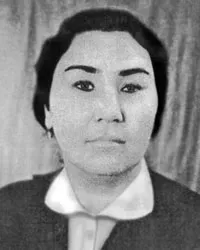
Legal scholar, the first Uzbek woman to earn an academic degree in law, academician of the Uzbek Academy of Sciences, Minister of Justice and chair of the Supreme Court of the Uzbek SSR.
- Occupation:
- Scientist, Politician, Minister
- Lived:
- June 3 1913(52 years old) ♊ — November 26, 1965
- Birthplace:
- Andijan
Biography
Khadicha Sulaimanova was a legal scholar, academician of the Uzbek Academy of Sciences (1956), Doctor of Juridical Sciences (1951) and professor (1952). She was born on 3 June 1913 in Andijan and died in Tashkent on 26 November 1965. In 1954 she was named Honoured Science Worker of the Uzbek SSR.
Her working life began after she finished the Institute of Soviet Construction and Law under the Central Executive Committee of the Uzbek SSR in 1935: from 1935 to 1938 she was a people's judge and a member of the republic's Supreme Court. She spent the next three years (1938–1941) as a postgraduate at the Moscow Law Institute.
From 1941 she worked in the criminal law department of the Tashkent Law Institute, first as assistant and associate professor and then as its head; in 1954–1955 she was the institute's rector. Having defended her candidate dissertation in 1945, she is considered the first Uzbek woman with an academic degree in law. Her doctoral work was defended in 1950–1951. In 1955–1956 she was dean of the law faculty at the Central Asian University.
Public offices: Minister of Justice of the Uzbek SSR (1956–1959), chair of the Legal Commission under the Council of Ministers (1959–1964) and, from 1964, chair of the Supreme Court of the Uzbek SSR.
Her scholarly writing covered criminal law, notably the rise and growth of legal science in Uzbekistan, and the issue of women's rights. She was among those who put forward the proposals to create the Institute of Philosophy and Law of the Academy of Sciences (1958) and the research institute of forensic expertise under the Ministry of Justice (1959). She attended international forums in Amsterdam (1956), London (1960), Cairo and Tokyo (1961) and Prague (1962).
Her memory is preserved: a street in Tashkent and the research institute of forensic expertise (now the Republican Centre of Forensic Expertise) carry her name, and the Tashkent Law Institute has a museum of hers.
Education
- Moscow Law InstituteUniversity · 1938 · Postgraduate studies
- Institute of Soviet Construction and Law under the Central Executive Committee of the Uzbek SSRUniversity · Tashkent · 1935
Career
- Academy of Sciences of the Uzbek SSRAcademician · Tashkent · 1956–1965now Academy of Sciences of Uzbekistan
- First Central Asian State UniversityDean of the law faculty · Tashkent · 1955–1956now National University of Uzbekistan
- Юридический институт при Ташкентском государственном университете имени В. И. ЛенинаAssistant, associate professor and head of the criminal law department; rector in 1954–1955 · Tashkent · 1941–1955now Tashkent State University of Law
- Ministry of Justice of the Uzbek SSRMinister · Tashkent · 1956–1959
- Legal Commission under the Council of Ministers of the Uzbek SSRChair · Tashkent · 1959–1964
- Supreme Court of the Uzbek SSRChair · Tashkent · 1964–1965
Awards
- Honoured Science Worker of the Uzbek SSR1954 · Uzbek SSR
Life path
- 1913Came into the world in Andijan, 3 June
- 1935Finished the Institute of Soviet Construction and Law; people's judge
- 1938–1941Postgraduate at the Moscow Law Institute
- 1945Defended her candidate's thesis
- 1951Degree of Doctor of Juridical Sciences
- 1952Title of professor
- 1954Rector of the Tashkent Law Institute; Honoured Science Worker of Uzbekistan
- 1955–1956Headed the law faculty of the Central Asian University (dean)
- 1956Elected academician of the Academy of Sciences
- 1956–1959Minister of Justice (Uzbek SSR)
- 1958Put forward the initiative to found the Institute of Philosophy and Law
- 1959–1964Led the Legal Commission under the Council of Ministers
- 1964Led the Supreme Court of the Uzbek SSR (chair)
- 1965Passed away in Tashkent, 26 November