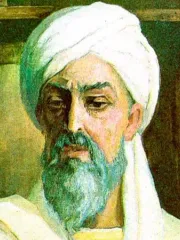
Abu Sahl al-Masihi
Physician and scholar from Gurgan who worked at the Ma’munid court in Khwarazm alongside al-Biruni and Avicenna and wrote a medical encyclopedia in one hundred chapters.
Biography
Abu Sahl ʿĪsā ibn Yaḥyā al-Masīḥī al-Jurjānī was a physician, philosopher and scholar of the 10th–11th centuries who wrote in Arabic. He was born around 970 in Gurgan (Jurjan), in the north of present-day Iran. The nisba “al-Masihi” points to his Christian faith: he came from a family of Iranian Christians.
According to the sources, he was educated in Baghdad. In the 990s, around 995, he came to Khwarazm and entered the service of the Ma’munid rulers at their court in Gurganj (now Köneürgench in Turkmenistan). A circle of scholars gathered around that court, among them al-Biruni, Avicenna, Abu Nasr ibn Iraq and Ibn al-Khammar.
About twelve of al-Masihi’s works were dedicated to al-Biruni, some of them on geometry and astronomy, but none of these has survived. Avicenna, for his part, dedicated to him a short treatise on the angle. A number of medieval historians and modern scholars call al-Masihi a teacher of Avicenna, but Avicenna himself, in the account of how he studied medicine, names no teacher.
Al-Masihi’s main work is an encyclopedia of medicine in one hundred chapters, the “Book of the Hundred”. It is one of the earliest works of its kind in Arabic and may in some respects have served as a model for Avicenna’s “Canon of Medicine”. Many manuscripts of it survive, and Amin al-Dawla ibn al-Tilmidh wrote a commentary on it. He also compiled a “General Medicine”, a work on the structure of the human organs, treatises on smallpox and epidemics, and a summary of Ptolemy’s “Almagest”.
Al-Masihi died around 1010 (1011 in some sources). According to a story told by Nizami Aruzi in the “Chahar Maqala”, when Mahmud of Ghazni demanded that the scholars of Khwarazm be sent to his court, al-Masihi and Avicenna refused and set out across the desert; al-Masihi perished on the way. Modern scholars treat the story with caution: the circumstances of his death are not fully clear.
Career
- Court of Khwarazmshah Ma’mun in Gurganj (“Ma’mun Academy”)Physician and scholar · 995–1010
Works
- “Kitab al-Mi’a” (“The Book of the Hundred”)Medical work
An encyclopedia of medicine in one hundred chapters; one of the earliest works of its kind in Arabic, preserved in many manuscripts.
- “General Medicine”Medical work
A handbook of the basic principles of medicine in 39 chapters.
- “The Manifestation of God’s Wisdom in the Creation of Man”Medical work
A work on the structure and purpose of the human organs.
- “Treatise on Smallpox”Medical treatise
A short work devoted to smallpox.
- “Treatise on Determining the Cause of Epidemics”Medical treatise
A treatise on the spread of infectious diseases.
- “Treatise on the Pulse”Medical treatise
A work on the principles of examining the pulse.
- Summary of the “Almagest”Astronomical work
An abridged presentation of Ptolemy’s well-known astronomical work.
Life path
- c. 970Birth
Born in Gurgan (Jurjan), in the north of Iran, into a family of Iranian Christians.
- before 995Studies in Baghdad
According to the sources, he studied medicine and other sciences in Baghdad.
- c. 995Move to Khwarazm
Arrived at the Ma’munid court in Gurganj and joined the circle of scholars gathered there.
- 995–1010Working alongside al-Biruni and Avicenna
Lived and worked in Khwarazm with al-Biruni and Avicenna; dedicated about twelve works to al-Biruni, and Avicenna dedicated a treatise on the angle to him.
- Khwarazm years“Book of the Hundred”
Wrote his encyclopedia of medicine in one hundred chapters, later copied and commented on many times.
- c. 1010Death
According to tradition, he refused to go to Mahmud of Ghazni, set out across the desert with Avicenna and perished on the way.
Legacy
Al-Masihi’s “Book of the Hundred” is one of the earliest medical encyclopedias in Arabic and may in some respects have been a model for Avicenna’s “Canon of Medicine”. Many manuscripts of it survive, and Amin al-Dawla ibn al-Tilmidh wrote a commentary on it. Because he worked in the same circle as al-Biruni and Avicenna, al-Masihi is remembered as part of the scholarly milieu of Khwarazm.
Era: Khwarazm under the Ma’munids, late 10th – early 11th century- Move to Khwarazm and service at the Ma’munid court (995)
- Death (1010)