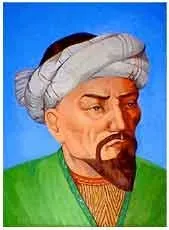
Ahmad Yasawi
Twelfth-century Sufi master and poet, founder of the Yasawiyya, the first Sufi order among the Turkic peoples, to whom the verse collection “Divan-i Hikmat” (“Book of Wisdom”) is attributed.
- Occupation:
- Religious figure, Writer
- Born:
- c. 1093 — c. 1166
- Father:
- Shayx Ibrohim
Biography
Khoja Ahmad Yasawi was born in the second half of the 11th century in the town of Sayram (Isfijab), in today’s Turkistan Region of Kazakhstan. The year of his birth is not known for certain: tradition puts it around 1093, and some sources give 1103. His father was Shaykh Ibrahim. Orphaned young, Ahmad moved with his elder sister Gavhar Shahnoz to the town of Yasi (today’s Turkistan), where his first teacher was Arslan Bab.
After Arslan Bab’s death he went to Bukhara and became a disciple of the Sufi master and Hanafi scholar Yusuf Hamadani (d. 1140). He is counted among Hamadani’s four successors, together with Abdullah Barqi, Hasan Andaqi and Abd al-Khaliq Ghijduvani. According to the order’s tradition, he led the Bukhara community for a time, then handed it over to Ghijduvani and returned to Yasi.
In Yasi he built a khanqah, trained many disciples and preached Islam and Sufism to the Turkic tribes of the Syr Darya and the Kipchak steppe in their own language. The Yasawiyya order he founded is regarded as the first Sufi order among the Turkic peoples, and it spread quickly across the Turkic-speaking lands. Among his disciples were Mansur Ata, Sulayman Hakim Ata, Said Ata and Zangi Ata.
According to legend, on reaching 63 — the age at which the Prophet Muhammad died — he would not go on living above ground longer than the Prophet, withdrew into an underground cell beside his khanqah and spent the rest of his life there in prayer. He died in Yasi in 562 AH (1166/67) and was buried there.
His name is attached to the “Divan-i Hikmat” (“Book of Wisdom”), a collection of mystical and moral poems in Turkic known as hikmats. They praise love of God, repentance, contentment and humility, urge care for orphans and the poor, and condemn greed, violence and pride. The collection was copied and added to by disciples over the centuries, and the oldest known manuscripts date from the 17th century, so scholars ascribe part of it to later poets of his order. From the late 19th century the “Divan-i Hikmat” was printed many times in Kazan, Istanbul and Tashkent, and in Uzbekistan it was published in 1991 as “Hikmatlar”. Two treatises in Persian are also attributed to him.
In 1389 Amir Timur ordered a new mausoleum to be built over Yasawi’s grave; work stopped when Timur died in 1405, and the building was left unfinished. For centuries the mausoleum has been a place of pilgrimage, and Kazakh khans and nobles were buried beside it; in 2003 it was inscribed on the UNESCO World Heritage List. The International Kazakh-Turkish University in Turkistan (1991) bears the name of Khoja Ahmad Yasawi.
Career
- Yasawiyya Sufi orderFounder (pir)
Life path
- c. 1093Born in Sayram
Born to Shaykh Ibrahim; sources give different years of birth.
- Move to Yasi
Orphaned young, he moved with his sister to Yasi, where Arslan Bab became his teacher.
- before 1140Disciple of Yusuf Hamadani in Bukhara
After Arslan Bab’s death he went to Bukhara, studied under Yusuf Hamadani and became one of his successors.
- after 1140Head of the Bukhara community
According to the order’s tradition, he led the community for a time after his master’s death and then handed it over to Abd al-Khaliq Ghijduvani.
- Khanqah in Yasi
Back in Yasi he built a khanqah, preached to the Turkic tribes in their own language and founded the Yasawiyya order.
- The underground cell
According to legend, at 63 he withdrew into an underground cell and spent the rest of his life there.
- 1166/67Death
Died in Yasi in 562 AH and was buried there.
Works
- “Book of Wisdom” (“Divan-i Hikmat”)Poetry collection
A collection of mystical and moral poems in Turkic known as hikmats. Added to by disciples over the centuries; the oldest known manuscript dates from the 17th century. Printed in Kazan, Istanbul and Tashkent from the late 19th century and published in Tashkent in 1991 as “Hikmatlar”.
- “Treatise on the Etiquette of the Path”Treatise (in Persian)
On the etiquette and stations of the Sufi path; copies were found in Tashkent. Attributed to Yasawi himself or to disciples who wrote down his teaching.
- “Treatise on the Forty Stations”Treatise (in Persian)
On the forty stages of the Sufi path; the only known manuscript is kept in a library in Turkey.
Legacy
Yasawi is revered as the founder of the first Sufi order among the Turkic peoples: the Yasawiyya spread quickly across the Turkic-speaking lands. The hikmat as a genre of Turkic poetry begins with his name and was carried on by his disciple Sulayman Hakim Ata. His mausoleum has been a place of pilgrimage for centuries, and the town was also called Hazrat-i Turkistan in his honour.
Era: 12th century, the Karakhanid period- Amir Timur ordered a mausoleum to be built over Yasawi’s grave (1389)
- Work on the mausoleum stopped with Timur’s death (1405)
- The “Divan-i Hikmat” was printed in Kazan (1895)
- “Hikmatlar” was published in Tashkent and a university named after Khoja Ahmad Yasawi opened in Turkistan (1991)
- The mausoleum was inscribed on the UNESCO World Heritage List (2003)