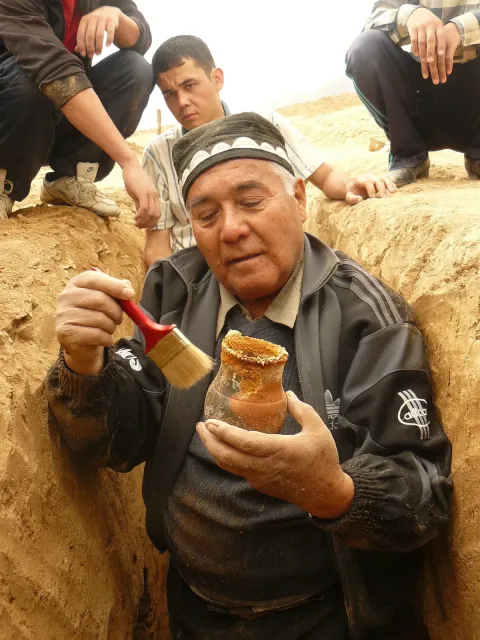
Ahmadali Askarov
Archaeologist and historian, academician; excavated Sapallitepa and Jarkutan and studied the Bronze Age of southern Uzbekistan.
- Occupation:
- Scientist, Historian
- Born:
- September 25 1935(91 years old) ♎
- Birthplace:
- Norin District, Namangan
Biography
Ahmadali Askarov was born on 25 September 1935 in the village of Uchtepa in the Narin district of the Namangan region, in a peasant family. He finished school in 1952 and studied history at the Nizami Pedagogical Institute in Tashkent, graduating in 1957. For a time he taught history at a school.
In 1958 he entered postgraduate study at the Leningrad branch of the USSR Academy of Sciences' Institute of Archaeology, under the archaeologist Mikhail Gryaznov, and defended his candidate's dissertation on the Bronze Age of the lower Zarafshan in 1963. At the Institute of History and Archaeology of the Uzbek SSR Academy of Sciences he worked as a junior and then a full researcher, and from 1966 as deputy director for research.
His name is tied to the Bronze Age of southern Uzbekistan. From 1969 to 1974 he excavated Sapallitepa in the Surkhandarya region, where 138 graves were opened and a fortified settlement was studied. From 1973 he led the excavations at the ancient town of Jarkutan near Sherabad; in 1983–1987 its central temple was investigated, which many researchers regard as an early Zoroastrian sanctuary. He also studied the settlement of Kuchuktepa and devoted a monograph to it.
In 1977 he defended his doctoral dissertation in Moscow on the Bronze Age of southern Uzbekistan. In 1970–1980 and 1983–1987 he directed the Institute of Archaeology of the Academy of Sciences of Uzbekistan; in 1984–1998 he chaired the academy's division of social sciences and humanities, and in 1991–1995 he headed the Institute of History. He was elected an academician in 1987 and served as a people's deputy in 1990–1995.
His research interests cover the farming and herding cultures of the Bronze and Early Iron Ages, the rise of the first cities and statehood in Uzbekistan, the ethnogenesis of the Uzbek people, the origins of Zoroastrianism, and the history of the sport of kurash as seen through archaeological evidence. He has written more than 450 scholarly works, including 16 monographs; over 50 of them appeared in foreign languages.
Askarov won the Beruni State Prize of the Uzbek SSR in 1985 and the title of Honoured Science Worker of Uzbekistan in 1995. On his 90th birthday, in 2025, he was awarded the Order «Buyuk xizmatlari uchun» («For Outstanding Services») by decree of the President.
Education
- Nizami Tashkent State Pedagogical UniversityUniversity · Tashkent · 1953–1957 · History
Career
- Academy of Sciences of UzbekistanAcademician; director of the Institutes of Archaeology and of History · Tashkent · 1970–present
- Institute of History and Archaeology of the Uzbek SSR Academy of SciencesJunior researcher, researcher, deputy director · Tashkent · 1961–1970
Awards
 Honoured Science Worker of Uzbekistan1995 · Uzbekistan
 Order «For Outstanding Merit»2025 · Uzbekistan
 Beruni State Prize of the Uzbek SSR1985 · Uzbek SSR
Life path
- 1935Birth
Born in the village of Uchtepa in the Narin district of the Namangan region.
- 1953–1957Pedagogical institute
Studied history at the Nizami Pedagogical Institute in Tashkent and graduated.
- 1958–1963Postgraduate study and candidate's degree
Studied in Leningrad under M. Gryaznov; defended his candidate's dissertation on the Bronze Age of the lower Zarafshan in 1963.
- 1966Deputy director
Became deputy director for research at the Institute of History and Archaeology.
- 1969–1974Excavation of Sapallitepa
Studied the Bronze Age site in the Surkhandarya region; 138 graves were opened.
- 1970–1987Director of the Institute of Archaeology
Headed the Institute of Archaeology of the Academy of Sciences of Uzbekistan in 1970–1980 and 1983–1987.
- 1973Excavations at Jarkutan
Began leading the expedition at the ancient town near Sherabad; the central temple was investigated in 1983–1987.
- 1977Doctoral dissertation
Defended his doctoral dissertation on the Bronze Age of southern Uzbekistan in Moscow.
- 1984–1998Chair of the humanities division
Headed the division of social sciences and humanities of the academy's Presidium.
- 1987Academician
Elected a full member of the Academy of Sciences.
- 1991–1995Director of the Institute of History
Led the Institute of History of the Academy of Sciences; also a people's deputy in 1990–1995.
- 2025Order
Awarded the Order «Buyuk xizmatlari uchun» on his 90th birthday.
Works
- “Sapallitepa” (1973)Monograph
A book on the excavation of the Bronze Age fortress in the Surkhandarya region.
- “The Ancient Farming Culture of the Bronze Age of Southern Uzbekistan” (1977)Monograph
On the farming communities of the Bronze Age in southern Uzbekistan.
- “The Kuchuktepa Settlement” (1979)Monograph
On the excavation of the settlement of Kuchuktepa in the Surkhandarya region.
- “Jarkutan (On the Problem of Proto-Urban Civilisation in the South of Uzbekistan)” (1983)Monograph
On the ancient town of Jarkutan and its exploration.
- “Theoretical and Methodological Problems of Research in Archaeology” (1988)Co-authored work
Written with co-authors; on methods of archaeological research.
- “Historical Anthropology of Central Asia” (1990)Co-authored work
With V. Alekseev and T. Khodzhaiov; from the Palaeolithic to Antiquity.