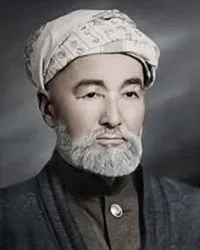
Elihan Tore Saghuni
Religious scholar and public figure, poet and translator, chairman of the provisional revolutionary government of the East Turkestan Republic in 1944, who spent his last decades in Tashkent.
- Occupation:
- Religious figure
- Lived:
- March 21 1885(90 years old) ♈ — February 28, 1976
- Father:
- Shokirxontoʻra
Biography
Alixonto‘ra Sog‘uniy (full name Alixonto‘ra Shokirxo‘ja o‘g‘li; also rendered Elihan Tore) was a religious scholar, public figure, poet and translator who headed the provisional revolutionary government of the East Turkestan Republic. He was born on 21 March 1885 in Tokmok. His schooling took place in Arabia (Medina) and in Bukhara’s madrasas, among them the Mir-i Arab; according to some accounts he also taught religious subjects in Bukhara from 1915 to 1923.
The tsarist authorities tried to draft local residents into labour service, and because he spoke out against that policy the secret police kept him under watch. When the 1916 uprising was crushed with great brutality, he left as a political émigré, first for Kashgar in China and later for Ghulja in Eastern Turkestan. Preaching ideas of liberty to ordinary people got him arrested by the Chinese administration in 1937 and condemned to life in prison; a judicial review led to his release in 1941.
On 12 November 1944 the East Turkestan Republic was declared, and Sog‘uniy was chosen to lead its Provisional Revolutionary Government. The plan for a national army was his own, and he was named its commander. In June 1946 Soviet agents covertly removed him from Ghulja under pressure, and he spent the rest of his life in Tashkent.
As a translator he rendered Ahmad Donish’s “Navodir ul-vaqoe”, Darvish Ali Changi’s “Treatise on Music” and the “Temur tuzuklari”. His own writings include the poetry collection “Devoni Sog‘uniy”, “Tarixi Muhammadiy”, “Shifo ul-ilal” (The Cure of Ailments), “Turkiston qayg‘usi” (Turkestan’s Sorrow) and further titles. He took great pains to keep old manuscripts and architectural monuments from being lost.
He died in Tashkent on 28 February 1976 and lies in the Shaykh Zayniddin Bobo cemetery. After independence, a secondary school in Tashkent’s Yakkasaroy district, a mahalla in Chilanzar and a street in Shaykhontohur were named in his memory.
Education
- Mir-i Arab MadrasaMadrasa · Bukhara
Life path
- 1885Born on 21 March in Tokmok
- 1916Left for Kashgar and then Ghulja after the uprising was suppressed
- 1937Arrested by the Chinese authorities and sentenced to life imprisonment
- 1941Released after a judicial review
- 1944Elected chairman of the provisional revolutionary government of the East Turkestan Republic on 12 November
- 1946Taken from Ghulja to the USSR in June; lived in Tashkent
- 1976Died in Tashkent on 28 February
Works
- “Devoni Sog‘uniy”Poetry collection
- “Tarixi Muhammadiy”Work
- “Shifo ul-ilal”Work
- “Turkiston qayg‘usi”Work
- Ahmad Donish, “Navodir ul-vaqoe” (translation)Translation
- Darvish Ali Changi, “Treatise on Music” (translation)Translation
- “Temur tuzuklari” (translation)Translation