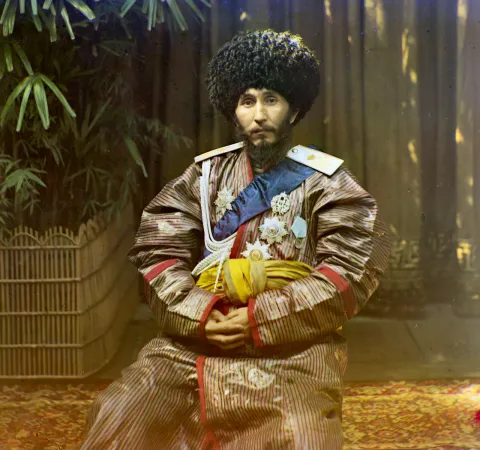
Isfandiyar Khan
Khan of Khiva from the Kungrad dynasty (1910–1918): ruled in close ties with the Russian Empire, issued a reform manifesto under pressure from the Young Khivans in 1917 and was killed by Junaid Khan in 1918.
- Occupation:
- Historical figure, Politician
- Real name:
- Isfandiyar Jurji Bahadur
- Born:
- 1871 — October 1, 1918
- Birthplace:
- Khiva, Khorezm
- Father:
- Muhammad Rahim Khan II
Biography
Asfandiyar Khan (Isfandiyar Khan) was a ruler of the Khanate of Khiva from the Uzbek Kungrad dynasty and khan from 1910 to 1918. He was born in Khiva in 1871 (the National Encyclopedia of Uzbekistan gives 1870). His father was Khan Muhammad Rahim II.
After his father’s death in 1910 he came to the throne with the support of the Russian government. His ties with the Russian Empire show in his titles: in 1910 he was given the rank of major-general, in 1911 he was enrolled in the Tsar’s retinue, and in 1913 Nicholas II granted him the title of «Highness». He was decorated with the Orders of St Stanislaus and St Anna, and in 1911 with the Order of the White Eagle. He visited St Petersburg in 1910 and 1914, and on 22 February 1913 attended, together with the Emir of Bukhara, the opening of the Cathedral Mosque there.
In the early years of the reign the enlightened vizier Islam Khoja played a large part in running the state: on his initiative Khiva got a post and telegraph service, a hospital, new-type schools and a cotton-ginning plant, and in 1908–1910 the Islam Khoja complex was built in the Ichan Kala. In 1913 Islam Khoja was killed on the khan’s orders. Clashes with the Yomut Turkmens went on, and in 1915 at Mangit and in January 1916 at Khojeli popular protests against taxes broke out.
Under Asfandiyar Khan new madrasas and mosques went up in Khiva. In 1912 a reception building was added to the Nurullabai Palace complex: it has several ceremonial halls of different shapes and a throne room decorated in the Russian Art Nouveau style, and many of the decorative elements were ordered from the Imperial Porcelain Factory in St Petersburg. In 1910 the photographer and first Uzbek film director Khudaybergen Devonov filmed the khan riding in a carriage with his heir, one of the first Uzbek documentary pieces.
After the February Revolution of 1917 the Young Khivans began to act openly. On 5 April they presented the khan with demands for reform; he issued a manifesto promising a representative body, the Majlis, whose chairman was Boboakhun Salimov. Later the situation sharpened, the Young Khivan government was overthrown and the manifesto’s reforms were cancelled.
In January 1918 the khan appointed the Yomut Turkmen leader Junaid Khan commander of the armed forces (sardar-i karim), and Junaid soon gathered power in his own hands. Asfandiyar Khan was killed by Junaid Khan on 1 October 1918 in the Nurullabai Palace in Khiva (the Encyclopaedia Iranica places the event on 30 September). Sayid Abdullah was put on the throne, but real power stayed with Junaid Khan; Sayid Abdullah’s rule ended in February 1920.
Career
Life path
- 1871Birth
Born in Khiva into the family of Muhammad Rahim II.
- 1910Accession
Became khan of Khiva after his father’s death; the same year was given the rank of major-general of the Russian Empire.
- 1911In the Tsar’s retinue
Enrolled in the Russian emperor’s retinue and awarded the Order of the White Eagle.
- 1912Reception hall built
A reception building was added to the Nurullabai Palace complex.
- 1913Title and the death of Islam Khoja
Received the title of «Highness» from Nicholas II; the vizier Islam Khoja was killed; on 22 February attended the opening of the Cathedral Mosque in St Petersburg.
- 1917Manifesto
On 5 April, under pressure from the Young Khivans, issued a manifesto of reforms and a Majlis was set up; the reforms were later cancelled.
- 1918Rise of Junaid Khan
In January appointed Junaid Khan commander of the armed forces.
- 1918Death
Killed by Junaid Khan on 1 October in the Nurullabai Palace in Khiva.
Legacy
Asfandiyar Khan ruled the Khanate of Khiva in the last period of its close ties with the Russian Empire. The rule of Sayid Abdullah, put on the throne after his death, ended in February 1920. Surviving from his time in Khiva are the reception building in the Nurullabai Palace and the Islam Khoja complex; a colour photograph of the khan from about 1911 is held in the Prokudin-Gorskii collection.
Era: The last period of Kungrad rule, early 20th century- After the death of Muhammad Rahim II, Asfandiyar became khan of Khiva (1910)
- A reception building was built in the Nurullabai Palace (1912)
- The vizier Islam Khoja was killed (1913)
- A manifesto of reforms was issued at the Young Khivans’ demand (1917)
- Junaid Khan killed Asfandiyar Khan and took power (1918)