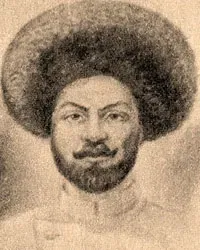
Biography
Avaz O'tar was an Uzbek Enlightenment poet from Khiva. His full name was Avaz, son of Polvonniyoz; he was born in Khiva on 15 August 1884 and died in 1919. He is known for his lyrics, the satirical Faloniy cycle and verse about the destiny of his nation.
He was schooled first in a maktab and then at the Inoqiy madrasa in Khiva. By roughly the age of 18 the public knew him as a poet. The ruler of Khiva, Muhammad Rahim II (Feruz), took particular interest in the talent, summoned the young man to the palace and assigned Tabibiy to be his teacher. Court life did not suit Avaz O'tar, however, and he withdrew from it.
The national awakening and independence ideas that gathered strength in the early twentieth century left a deep mark on his writing. From then on his poems were dominated by freedom and enlightenment and by laughter aimed at everyday vices. Alongside these he wrote lyrics praising lofty human qualities and genuine love, as well as quatrains and rubai. The Faloniy cycle is also a product of those years. In Millat, Hurriyat, Topar erkan, qachon, Xalq, Zamon and other poems he offered a fresh view of the nation's future and fate.
Some poems came out in periodicals of his time: Oyina, Vaqt and Mulla Nasriddin. Of his legacy, two divans (Saodat ul-iqbol and Devoni Avaz) and ghazals copied into anthologies have survived. Manuscripts of the divans are held at the Institute of Oriental Studies of the Academy of Sciences of Uzbekistan under inventory numbers 942, 7102 and 3451.
His memory is honoured: schools, streets and avenues across the republic bear his name, and Khiva has a house-museum and a monument. He is also the subject of literary works: Erkin Samandar's poem Erk sadosi, A. Bobojon's drama G'azal fojiasi, S. Siyoyev's novella Bir chora zamon istab and Sa'dulla Siyoyev's novel Avaz (1987). A selection of his works was published in Russian in 1951 and in Uzbek in 1984.
Education
- Inaqi Madrasa (Khiva)Madrasa · Khiva
Career
- Court of the Khanate of KhivaCourt poet · Khiva
Life path
- 1884Born
In Khiva, 15 August.
- 1902Known as a poet
Known among the people at about 18; studied at the Inoqiy madrasa in Khiva.
- 1902–1919Court and creative work
Invited to the court of Muhammad Rahim II and taught by Tabibiy, he left it; the Faloniy cycle, poems such as Millat and Hurriyat, publication in Oyina, Vaqt and Mulla Nasriddin.
- 1919Died
Sources give only the year of death.
- 1951, 1984Selected works
Published in Russian (1951) and as the Uzbek Saylanma (1984).
Works
- «Saodat ul-iqbol»Divan
- «Devoni Avaz»Divan
- «Faloniy»Cycle of satirical poems
- «Millat»Poem
- «Hurriyat»Poem
- «Topar erkan, qachon»Poem
- «Xalq»Poem
- «Zamon»Poem