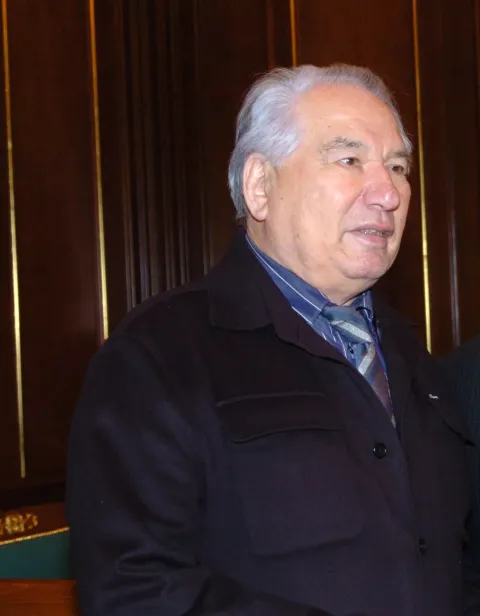
Chingiz Aitmatov
Kyrgyz writer in Kyrgyz and Russian, author of the novellas “Jamilia”, “Farewell, Gulsary!” and “The White Ship” and the novel “The Day Lasts More Than a Hundred Years”, Lenin Prize and triple USSR State Prize winner, diplomat.
- Occupation:
- Writer, Prose writer
- Born:
- December 12 1928(79 years old) ♐ — June 10, 2008
- Father:
- Torekul Aitmatov
- Mother:
- Nagima Abduvalieva
- Children:
- Sanjar Aytmatov, Asqar Aytmatov, Eldar Aytmatov, Shirin Aytmatova
Biography
Chingiz Aitmatov was born on 12 December 1928 in the village of Sheker in the Talas Valley of Kyrgyzstan (then the Kirghiz ASSR). His father, Torekul Aitmatov, rose from a peasant activist to a Soviet and Communist Party official of Kyrgyzstan, but was arrested in 1937 and shot in 1938. His mother, Nagima Abduvalieva, a Tatar, was a political officer in the army and later a public figure. Shortly before the father’s arrest the family moved to Sheker, where the children grew up. During the war the fourteen-year-old Chingiz served as secretary of the village soviet and also worked as a teacher and at other jobs.
After eight years of school he studied at the Dzhambul Zootechnical College in Kazakhstan, graduating with honours. In 1948 he entered the Kyrgyz Agricultural Institute in Frunze (now Bishkek), graduated in 1953 and spent the next three years working in livestock farming. He began writing at the same time: his first story, “The Newspaper Boy Dziuio”, written in Russian, was printed in 1952. In 1956–1958 he attended the Higher Literary Courses at the Maxim Gorky Literature Institute in Moscow.
In 1957 the magazine “Ala-Too” published his Kyrgyz novella “Face to Face”. “Jamilia”, which came out in 1958, brought him international fame; Louis Aragon translated it into French. It was followed by the novellas “Camel’s Eye” (1960), “To Have and to Lose” (1961), “The First Teacher” (1962) and “Mother Earth” (1963), and in 1963 the book “Tales of the Mountains and Steppes” won him the Lenin Prize. He joined the Communist Party in 1959 and in 1959–1960 edited the magazine “Literaturny Kirgizstan” while also serving as Pravda’s correspondent in Kyrgyzstan. He wrote his early works mainly in Kyrgyz and translated some of them into Russian himself; from the mid-1960s he wrote chiefly in Russian.
“Farewell, Gulsary!” (1966) received the USSR State Prize in 1968. The director Bolotbek Shamshiev filmed “The White Ship” (1970), and the literary basis of the film brought Aitmatov a second State Prize in 1977. With the Kazakh playwright Kaltay Mukhamedzhanov he wrote the play “The Ascent of Mount Fuji” (1973). The novellas “Cranes Fly Early” (1975) and “Piebald Dog Running Along the Shore” (1977) were followed by the novel “The Day Lasts More Than a Hundred Years” (1980), in which the legend of a captive robbed of his memory — the mankurt — became one of the book’s central symbols; it won him a third State Prize in 1983. He was made a Hero of Socialist Labour in 1978. The novel “The Place of the Skull” (1986) was the last of his works to appear in the USSR.
Aitmatov was also active in public life: he sat in the Soviet of Nationalities of the USSR Supreme Soviet in 1966–1989, was a People’s Deputy of the USSR in 1989–1991 and a member of the USSR Presidential Council, served as first secretary of the Writers’ Union of Kyrgyzstan in 1986–1991, edited the magazine “Inostrannaya Literatura” and initiated the international Issyk-Kul Forum. In 1974 he was elected a full member of the Academy of Sciences of the Kyrgyz SSR. In 1973 he was among the signatories of a letter by Soviet writers condemning Alexander Solzhenitsyn and Andrei Sakharov. From 1990 he was the Soviet (from 1992 the Russian) ambassador to Luxembourg, and in 1994–2006 Kyrgyzstan’s ambassador to the Benelux countries. In these years he published “The White Cloud of Genghis Khan”, “The Mark of Cassandra” (1994) and “When the Mountains Fall” (“The Eternal Bride”, 2006). In 1997 he was named a Hero of the Kyrgyz Republic.
According to the National Encyclopedia of Uzbekistan, almost all of Aitmatov’s works have been published in Uzbek and staged in Uzbek theatres, and the composer I. Akbarov wrote music for “Mother Earth”. He was awarded Uzbekistan’s orders “Do'stlik” (Friendship, 1995) and “Buyuk xizmatlari uchun” (For Outstanding Merit, 1998); the second was given for his contribution to the friendship between the Uzbek and Kyrgyz peoples and on his 70th birthday.
In May 2008 Aitmatov was being treated in a hospital in Nuremberg, Germany, where he died on 10 June. On 14 June he was buried at the Ata-Beyit memorial complex near Bishkek, and the day of his funeral was declared a day of mourning in Kyrgyzstan. In 2018 his 90th anniversary was marked in Uzbekistan under a resolution of the President, which provided for a memorial book, “Chingiz Aitmatov and Uzbekistan”, a documentary film and naming a street in Tashkent after him; that year a street in the capital was renamed after him. In 2023, for his 95th anniversary, the O'zbekiston publishing house issued a ten-volume edition of his works in Uzbek. His books have been translated into more than 170 languages.
Education
- Kyrgyz Agricultural InstituteUniversity · 1948–1953 · Animal husbandry
- Maxim Gorky Literature InstituteUniversity · 1956–1958 · Higher Literary Courses
Career
- Congress of People’s Deputies of the USSRPeople’s Deputy of the USSR · 1989–1991
- Union of Soviet WritersMember of the secretariat
- Communist Party of the Soviet UnionMember (from 1959) · 1959–…
- Supreme Soviet of the USSRDeputy of the Soviet of Nationalities (7th to 11th convocations) · 1966–1989
- Pravda newspaperCorrespondent in Kyrgyzstan · 1959–…
- Academy of Sciences of KyrgyzstanFull member · 1974–…
- Writers’ Union of KyrgyzstanFirst secretary · 1986–1991
- Embassy of Kyrgyzstan in BelgiumAmbassador to the Benelux countries · 1994–2006Everyone who held this post →
Awards
 Order «For Outstanding Merit»1998 · Uzbekistan
 Order «Do'stlik» (Friendship)1995 · Uzbekistan
 Hero of Socialist Labour1978 · USSR
 Order of Lenin1971 · USSR
- Order of Lenin1978 · USSR
 Order of the October Revolution1988 · USSR
 Order of the Red Banner of Labour1962 · USSR
- Order of the Red Banner of Labour1967 · USSR
 Order of Friendship of Peoples1984 · USSR
 Medal «For Labour Distinction»1958 · USSR
 Lenin Prize1963 · USSR
 USSR State Prize1968 · USSR
- USSR State Prize1977 · USSR
- USSR State Prize1983 · USSR
 Order of Friendship (Russia)1998 · Russia
Life path
- 1928Birth
Born in the village of Sheker in the Talas Valley of Kyrgyzstan.
- 1937–1938Father’s repression
His father, Torekul Aitmatov, was arrested and shot.
- 1948–1956Studies and first stories
Graduated from the Kyrgyz Agricultural Institute and worked in livestock farming; his first story, “The Newspaper Boy Dziuio”, was printed in 1952.
- 1956–1958Higher Literary Courses
Studied at the courses of the Maxim Gorky Literature Institute in Moscow.
- 1958“Jamilia”
The novella that brought him international fame came out.
- 1963Lenin Prize
For the book “Tales of the Mountains and Steppes”.
- 1966–1989USSR Supreme Soviet
Deputy of the Soviet of Nationalities.
- 1968State Prize
USSR State Prize for “Farewell, Gulsary!”; twice more, in 1977 and 1983.
- 1978–1980Hero of Socialist Labour and a novel
Made a Hero of Socialist Labour in 1978; “The Day Lasts More Than a Hundred Years” came out in 1980.
- 1990–2006Diplomatic service
Soviet and then Russian ambassador to Luxembourg; Kyrgyzstan’s ambassador to the Benelux countries in 1994–2006.
- 1995–1998Orders of Uzbekistan
Awarded the orders “Do'stlik” (1995) and “Buyuk xizmatlari uchun” (1998).
- 2008Death
Died in Nuremberg on 10 June; buried at the Ata-Beyit complex near Bishkek.
Works
- “Jamilia” (1958)Novella
A love story in a wartime Kyrgyz village, told by a teenage boy; Louis Aragon translated it into French.
- “To Have and to Lose” (1961)Novella
A love story, filmed several times; the Russian title means “My Poplar in a Red Kerchief”.
- “The First Teacher” (1962)Novella
About Duishen, who opened the first school in a village; filmed by Andrei Konchalovsky in 1965.
- “Mother Earth” (1963)Novella
About a Kyrgyz mother who lost her family in the war; the composer I. Akbarov wrote music for it.
- “Farewell, Gulsary!” (1966)Novella
About the herdsman Tanabai and his pacer Gulsary; USSR State Prize in 1968.
- “The White Ship” (1970)Novella
About a boy living with his grandfather and the legend of the Horned Mother Deer; filmed by Bolotbek Shamshiev in 1975.
- “The Ascent of Mount Fuji” (1973)Play
Written with the Kazakh playwright Kaltay Mukhamedzhanov.
- “Cranes Fly Early” (1975)Novella
Awarded the Toktogul State Prize of the Kyrgyz SSR.
- “Piebald Dog Running Along the Shore” (1977)Novella
Later filmed by German and Soviet filmmakers.
- “The Day Lasts More Than a Hundred Years” (1980)Novel
About the people of a remote steppe railway halt and the legend of the mankurt; USSR State Prize in 1983.
- “The Place of the Skull” (1986)Novel
A novel in which the fates of a wolf family and of people intertwine; the last of his works published in the USSR.
- “The Mark of Cassandra” (1994)Novel
A science-fiction novel about the creation of an artificial human.
Legacy
The Great Russian Encyclopedia calls Aitmatov the first Kyrgyz writer to win worldwide fame; his books have been translated into more than 170 languages. His prose weaves folk legends, myths and parables into stories of contemporary life, and the legends of the Horned Mother Deer in “The White Ship” and of the mankurt in “The Day Lasts More Than a Hundred Years” are widely known. “The First Teacher”, “Jamilia”, “The White Ship” and other works have been filmed. In Uzbekistan almost all of his books have been published in Uzbek, a ten-volume edition of his works came out in 2023, and a street in Tashkent bears his name.
Era: Kyrgyz and Russian-language Soviet literature of the second half of the 20th century- Lenin Prize for “Tales of the Mountains and Steppes” (1963)
- Andrei Konchalovsky filmed “The First Teacher” (1965)
- Bolotbek Shamshiev filmed “The White Ship” (1975)
- Awarded Uzbekistan’s Order “Do'stlik” (1995)
- Awarded the Order “Buyuk xizmatlari uchun” (1998)
- His 90th anniversary was marked in Uzbekistan and a Tashkent street was named after him (2018)
- A ten-volume edition of his works came out in Uzbek (2023)