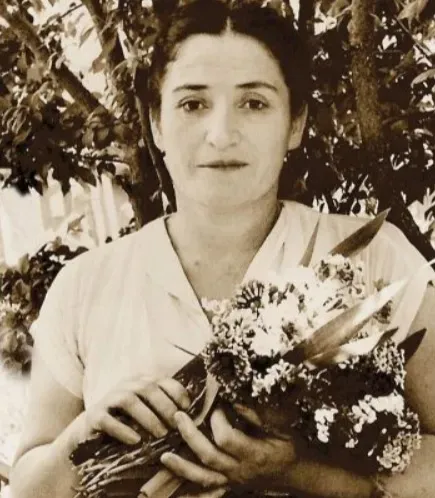
Edie Topchi
Crimean Tatar singer (1919–1967), Honoured Artist of the Uzbek SSR; after the deportation she lived in Bekabad and from 1957 was a soloist of the State Crimean Tatar ensemble, later Haytarma, in Tashkent.
- Occupation:
- Singer, Folk singer
- Nickname:
- Nightingale of the Crimean Tatar people
- Lived:
- September 22 1919(48 years old) ♍ — November 7, 1967
Biography
Edie Topchi (Ediye Topçı) was a Crimean Tatar singer, Honoured Artist of the Uzbek SSR. She was one of the leading performers of Crimean Tatar folk song and was called the nightingale of the Crimean Tatar people. For the last decade of her life she was a soloist of the Haytarma ensemble in Tashkent.
She was born on 22 September 1919 in Bakhchysarai and took part in amateur arts as a schoolgirl. In 1935, aged sixteen, she began working at the Crimean Radio Committee, singing in its vocal ensemble, and in 1938 became its soloist. In 1940 she entered the vocal department of the Simferopol music school, studying in the class of N. Chernov; the composers Yaya Sherfedinov and Ilyas Bakhshish helped her in mastering Crimean Tatar folk song. In 1941 she moved to the Directorate for Arts under the Council of People's Commissars of the Crimean ASSR.
The war prevented her from entering the Moscow Conservatory. In May 1944 the Crimean Tatar people were deported from Crimea to Central Asia, and she found herself in the Uzbek SSR, in Bekabad. In 1944–1946 she was a soloist of the Uzbek State Theatre. She then had to leave the stage: in 1950–1951 she led a choir circle, and later worked as a weigher at a cotton plant, a seamstress in a local industrial combine and an events organiser in the city park.
She returned to singing in the amateur ensemble of the Bekabad House of Culture. In 1957, through the efforts of the composer Edem Nalbandov, the State Crimean Tatar Song and Dance Ensemble (later Haytarma) was founded under the Uzbek State Philharmonic. Topchi became one of its soloists and performed from its founding alongside Sabriye Eredzhepova, Ablyamit Umerov, Selime Chelebieva and others. Her voice was noted as high and powerful, with a velvety timbre.
In 1966 she was named Honoured Artist of the Uzbek SSR for her contribution to the art of song. After a long and severe illness she died in Tashkent on 7 November 1967.
For her centenary, a memorial evening was held on 4 October 2019 at the Crimean Tatar Museum of Cultural and Historical Heritage in Simferopol, where artists of the Haytarma and Qirim ensembles performed songs from her repertoire.
Career
- Uzbek State PhilharmonicSoloist · Tashkent · 1957–1967
- Haytarma EnsembleSoloist · 1957–1967
Awards
 Honoured Artist of the Uzbek SSR1966 · Uzbek SSR
Life path
- 1919Birth
Born on 22 September in Bakhchysarai.
- 1935Crimean Radio Committee
Began singing in the committee's vocal ensemble; became its soloist in 1938.
- 1940Music school
Entered the vocal department of the Simferopol music school (class of N. Chernov).
- 1941Directorate for Arts
Moved to the Directorate for Arts under the Council of People's Commissars of the Crimean ASSR.
- 1944Deportation
After the deportation of the Crimean Tatar people in May she found herself in Bekabad, Uzbek SSR.
- 1944State Theatre
Soloist of the Uzbek State Theatre until 1946.
- 1950Choir circle
Led a choir circle until 1951; in the following years she worked outside the stage.
- 1957State ensemble
Became a soloist of the State Crimean Tatar Song and Dance Ensemble under the Uzbek State Philharmonic.
- 1966Title
Named Honoured Artist of the Uzbek SSR.
- 1967Death
Died in Tashkent on 7 November.
Songs
| # | Song | Listen |
|---|---|---|
| 1 | «Menide ğamdan azat ile» |