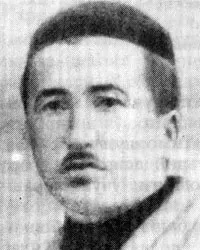
Elbek
Uzbek poet, prose writer and children's author, also a textbook writer; arrested in 1937 as an “enemy of the people”, he died in 1939 in a Magadan camp and was later rehabilitated.
- Occupation:
- Writer, Poet, Prose writer, Children's writer
- Lived:
- 1898 — 1939
- Birthplace:
- Bo'stonliq District, Tashkent Region
Biography
Elbek (real name Mashriq Yunusov) was an Uzbek poet, prose writer and children's author who also wrote textbooks. He was born in 1898 in the village of Xumson, Bostonliq district, Tashkent region. Arrested in 1937 as an “enemy of the people”, he died in 1939 in exile, in one of the Magadan camps, and was rehabilitated afterwards.
In 1905 he went to an old-style village school. The hard years of 1910–1911 pushed him, like his brothers, to leave the family home: in 1911 he reached Tashkent and entered the service of a wealthy man (as a watchman and servant). He carried on with his studies at the “Xoniy” school in the Old City and, from 1914, at the “Namuna” school, earning a living in a printing shop and by selling newspapers.
After completing an eight-month teachers' course in 1919 he became a schoolteacher. From 1921 he was employed in scholarly bodies attached to the Turkestan People's Commissariat of Education and contributed to the journals “Maorif va o‘qituvchi”, “Inqilob” and “Bilim o‘chog‘i”. His earliest poems came out in the newspapers “El bayrog‘i”, “Turon”, “Turk so‘zi” and “Ulug‘ Turkiston”, and in 1922 they were included in the anthology “Young Uzbek Poets”, which also carried work by Fitrat and Cho‘lpon.
“Armug‘on” (1921) was his first collection and was made up mainly of fables. Over the following years he published “Yolqinlar” (1925), “Sezgilar” (1927), “Chirchiq bo‘ylarida” (1935), “Collected Songs”, “Children's Song” and “Poems” (1937). He also composed many narrative poems: “Anorgul” (1926), “Beautiful Girl” (1927), “Turkestan” (1928), “Cotton”, “Chirchiq”, “My Past” (1929), “Batrak Kolkhoz” (1930), “Tozagul” and “Uzbekistan” (1934), “The Gardener”, “The Boot” and “The Marksman” (1935). “Tozagul” is mentioned as the first verse novel in twentieth-century Uzbek literature.
Elbek wrote for children too. He is the author of primary-school textbooks and manuals such as “Yozuv yo‘llari” (1921), “Mother Tongue for the Primary School” and “Beautiful Handwriting” (1934), and the compiler of the homonym dictionary “Uzbek Homonyms” (1934). He joined folklore-collecting expeditions and rendered poems by Krylov, Pushkin and Nekrasov into Uzbek. His prose is known through the stories in the collections “Qo‘shchi Turg‘un” (1925) and “Dadamat” (1936).
According to the sources, after his arrest he was sentenced to ten years and dispatched to Magadan; his death falls in 1939, though the exact date is given differently in different sources. Elbek was rehabilitated on 1 August 1957.
Education
- Khoniy School (Tashkent)School · Tashkent · 1911–1911
- Avloni's Usuli Savtiya School (Tashkent)School · Tashkent · 1914–1914
Life path
- 1898Born
In the village of Xumson, Bostonliq district, Tashkent region.
- 1911Moved to Tashkent
Worked for a rich man, studied in the city, worked in a printing house.
- 1919Teachers' course
Finished an eight-month course and taught.
- 1921“Armug‘on”
First verse collection (fables) and the primary-school manual “Yozuv yo‘llari”.
- 1921–1934In scholarly institutions
Worked under the Turkestan Commissariat of Education and later at the Cultural Construction Research Institute (1931–1934).
- 1922“Young Uzbek Poets”
His poems appeared in the anthology alongside poems by Fitrat and Cho‘lpon.
- 1927“Beautiful Girl”
A narrative poem in a series that includes “Anorgul” (1926) and “Turkestan” (1928).
- 1934“Tozagul” and a dictionary
Verse novel “Tozagul” and the dictionary of homonyms “Uzbek Homonyms”.
- 1935“Chirchiq bo‘ylarida”
Verse collection and the poem “The Marksman”.
- 1936“Dadamat”
Collection of stories.
- 1937Arrest
Arrested as an “enemy of the people”.
- 1939Death
Died in a Magadan camp.
- 1957Rehabilitation
Rehabilitated on 1 August.
Works
- “Armug‘on” (1921)Verse collection (fables)
- “Yozuv yo‘llari” (1921)Textbook
- “Yolqinlar” (1925)Verse collection
- “Qo‘shchi Turg‘un” (1925)Story
- “Anorgul” (1926)Narrative poem
- “Sezgilar” (1927)Verse collection
- “Beautiful Girl” (1927)Narrative poem
- “Turkestan” (1928)Narrative poem
- “Cotton” (1929)Narrative poem
- “Chirchiq” (1929)Narrative poem
- “My Past” (1929)Narrative poem
- “Batrak Kolkhoz” (1930)Narrative poem
- “Tozagul” (1934)Verse novel
Described as the first verse novel of twentieth-century Uzbek literature.
- “Uzbekistan” (1934)Narrative poem
- “Beautiful Handwriting” (1934)Textbook
- “Uzbek Homonyms” (1934)Dictionary
Dictionary of homonyms.
- “Chirchiq bo‘ylarida” (1935)Verse collection
- “The Gardener” (1935)Narrative poem
- “The Boot” (1935)Narrative poem
- “The Marksman” (1935)Narrative poem
- “Dadamat” (1936)Story collection
- “Poems” (1937)Verse collection