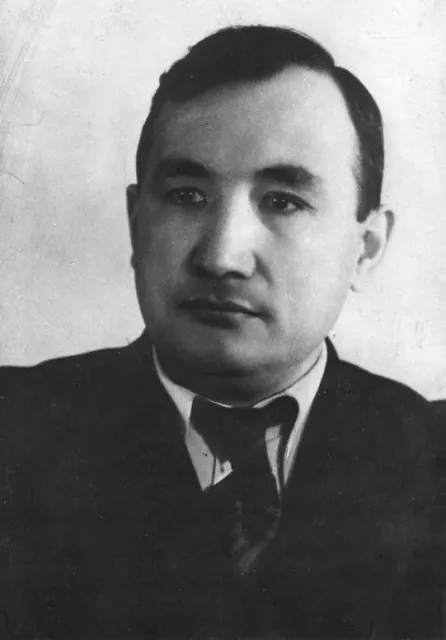
Habib Abdullayev
Geologist, academician and president of the Academy of Sciences of the Uzbek SSR (1956–1962), founder of the metallogenic school of geology in Uzbekistan and a Lenin Prize laureate.
Biography
Habib Muhamedovich Abdullayev was born on 31 August 1912 in the village of Aravan in the Fergana region (now in Kyrgyzstan) to a peasant family. From 1930 to 1935 he studied at the Central Asian Industrial Institute in Tashkent and graduated as a geological engineer. He then headed a prospecting party of the Sredazgeologorazvedka trust and studied the structure, composition and origin of the Langar tungsten-molybdenum deposit.
In 1937–1939 he did postgraduate work and taught at the Moscow Geological Prospecting Institute, defending his candidate dissertation in 1939. From 1940 he was a docent in the department of mineral resources at the Central Asian Polytechnic Institute in Tashkent and for a time its director; in 1941 he was appointed head of the industry department of the Communist Party of Uzbekistan’s Central Committee. From 1942 he was deputy chairman of the republic’s government, and from 1944 also chairman of its State Planning Committee; during the war he worked on locating and developing strategic mineral resources.
In 1943 he became a corresponding member of the Academy of Sciences of the Uzbek SSR, in 1946 he defended his doctoral dissertation, “Geology of the Scheelite-Bearing Skarns of Central Asia”, and in 1947 he became an academician and vice-president of the Academy; during those years he also directed the Institute of Geology. From 1956 until his death he was president of the Academy, and in 1958 he was elected a corresponding member of the USSR Academy of Sciences.
Abdullayev’s central scientific idea was the theory of a genetic link between ore mineralisation and granitoid intrusions, for which he received the Lenin Prize in 1959. He identified Central Asia as a distinct metallogenic province and showed how deposits of tungsten, tin, and non-ferrous and ferrous metals formed. He wrote more than 130 scientific works, including 7 monographs; 7 doctoral and 28 candidate dissertations were defended under his supervision. He founded the Department of Petrology and Metallogeny at the Tashkent Polytechnic Institute, organised the Uzbek Geological Journal, and in 1960 became a member of the Geological Society of France and the Mineralogical Society of Great Britain.
Habib Abdullayev died in Tashkent on 20 June 1962 and was buried in the Chigatay cemetery. In 1970 he was posthumously awarded the Beruni State Prize of the Uzbek SSR, and in 2002 the Order “Buyuk xizmatlari uchun” (“For Outstanding Merit”). The Institute of Geology and Geophysics, streets in Tashkent and Osh and several schools bear his name; a Gold Medal in his name was established in 1992 and a museum opened at the institute. A Tashkent metro station carried his name from 2001 to 2015.
Education
- Central Asian Industrial InstituteUniversity · Tashkent · 1930–1935 · Geological engineer
- Moscow Geological Prospecting InstituteUniversity · 1937–1939 · Candidate of Geological and Mineralogical Sciences (1939)
Career
- Academy of Sciences of UzbekistanCorresponding member (1943), academician and vice-president (1947–1955) and president (1956–1962) of the Academy of Sciences of the Uzbek SSR · Tashkent · 1943–1962
- Supreme Soviet of the Uzbek SSRDeputy (4th convocation) · Tashkent · 1955–1959
- Supreme Soviet of the USSRDeputy (5th convocation) · 1958–1962
- Council of People’s Commissars of the Uzbek SSRDeputy chairman · 1942–1946
- Council of Ministers of the Uzbek SSRDeputy chairman · Tashkent · 1946–1948
- Institute of Geology of the Academy of Sciences of the Uzbek SSRDirector · Tashkent · 1947–1949Everyone who held this post →
- Central Asian Polytechnic InstituteDocent, director, head of the Department of Petrology and Metallogeny · Tashkent · 1940–…Everyone who held this post →
- State Planning Committee (Gosplan) of the Uzbek SSRChairman · Tashkent · 1944–…Everyone who held this post →
Awards
 Order «For Outstanding Merit»2002, posthumously · Uzbekistan
 Beruni State Prize of the Uzbek SSR1970, posthumously · Uzbek SSR
 Order of Lenin1957 · USSR
 Order of the Red Banner of Labour1950 · USSR


 Lenin Prize1959 · USSR
Life path
- 1912Birth
Born in the village of Aravan in the Fergana region (now Kyrgyzstan) to a peasant family.
- 1930–1935Central Asian Industrial Institute
Studied in Tashkent and graduated as a geological engineer.
- 1935Study of Langar
Headed a prospecting party of the Sredazgeologorazvedka trust and studied the Langar tungsten-molybdenum deposit.
- 1937–1939Moscow Geological Prospecting Institute
Did postgraduate work and taught; defended his candidate dissertation in 1939.
- 1940–1941Central Asian Polytechnic Institute
Docent in the department of mineral resources, then director of the institute.
- 1941–1944Government posts
Head of the Party’s industry department, from 1942 deputy chairman of the republic’s government, and from 1944 chairman of its State Planning Committee.
- 1946Doctoral dissertation
Defended his dissertation “Geology of the Scheelite-Bearing Skarns of Central Asia”.
- 1947Academician and vice-president
Became an academician and vice-president of the Academy of Sciences of the Uzbek SSR and headed the Institute of Geology.
- 1956President of the Academy
Elected president of the Academy of Sciences of the Uzbek SSR and held the post until 1962.
- 1958Corresponding member of the USSR Academy
Elected a corresponding member of the USSR Academy of Sciences and a deputy of the Supreme Soviet of the USSR.
- 1959Lenin Prize
Received the Lenin Prize for his work on the genetic link between ore mineralisation and granitoid intrusions.
- 1962Death
Died in Tashkent on 20 June and was buried in the Chigatay cemetery.
Works
- “On the Paragenesis of the Main Hypogene Minerals of the Langar Deposit” (1942)Scientific article
Results of the study of the Langar tungsten-molybdenum deposit.
- “Geology of the Scheelite-Bearing Skarns of Central Asia” (1947)Monograph
A work based on his doctoral dissertation.
- “An Outline of the Metallogeny of Central Asia” (1949)Monograph
On the deposits of iron, tungsten and tin.
- “The Genetic Link of Ore Mineralisation with Granitoid Intrusions” (1954)Monograph
The main work of the series recognised with the Lenin Prize.
- “Dykes and Ore Mineralisation” (1957)Monograph
On the connection between dykes and ore formation.
- “Magmatism and Ore Mineralisation of Central Asia” (1960)Monograph
On the relation between magmatism and ore formation.
- “Selected Works” (7 volumes) (1964)Collected works
His selected works were published in 1964–1969.