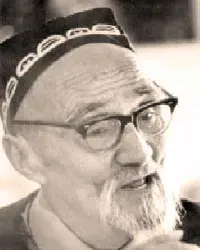
Biography
Habibiy (full name Zokirjon Kholmuhammad ugli Habibiy) was a poet known for his ghazals and song lyrics, and the aruz metre was central to his craft. He was born in 1890 in the village of Qo‘qon, in the Paxtaobod district of the Andijan region, into a peasant family. He was schooled in an old-style school and then in madrasas in Andijan and Kokand. By reading the ghazals of Navoi, Fuzuli, Muqimi and Furqat he picked up the secrets of aruz and tried his hand at verse after their example.
In 1919 he lived in the Andijan village of Bo‘taqora and tilled the land. During the 1920s he composed many poems close to folk songs. When preparations for the 500th anniversary of Navoi's birth began, he came to Tashkent in 1938 on the invitation of the Navoi committee, along with fellow poets Boqiy, Mahjuriy, Anisiy and Sayfiy, and joined the study of Navoi's heritage together with G‘afur G‘ulom, Hamid Olimjon and others. In 1939 he was drawn in as a poet to the construction of the Fergana Canal; afterwards his ghazals started to appear in the republican press and were sung by well-known performers. From 1940 to 1946 he served as literary assistant at the regional music drama and comedy theatre opened in Yangiyo‘l.
Habibiy responded to the themes of his time: the collective-farm system, canal building, the reclamation of the steppe and the construction of the Farhod hydropower station. Poems about the homeland and the life of the people come first in his work, for instance “O‘lkam”, “Farhod qo‘shig‘i”, “Muborak yosh”, “Inson aziz”, “Ulug‘ burch”, “Chevarlar” and “Muddao bilan”. His ghazals of the Second World War period include “Jangchi yigit qo‘shig‘i”, “Boladan ota-onaga xat” and “Onadan bolaga xat”.
The poet's legacy runs to over 40,000 couplets in ghazal, murabba, muhammas, musaddas, ruba‘i, tuyuq, qasida and narrative-poem forms. Music was written for more than 300 of his ghazals, and the golden fund of Uzbek Radio keeps over 200 songs on his words. “Diyorimsan”, “Farg‘ona ruboiysi”, “Bo‘lmasa”, “Yaxshiroq” and “Nima bo‘lding” are especially widely known. Collections published include “Ko‘ngil taronalari” (1957), “Tanlangan asarlar” (1967) and “Devon” (1971).
In 1970 he received the title Honoured Cultural Worker of the Uzbek SSR, and in 1974, shortly before turning 85, he was recognised as People's Poet of the Uzbek SSR. Habibiy died in Tashkent on 16 April 1980 and was laid to rest in the Kamolon cemetery. Streets in Tashkent, Andijan and the Paxtaobod district are named for him, and the Paxtaobod district has his house-museum.
Career
- Mannon Uygur Regional Musical Drama Theatre (Yangiyul)Literary assistant · Yangiyul · 1940–1946
Awards
- People's Poet of the Uzbek SSR1974 · Uzbek SSR
 Honoured Worker of Culture of the Uzbek SSR1970 · Uzbek SSR
Life path
- 1890Born
In the village of Qo‘qon, Paxtaobod district, Andijan region, in a peasant family.
- 1919In the village of Bo‘taqora
Tilled the land.
- 1920-yillarIn the style of folk songs
Composed many poems.
- 1938Moved to Tashkent
On the invitation of the Navoi committee; joined the study of Navoi's heritage.
- 1939Building of the Fergana Canal
Drawn in as a poet; his ghazals started to be printed.
- 1940–1946At the music drama and comedy theatre
Literary assistant at the regional theatre opened in Yangiyo‘l.
- 1957“Ko‘ngil taronalari”
Verse collection published.
- 1970Title
Honoured Cultural Worker.
- 1974People's Poet of Uzbekistan
Title received shortly before he turned 85.
- 1980Died
On 16 April in Tashkent; laid to rest in the Kamolon cemetery.
Works
- «Mehnat qo'shiqlari»Poetry collection
- «Yangi yallalar» (1949)Poetry collection
- «Kolxozchilar ashulasi» (1951)Poetry collection
- «Ko'ngil taronalari» (1957)Poetry collection
- «Zamon farhodlari» (1959)Poetry collection
- «Tanlangan asarlar» (1967)Poetry collection
- «Devon» (1971)Poetry collection
- «Navro'zi olam» (1973)Poetry collection
- «Diyorimsan»Ghazal
- «Farg'ona ruboiysi»Ruba‘i