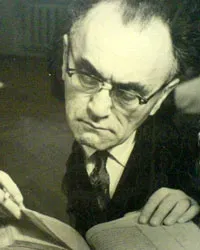
Literary scholar and textologist, Doctor of Philology and professor, a leading researcher of the textual study of Navoiy’s lyric poetry and director of the Navoiy Literature Museum and the Institute of Manuscripts.
Biography
Hamid Sulaymonov was a literary scholar and textual critic, Doctor of Philology and professor, who devoted most of his research to the texts of Alisher Navoiy’s lyric poetry. He was born in Tashkent on 5 May 1910 and died in 1979.
He finished the Moscow Institute of Cinematography in 1932. From 1935 to 1950 he taught at the Tashkent Pedagogical Institute, where he also chaired a department, and was a docent at Tashkent State University. He suffered repression in the 1950s and was rehabilitated in the 1960s. He received his doctorate in 1961 and the rank of professor in 1971.
His work on Navoiy’s texts runs as follows. In 1946–1947 he drew up a bibliography of the poet’s manuscripts. In 1959 he found manuscripts of the divans “Badoye ul-bidoya” and “Navodir un-nihoya” and demonstrated that the poet himself had arranged them. He prepared the critical text of “Xazoyin ul-maoniy” and had it published in 1958–1960. After finding manuscripts of the “Devoni Foniy” in France, he issued it in 1965 from a facsimile.
Sulaymonov brought the facsimile of Hofiz Xorazmiy’s two-volume divan, kept in Hyderabad (India), to Tashkent in 1977; it was printed in 1980 with his foreword. He also wrote scholarly works on calligraphy and the art of the book and put together albums of illustrations: to the “Boburnoma” (1959), to Navoiy’s works (1980) and to the works of Amir Khusrau (1983). F. Sulaymonova was his co-author on the last two.
His posts: sector head at the Institute of Language and Literature of the Uzbek Academy of Sciences (1962–1967), director of the Alisher Navoiy Museum of Literature (1967–1969), and director of the Institute of Manuscripts (1978–1979). He directed the establishment of the literature museums in Tashkent, Andijan, Kokand, Samarkand and Jizzakh, and of the Institute of Manuscripts.
Sulaymonov was named Honoured Scientist of Uzbekistan in 1964 and in 1979 became a laureate of the Beruniy State Prize of Uzbekistan. A street in Tashkent carries his name.
Education
- Gerasimov Institute of Cinematography (VGIK)University · 1932
Career
- Institute of Language and LiteratureHead of a sector · Tashkent · 1962–1967
- Alisher Navoi State Museum of LiteratureDirector · Tashkent · 1967–1969
- Institute of Manuscripts of the Academy of SciencesDirector · Tashkent · 1978–1979
Awards
- Honoured Science Worker of the Uzbek SSR1964 · Uzbek SSR
 Beruni State Prize of the Uzbek SSR1979 · Uzbek SSR
Life path
- 1910Came into the world in Tashkent on 5 May
- 1932Finished the Moscow Institute of Cinematography
- 1935–1950Taught at the Tashkent Pedagogical Institute and chaired a department there; docent at Tashkent State University
- 1946–1947Drew up a bibliography of Navoiy's manuscripts
- 1958–1960Prepared and published the critical text of “Xazoyin ul-maoniy”
- 1959Discovered the manuscripts of Navoiy's divans “Badoye ul-bidoya” and “Navodir un-nihoya”
- 1961Received the degree of Doctor of Philology
- 1962–1967Led a sector of the Institute of Language and Literature
- 1967–1969Ran the Navoiy Museum of Literature
- 1978–1979Ran the Institute of Manuscripts
- 1979Awarded the Beruniy State Prize; died the same year
Works
- Bibliography of Navoiy manuscripts (1947)Bibliography
- Navoiy, “Xazoyin ul-maoniy” (critical text) (1960)Edition
- Illustrations to the “Boburnoma” (1959)Album
- “Devoni Foniy” (facsimile edition) (1965)Edition
- Illustrations to Navoiy’s works (with F. Sulaymonova) (1980)Album
- Illustrations to Amir Khusrau’s works (with F. Sulaymonova) (1983)Album
- Facsimile of Hofiz Xorazmiy’s “Divan” (with a foreword) (1980)Edition