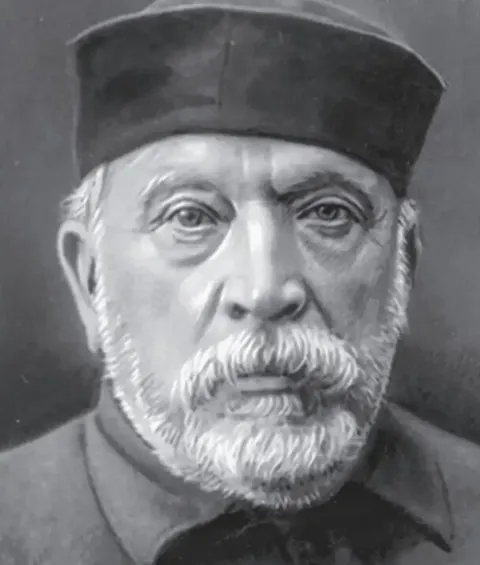
Ivan Kablukov
Russian and Soviet physical chemist, professor at Moscow University; co-author of the idea of ion solvation, who died in Tashkent in 1942.
Biography
Ivan Alekseyevich Kablukov was born on 2 September 1857 (21 August in the old style) in the village of Prussy in Moscow Governorate, now in the Mytishchi district of Moscow Oblast, into the family of a dentist. His father, Aleksey Fyodorovich, managed the Saltykov-Shchedrin estate. In 1876 Kablukov finished the 2nd Moscow Classical Gymnasium and entered the natural science department of the physics and mathematics faculty at Moscow University; he graduated in 1880 with the degree of candidate and, on Vladimir Markovnikov’s recommendation, was kept on at the chemistry department to prepare for a professorship.
In 1881–1882 he worked in Alexander Butlerov’s chemical laboratory at St Petersburg University and then continued with Markovnikov in Moscow. From 1885 he was a privatdozent at Moscow University, lecturing on dissociation; in 1882–1884 he also taught at the Moscow Higher Women’s Courses. He defended a master’s thesis on glycerols and other trihydric alcohols in 1887 and a doctoral thesis on the theory of solutions in 1891. In 1889 he worked in Wilhelm Ostwald’s laboratory in Leipzig.
His main field was the electrochemistry of non-aqueous solutions. In 1889–1891 he studied the conductivity of electrolytes in organic solvents, concluded that the solvent interacts chemically with the dissolved substance and, independently of Vladimir Kistiakovsky, put forward the idea of ion solvation. This work began the bringing together of the physical and chemical theories of solutions. In 1905 he was among the first to use thermal analysis to study the exchange of salts in melts.
From 1899 Kablukov was an associate professor at the Moscow Agricultural Institute (later the Timiryazev Academy); from 1903 he was an extraordinary and from 1906 an ordinary professor at Moscow University, and from 1910 an emeritus professor. From 1922 he also directed the university’s Research Institute of Chemistry. He was the first at the university to teach a systematic course of physical chemistry, and his textbook “Fundamentals of Inorganic Chemistry” (1900) went through 13 editions.
He also worked on practical problems: he took part in setting up Russian production of mineral fertilizers, devised a way to obtain bromine from the brine of Lake Saki in Crimea and studied beekeeping. From 1933 until the early 1940s he headed the department of inorganic and analytical chemistry at the Stalin Industrial Academy.
He was named Hero of Labour in 1924, became a corresponding member of the USSR Academy of Sciences in 1928 and an honorary member in 1932, was Honoured Worker of Science of the RSFSR (1929), and received the Order of the Red Banner of Labour (1937) and the Order of Lenin (1940).
After the war began, part of his department’s staff was evacuated; Kablukov died in Tashkent in the evacuation on 5 May 1942. A memorial plaque marks Building No. 6 of the Timiryazev Academy in Moscow, where he worked.
Education
- Moscow State UniversityUniversity · 1876–1880 · Candidate degree (natural sciences)
Career
- Moscow State UniversityPrivatdozent, professor · 1885–1942
- Moscow Agricultural Institute (Timiryazev Academy)Professor of chemistry · 1899–1942
- USSR Academy of SciencesCorresponding member (1928), honorary member (1932) · 1928–1942
Awards
 Order of Lenin1940 · USSR
 Order of the Red Banner of Labour1937 · USSR
Life path
- 1857Birth
Born in the village of Prussy, Moscow Governorate.
- 1876–1880Moscow University
Studied in the natural science department of the physics and mathematics faculty and took the degree of candidate.
- 1881–1882In St Petersburg
Worked in Butlerov’s laboratory.
- 1887Master’s thesis
On glycerols and trihydric alcohols.
- 1889In Leipzig
Studied electrical conductivity in Ostwald’s laboratory.
- 1891Doctoral thesis
On the theory of solutions and chemical equilibrium.
- 1899Agricultural Institute
Appointed associate professor at the Moscow Agricultural Institute, where he worked until 1942.
- 1903–1906Professor at Moscow University
Extraordinary professor from 1903, ordinary professor from 1906.
- 1924Hero of Labour
Awarded the title Hero of Labour.
- 1928–1932USSR Academy of Sciences
Elected corresponding member in 1928 and honorary member in 1932.
- 1942Death
Died in Tashkent on 5 May.
Works
- “Glycerols, or Triatomic Alcohols and Their Derivatives” (1887)Master’s thesis
- “Modern Theories of Solutions (Van ’t Hoff and Arrhenius) in Connection with the Doctrine of Chemical Equilibrium” (1891)Doctoral thesis
- “Fundamentals of Inorganic Chemistry” (1900)Textbook
- “Fundamentals of Physical Chemistry” (1900)Textbook (three parts: 1900, 1902, 1910)
- “Sketches from the History of Electrochemistry in the 19th Century” (1901)Historical essay
- “The Phase Rule Applied to Saturated Salt Solutions” (1933)Monograph
- “Physical and Colloid Chemistry” (1935)Textbook