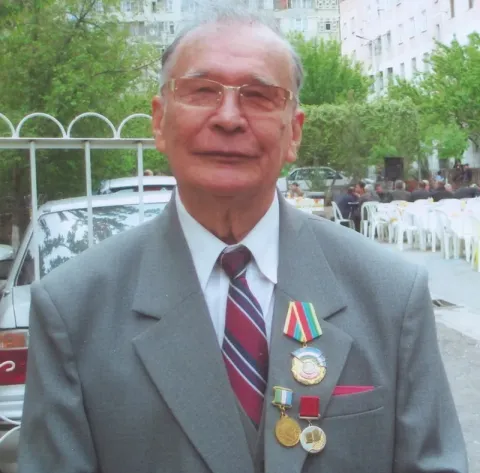
Jonrid Abdullakhonov
Uzbek writer, poet, playwright and journalist, author of the novels “Tufon”, “Borsa-kelmas” and “Suiqasd”, holder of the Order of Mehnat Shuhrati.
- Occupation:
- Writer, Poet, Prose writer, Playwright, Publicist
- Born:
- March 3 1929(86 years old) ♓ — March 29, 2015
- Birthplace:
- Namangan
- Father:
- Muhitdin Abdullaxonov
- Mother:
- Shahribonu Abdullaxonova
Biography
Jonrid Muhitdinovich Abdullakhonov was born on 3 March 1929 in Namangan. His father, Muhitdin Abdullakhonov, was one of the founders of the Namangan Drama Theatre and went missing near Stalingrad in October 1942. His fate became known only in 2008, through the Polish Red Cross: he had died in March 1943 in the Benjaminow prisoner-of-war camp and was buried near the village of Białobrzegi outside Warsaw. His mother, Shahribonu, was a schoolteacher and died in 1943.
He published his first poems at the age of twelve in Namangan’s city newspapers. After news of his father’s disappearance and his mother’s death, the fourteen-year-old walked from Namangan to Tashkent and found work as an announcer on the children’s programme “Pioner ertaligi” (“Pioneer Morning”) on republican radio.
In 1949, as the author of many poems and the play “Aleksey Peshkov”, he was admitted to the newly founded journalism faculty of Central Asian State University (today the National University of Uzbekistan) and graduated in 1954. He joined the Union of Writers of the USSR in 1956, and in 1960 completed the Higher Literary Courses at the Gorky Literature Institute in Moscow, in the seminar led by Konstantin Paustovsky.
For many years, with interruptions, he was editor-in-chief of literary broadcasting at Uzbek radio and television, worked in the apparatus of the Writers’ Union, and served as chief specialist at the Ministry of Culture of the Uzbek SSR. From 1976 to 1982 he headed the Uzbek branch of the USSR Literary Fund. In the early 1960s the newspaper Trud printed his article “Is the Jayhun Our Friend?”, which urged rational use of water resources and warned that the Aral Sea would shrink; it provoked the displeasure of the republic’s party leadership.
After the poetry collection “Maktabdoshlarim” (1952) and the story collections “Hikoyalar” (1956) and “To‘yga kelinglar” (1960), he turned to the novel: “Yo‘l” (1964), “To‘fon” about the working class, “Borsa-kelmas” (1978) on the Aral Sea problem, “Xonadon”, “Suiqasd” (1991) and “Tergov” (2000). For “To‘fon” (published in Russian as “Uragan”, 1975) he won the competition held by the All-Union Central Council of Trade Unions and the USSR Writers’ Union, and his play “Olov qalblar” (“Fiery Hearts”) won the republican drama competition. A television film, “Azizakhon”, directed by M. Mukhamedov, was made from his screenplay in 1964. He also translated Daniil Granin and Abbé Prévost into Uzbek.
From 1991 he was a member of the Writers’ Union of Uzbekistan, and in the 1990s he wrote for the trade-union federation’s newspaper Ishonch under the pen name Abdusamad. He was awarded the Order of Mehnat Shuhrati. He died on 29 March 2015 in Tashkent and was buried in the Minor cemetery.
Education
- National University of UzbekistanUniversity · Tashkent · 1949–1954 · Journalism
- Maxim Gorky Literature InstituteUniversity · 1960 · Higher Literary Courses
Career
- Writers' Union of UzbekistanMember · Tashkent · 1991–…
- Uzbek RadioAnnouncer, later editor-in-chief of literary broadcasting · Tashkent · 1943–…
- Union of Soviet WritersMember · 1956–1991
- Ministry of Culture of the Uzbek SSRChief specialist · Tashkent
Awards
 Order of Labor GloryUzbekistan
Life path
- 1929Birth
Born in Namangan; his father was one of the founders of the Namangan Drama Theatre.
- 1943To Tashkent
At fourteen walked from Namangan to Tashkent and became an announcer on “Pioner ertaligi” on republican radio.
- 1949–1954Central Asian State University
Studied at the newly founded journalism faculty.
- 1956Joined the USSR Writers’ Union
Remained a member until 1991.
- 1960Higher Literary Courses
Graduated in Moscow from the courses at the Gorky Literature Institute (Konstantin Paustovsky’s seminar).
- 1960-yillar boshiThe article “Is the Jayhun Our Friend?”
Published in Trud an article warning of the shrinking of the Aral Sea.
- 1964The novel “Yo‘l” and the TV film “Azizakhon”
His first major novel “Yo‘l” appeared, and the TV film “Azizakhon” was made from his screenplay.
- 1976–1982Uzbek branch of the Literary Fund
Director of the Uzbek branch of the USSR Literary Fund.
- 1978“Borsa-kelmas”
First edition of the novel on the Aral problem; a Russian edition followed in Moscow in 1981.
- 1991Writers’ Union of Uzbekistan
Became a member of the Writers’ Union of Uzbekistan; the novel “Suiqasd” was published the same year.
- 2009“Tarki dunyo”
The chronicle novel “Tarki dunyo” was published by the “O‘zbekiston” publishing house.
- 2015Death
Died on 29 March in Tashkent and was buried in the Minor cemetery.
Books
- “Maktabdoshlarim” (My Schoolmates)1952 · Poetry collection
His first book.
- “Hikoyalar” (Stories)1956 · Story collection
Stories about the lives of young people.
- “To‘yga kelinglar” (Come to the Wedding)1960 · Story collection
A collection of stories.
- “Yo‘l” (The Road)1964 · Novel
His first major novel, about construction and building; a Russian edition appeared in 1967.
- “To‘fon” (The Hurricane)1968 · Novel
A novel about working-class life; published in Moscow in 1975 as “Uragan”.
- “Borsa-kelmas”1978 · Novel trilogy
Devoted to the Aral Sea problem and the protection of nature.
- “Xonadon”1988 · Novel
A novel of family life.
- “Suiqasd” (The Assassination Attempt)1991 · Novel
A novel exposing bribery and window-dressing.
- “Tergov” (The Inquiry)2000 · Novel
An adventure-flavoured novel.
- “Tarki dunyo” (Renouncing the World)2009 · Chronicle novel
Published by the “O‘zbekiston” publishing house.