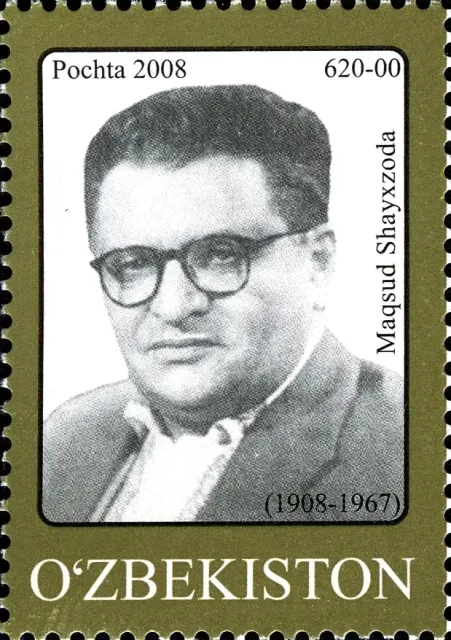
Maqsud Shayxzoda
Uzbek poet, playwright, literary scholar and translator of Azerbaijani origin, author of the poem “Tashkentnoma” and the tragedies “Jalal ad-Din Manguberdi” and “Mirzo Ulugbek”; Honoured Art Worker of the Uzbek SSR (1964).
- Occupation:
- Writer, Scientist, Educator, Poet, Playwright
- Born:
- November 7 1908(58 years old) ♏ — February 19, 1967
- Father:
- Ma'sumbek
- Mother:
- Fotima xonim
Biography
Maqsud Shayxzoda was born on 7 November 1908 in Aghdash, in present-day Azerbaijan, to the physician Ma’sumbek and his wife Fatima Khanum; he was Azerbaijani by nationality. After primary school in his home town he studied in 1921–1925 at the teachers’ seminary (Darulmuallimin) in Baku, where Abdulla Shaig and Huseyn Javid were among the teachers. His first poems, written in Azerbaijani, appeared in the Baku newspaper “Kommunist” in 1921.
After the seminary he taught in Dagestan, in Derbent and Buynaksk. In 1927 he was arrested on a charge of involvement in a “counter-revolutionary” group and sentenced to exile; in February 1928 he was sent to Tashkent, where he lived for the rest of his life.
In Tashkent he studied briefly at the Oriental faculty of the Central Asian University (1928) and then worked on the staff of the newspapers “Sharq haqiqati” (1929–1932), “Qizil O'zbekiston” and “Yosh leninchi” (1932) and the magazine “Guliston” (1933–1934). His first poem in Uzbek came out in 1929, followed by the collections “Those in Tune with Me” (1933), “The Third Book” (1934) and “Republic” (1935). In 1933 he passed the examinations of the Baku Pedagogical Institute as an external student, in 1934 he began postgraduate studies, and in 1935–1938 he was a research fellow at the Institute of Language and Literature.
From 1938 until his death, apart from the years of imprisonment, he taught the history of Uzbek literature at the Tashkent Pedagogical Institute (now the Nizami university), serving as dean and head of department; he held a candidate’s degree in philology and the rank of associate professor. He studied Alisher Navoi throughout his career, from the collection of articles “The Poet of Genius” (1941) to the study “The Sultan in the Realm of the Ghazal” (1966), and also wrote on Babur, Muqimiy, Furqat and the epic “Alpomish”.
During the war he published the collection “What Is the Fight For?” (1942) and others, and the narrative poems “The Elder” (1943), about Yo'ldosh Oxunboboyev, and “The Third Son” (1944). His verse tragedy “Jalal ad-Din Manguberdi”, about the Khwarazmshah’s struggle against the Mongol invasion, was staged in Tashkent in 1944 but removed from the repertoire in 1946 for allegedly “idealising the feudal past”.
In 1951 his life and writings were placed under investigation, and on 20 September 1952 he was arrested. In January 1953 he was sentenced to 25 years’ imprisonment and sent to a labour camp in the Irkutsk region. After Stalin’s death the case was reviewed, and in the mid-1950s Shayxzoda was released and rehabilitated, his health badly damaged by imprisonment.
In the last decade of his life he wrote the lyrical-philosophical poem “Tashkentnoma” (1958), the collection “Years and Roads” (1961) and the tragedy “Mirzo Ulugbek” (1961) about the last two years of the scholar-ruler’s life; it was staged by the Hamza Theatre, and from his screenplay the director Latif Fayziyev made the film “The Star of Ulugbek” (1964). He translated Shakespeare’s “Hamlet” and “Romeo and Juliet”, Pushkin, Lermontov, Rustaveli and Nâzım Hikmet into Uzbek. In 1964 he was named Honoured Art Worker of the Uzbek SSR; he also received the Order of the Badge of Honour. A play about al-Biruni remained unfinished, and its manuscript has been lost.
Maqsud Shayxzoda died in Tashkent on 19 February 1967 and was buried in the Chig'atoy cemetery. In 2001 he was posthumously awarded the Order “For Outstanding Merit” (Buyuk xizmatlari uchun). School No. 167 in Tashkent bears his name, and in 2008 the Uzbek post issued a stamp with his portrait.
Education
- Baku Teachers’ Seminary (Darulmuallimin)College · 1921–1925
- National University of UzbekistanUniversity · Tashkent · 1928–1929 · Oriental faculty (then the Central Asian State University), studied briefly
- Institute of Language and LiteratureOther · Tashkent · 1934–1935 · Postgraduate studies
- Baku Pedagogical InstituteUniversity · 1933 · By correspondence; passed the examinations externally in 1933
Career
- Qizil O'zbekiston newspaperStaff member · Tashkent · 1932–1932
- Guliston magazineStaff member · Tashkent · 1933–1934
- Yosh Leninchi newspaperStaff member · Tashkent · 1932–1932
- Sharq haqiqati newspaperStaff member · Tashkent · 1929–1932
- Institute of Language and LiteratureResearch fellow · Tashkent · 1935–1938
- Nizami Tashkent State Pedagogical UniversityLecturer in the history of Uzbek literature, associate professor; dean and head of department · Tashkent · 1938–1967
Awards
 Order «For Outstanding Merit»2001, posthumously · Uzbekistan
- Honoured Art Worker of the Uzbek SSR1964 · Uzbek SSR

Life path
- 1921–1925Baku Teachers’ Seminary
Studied at the Darulmuallimin; his first poems appeared in the Baku newspaper “Kommunist”.
- 1925–1927Teacher in Dagestan
Taught in Derbent and Buynaksk.
- 1927–1928Arrest and exile
Accused of links to a “counter-revolutionary” group and exiled to Tashkent in February 1928.
- 1929–1934Newspapers and magazines
Worked on “Sharq haqiqati”, “Qizil O'zbekiston”, “Yosh leninchi” and “Guliston”; his first poem in Uzbek came out in 1929.
- 1935–1938Institute of Language and Literature
Research fellow at the institute after postgraduate studies.
- 1938–1967Pedagogical Institute
Taught the history of Uzbek literature, served as dean and head of department, and studied the work of Navoi.
- 1944“Jalal ad-Din Manguberdi”
The tragedy was staged in Tashkent; it was removed from the repertoire in 1946.
- 1952 – mid-1950sImprisonment
Arrested in 1952, sentenced to 25 years and sent to a camp in the Irkutsk region; released and rehabilitated after Stalin’s death.
- 1958“Tashkentnoma”
His lyrical-philosophical poem about Tashkent was published.
- 1961“Mirzo Ulugbek”
His tragedy about the last years of Ulugbek reached the stage.
- 1964“The Star of Ulugbek” and an honorary title
A film was made from his screenplay; he was named Honoured Art Worker of the Uzbek SSR.
- 1967Death
Died in Tashkent on 19 February.
Works
- “Those in Tune with Me” (1933)Poetry collection
One of his first collections in Uzbek.
- “The Poet of Genius” (1941)Collection of articles
Studies of the work of Alisher Navoi.
- “What Is the Fight For?” (1942)Poetry collection
Patriotic poems of the war years.
- “The Elder” (1943)Narrative poem
About Yo'ldosh Oxunboboyev.
- “Jalal ad-Din Manguberdi” (1944)Tragedy
On the Khwarazmshah’s struggle against the Mongol invasion; the full Uzbek text was printed only in 1988.
- “Tashkentnoma” (1958)Lyrical-philosophical poem
A poem on the past and present of Tashkent.
- “Years and Roads” (1961)Poetry collection
Lyric poetry of his later years.
- “Mirzo Ulugbek” (1961)Tragedy
On the last two years of Ulugbek’s life; translated into Russian by Naum Grebnev.
- “The Star of Ulugbek” (1964)Screenplay
For the film by Latif Fayziyev.
- “The Sultan in the Realm of the Ghazal” (1966)Study
On Navoi’s ghazals.
- Translation of Shakespeare’s “Hamlet”Translation
Translated into Uzbek; he also translated “Romeo and Juliet”.
Filmography
| Title | Year |
|---|---|
| Ulugh Beg’s Star | 1965 |