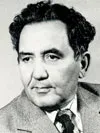
Biography
Matyoqub Qo’shjonov was born on 5 May 1918 in the village of Hallang near Tashauz (Toshhovuz), in present-day Turkmenistan, into a shepherd’s family. He studied at teacher-training schools and, until 1942, taught Uzbek language and literature at a school in Tashauz.
He served in the Second World War as a sniper, and the war later found its way into his literary-biographical books. After the war he graduated with distinction from the philology faculty of the Central Asian State University (1945–1950) and worked in the apparatus of the Central Committee of the Communist Party of Uzbekistan, then studied at the Academy of Social Sciences in Moscow. His career as a critic began in the same years: his first review appeared in 1956.
From 1957 to 1960 he was a docent in the university’s department of Uzbek literature. From 1960 until the end of his life he worked at the Institute of Language and Literature of the Academy of Sciences of Uzbekistan: as a senior researcher, head of a department, director (1975–1986), and later leading researcher and scientific consultant. He took his doctorate in philology in 1972.
His main research concerns Uzbek literature of the twentieth century, the methodology of literary criticism and the writer’s craft. He analysed the work of Qodiriy, Oybek, Abdulla Qahhor, Abdulla Oripov and others, studying plot, composition, character and conflict in the literary work. For the books “Meaning and Measure” (1974) and “Facets of Talent” (1975) he received the Hamza State Prize of the Uzbek SSR in 1977. He took part in producing the two-volume “Theory of Literature”, the five-volume “History of Uzbek Literature” and dictionaries of the Uzbek language; five doctors and fifteen candidates of sciences were trained under his supervision.
In 1978 he was given the title Honoured Scientist of the Uzbek SSR, and in 2000 he became an academician of the Academy of Sciences of Uzbekistan. In the years of independence he wrote “The Uzbek’s Selfhood” (1994) and, with a co-author, a study of Abdulla Oripov (2000); his literary-biographical books “The Trigger Was Pulled” (1990), “Pain” (1996) and “Regret” (2004) were published. He received the orders “El-yurt hurmati” (1999) and “Buyuk xizmatlari uchun” (2003).
Matyoqub Qo’shjonov died in Tashkent on 16 August 2005. In 2018 the Institute of Uzbek Language, Literature and Folklore held a scholarly conference for the centenary of his birth.
Education
- Central Asian State UniversityUniversity · Tashkent · 1945–1950 · Philologist (degree with distinction)
- Academy of Social Sciences under the CPSU Central Committee (Moscow)University · 1953–1957 · Postgraduate studies
Career
- Academy of Sciences of UzbekistanAcademician · Tashkent · 2000–…
- Institute of Language and LiteratureSenior researcher, director (1975–1986), leading researcher · Tashkent · 1960–…Everyone who held this post →
- Central Asian State UniversityDocent · Tashkent · 1957–1960
- Central Committee of the Communist Party of UzbekistanResponsible official · Tashkent · 1950–1953
Awards
 Order «For Outstanding Merit»2003 · Uzbekistan
 Order «El-yurt hurmati»1999 · Uzbekistan
- Honoured Science Worker of the Uzbek SSR1978 · Uzbek SSR
 Hamza State Prize of the Uzbek SSR1977 · Uzbek SSR
Life path
- 1918Born
Born in the village of Hallang near Tashauz (now Turkmenistan) into a shepherd’s family.
- 1930s–1942School teacher
Studied at teacher-training schools and taught Uzbek language and literature at a school in Tashauz.
- 1942–1945The war
Fought in the Second World War as a sniper.
- 1945–1950University
Graduated with distinction from the philology faculty of the Central Asian State University.
- 1950–1953In the party apparatus
Worked as a responsible official of the Central Committee of the Communist Party of Uzbekistan.
- 1953–1957Studies in Moscow
Did postgraduate study at the Academy of Social Sciences in Moscow; his first critical review appeared in 1956.
- 1957–1960University docent
Taught in the department of Uzbek literature of the Central Asian State University.
- 1960–1975Institute of Language and Literature
Worked at the institute as a senior researcher and later head of a department; defended his doctoral dissertation in 1972.
- 1975–1986Director of the institute
Headed the Institute of Language and Literature; received the Hamza Prize in 1977 and the title Honoured Scientist in 1978.
- 1986–2005Leading scholar
Remained at the institute as leading researcher and scientific consultant; wrote “The Uzbek’s Selfhood” (1994) and other books.
- 2000Academician
Elected an academician of the Academy of Sciences of Uzbekistan.
- 2005Death
Died in Tashkent on 16 August.
Books
- “Meaning and Measure”1974 · Collection of critical essays
Analyses problems of composition in Uzbek prose of the 1970s; one of the books honoured with the Hamza Prize.
- “Facets of Talent”1975 · Critical study (in Russian)
A book in Russian, one of the works honoured with the Hamza Prize.
- “Oybek”1976 · Monograph
A book on the work of the writer Oybek.
- “Essence and Artistry”1977 · Collection of critical essays
Devoted to questions of literary theory and the writer’s craft.
- “The Responsibility of Craft”1977 · Collection of critical essays
Critical essays on the writer’s craft.
- “The Trigger Was Pulled”1990 · Literary-biographical book
About the hard days of ordinary soldiers during the war.
- “The Uzbek’s Selfhood”1994 · Literary-critical book
A book of reflections on well-known writers.
- “Pain”1996 · Literary-biographical book
- “Abdulla Oripov”2000 · Study (co-authored)
A book on the work of the poet Abdulla Oripov.
- “Regret”2004 · Literary-biographical book