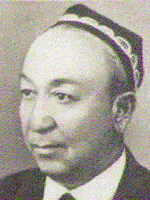
Biography
Mirtemir (born Mirtemir Umarbekovich Tursunov) was born on 30 May 1910 in the village of Ikan near the town of Turkestan (now in the Turkestan Region of Kazakhstan). He studied at an old-method school (1919–1920), then in Tashkent at the Almaiy model labour school (1920–1923) and at the Uzbek men’s college (1925–1929). His first poems were printed from 1926, and in 1928 his collection “Shu‘lalar qo‘ynida” (“In the Embrace of the Rays”) came out.
In 1929 he went to Samarkand, where he worked as secretary to Yo‘ldosh Oxunboboyev, chairman of the Central Executive Committee of Uzbekistan, while studying at the language and literature faculty of the Pedagogical Academy; some sources say he graduated in 1932. He belonged to the literary organisation “Qizil qalam”. On 8 August 1932 he was arrested by the GPU for his ties with Botu and Oltoy, whom the authorities called “nationalists”.
After his release he worked as a literary staff member of the newspaper “Yangi hayot” (1936), chief editor at the republic’s radio committee (1941), editor at the state publishing house Uzdavnashr (1942) and literary staff member of the opera and ballet theatre (1943–1944). In the 1930s he wrote the narrative poems “Barot” (1930), “Xidir” (1932), “Dilkusho”, “Suv qizi” (“The Water Girl”, 1937) and “Oysanamning to‘yida” (“At Oysanam’s Wedding”, 1938); the collections “Poytaxt” (“The Capital”, 1936), “Qasd” (1944) and “Yangi she‘rlar” (“New Poems”, 1947) were published.
After the Second World War his chances to publish his own poetry were restricted, and he worked mainly as a translator and editor. He rendered poems by Pushkin, Lermontov, Nekrasov, Abai, Magtymguly and Berdaq into Uzbek, and, together with others, Rustaveli’s “The Knight in the Panther’s Skin” and the Kyrgyz epic “Manas”. His translations of Karakalpak poetry and the cycle “Qoraqalpoq daftari” (“The Karakalpak Notebook”, late 1950s) brought him back to his own writing; the lyric tale “Surat” (“Portrait”) from that cycle influenced the development of the lyric narrative poem in Uzbek poetry of the 1960s and 1970s.
In 1957–1964 he was head of a department and adviser at the Writers’ Union, and in 1965–1966 an editor at the fiction publishing house; he mentored many young poets who entered literature in the 1960s. His songs, such as “Yali-yali”, became folk favourites. He received the Order of the Badge of Honour (1959) and the Order of the Red Banner of Labour; in 1971 he was named People’s Poet of the Uzbek SSR, and in 1977 he won the Berdaq State Prize of Karakalpakstan.
Mirtemir died in Tashkent in January 1978 and was buried in the Chigatai cemetery. He was posthumously awarded the Hamza State Prize of the Uzbek SSR (1979) and the Order “For Outstanding Merit” (“Buyuk xizmatlari uchun”, 2001). His four-volume collected works appeared in 1980–1983; a house-museum has been opened in his native village, and a street in Tashkent and a school in the Bo‘z district of Andijan Region bear his name.
Education
- Almaiy Model Labour SchoolSchool · Tashkent · 1920–1923
- Uzbek Men’s CollegeCollege · Tashkent · 1925–1929
- Uzbek Pedagogical AcademyUniversity · Samarkand · 1929–1932 · Faculty of Language and Literature
Career
- Writers' Union of UzbekistanHead of a department and adviser · Tashkent · 1957–1964
- State Publishing House of UzbekistanEditor · Tashkent · 1942–…
- Uzbek RadioChief editor of the republic’s radio committee · Tashkent · 1941–…Everyone who held this post →
Awards
 Order «For Outstanding Merit»2001, posthumously · Uzbekistan
- People's Poet of the Uzbek SSR1971 · Uzbek SSR
 Hamza State Prize of the Uzbek SSR1979, posthumously · Uzbek SSR

 Order of the Badge of Honour1959 · USSR
Life path
- 1910Birth
Born in the village of Ikan near the town of Turkestan.
- 1920–1929Schooling in Tashkent
Studied at the Almaiy model labour school (1920–1923), then at the Uzbek men’s college (1925–1929).
- 1928First collection
The poetry collection “Shu‘lalar qo‘ynida” was published.
- 1929–1932In Samarkand
Secretary to Yo‘ldosh Oxunboboyev, chairman of the Central Executive Committee of Uzbekistan; studied at the Pedagogical Academy.
- 1932Arrest
Arrested by the GPU on 8 August over ties with so-called “nationalists”; released later.
- 1936–1944Newspaper, radio, publishing, theatre
Literary staff member of “Yangi hayot”, chief editor at the radio committee (1941), editor at Uzdavnashr (1942), literary staff member of the opera and ballet theatre (1943–1944).
- 1950s“The Karakalpak Notebook”
Translations of Karakalpak poetry and the cycle “Qoraqalpoq daftari” returned him to his own writing.
- 1957–1964At the Writers’ Union
Head of a department and adviser.
- 1965–1966At a publishing house
Editor at the fiction publishing house.
- 1971People’s Poet
Named People’s Poet of the Uzbek SSR.
- 1978Death
Died in Tashkent in January.
- 1979Hamza State Prize
Posthumously awarded the Hamza State Prize of the Uzbek SSR.
Works
- “Shu‘lalar qo‘ynida” (“In the Embrace of the Rays”) (1928)Poetry collection
The poet’s first collection.
- “Barot” (1930)Narrative poem
One of his narrative poems of the 1930s.
- “Poytaxt” (“The Capital”) (1936)Poetry collection
A collection of the mid-1930s.
- “Suv qizi” (“The Water Girl”) (1937)Narrative poem
A narrative poem about ordinary working people.
- “Oysanamning to‘yida” (“At Oysanam’s Wedding”) (1938)Narrative poem
One of his narrative poems of the 1930s.
- “Qasd” (“Revenge”) (1944)Poetry collection
A collection published during the war years.
- “Yangi she‘rlar” (“New Poems”) (1947)Poetry collection
One of his first post-war collections.
- “Surat” (“Portrait”) (1957)Lyric tale
Part of the Karakalpak cycle; it influenced the lyric narrative poem as a genre.
- “Saralangan asarlar” (“Selected Works”) (1958)Poetry collection
A volume of selected poems.
- “Yali-yali”Poem and song
A song about the building of the Great Fergana Canal that became a folk favourite.
- “Collected Works” (4 volumes) (1980)Collected works
Published in 1980–1983.
Legacy
Mirtemir’s poems and songs are counted among the finest examples of 20th-century Uzbek lyric poetry, and his tale “Surat” influenced the development of the lyric narrative poem. He mentored young poets who entered literature in the 1960s, founding a school of his own, and some of his poems became folk songs.
Era: Uzbek poetry of the Soviet period- Named People’s Poet of the Uzbek SSR (1971)
- Berdaq State Prize of Karakalpakstan (1977)
- Hamza State Prize of the Uzbek SSR (posthumous) (1979)
- Four-volume collected works published (1980)