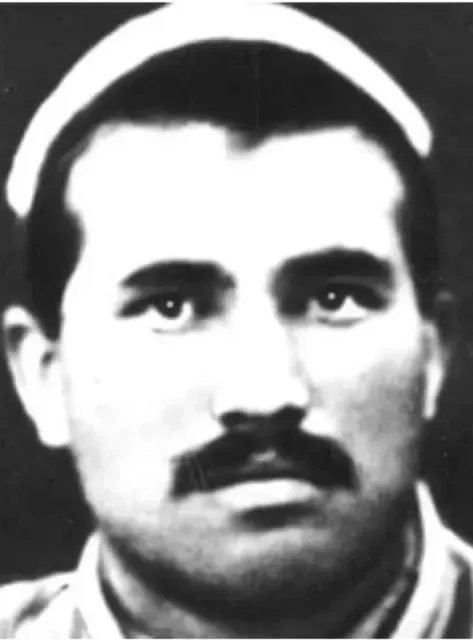
Rafiq Mumin
Uzbek poet, playwright and teacher, author of the poem “Qapchigay” and a pupil of Cho‘lpon. Arrested in 1937, he returned in 1947 and died in 1951.
- Occupation:
- Writer, Educator, Poet, Playwright
- Born:
- February 7 1900(51 years old) ♒ — May 5, 1951
- Birthplace:
- Namangan
Biography
Rafiq Mumin (born Mominov) was born in 1900 in the Namangan area, then part of the Fergana Oblast of the Russian Empire. Some sources name the village of Qarqonquloq as his birthplace, others the city of Namangan. His father was a shoemaker. The boy studied at the Jadid schools “Namuna” and “Irfon” and finished his schooling by 1916.
From 1917 he taught at the “Irfon” school, and after the revolution he completed teachers’ courses and worked in schools. In 1918 he worked for the newspaper “Farg‘ona nidosi” and later published in “Yangi Farg‘ona”. Meeting Cho‘lpon in 1920 was important in his growth as a poet; Mumin regarded him as his teacher. He signed his poems with the pen names Mashrab, Rafiq and Hulkar. As an educator at a children’s home in Namangan he paid special attention to orphans and, according to biographical accounts, brought about the opening of four new schools in the city in 1925–1927.
In 1923 Mumin organized a research expedition to the Fergana Valley and recorded from the bard Yormat the epic “Zevak” and other works of folk literature. In the early 1920s, with Og‘uzxon (H. Yo‘ldoshqoriyev), he wrote the dramas “Yosh qurbonlar” (“Young Victims”), “Yoriltosh” and “Gulyor”, staged by amateur companies, and published the poem “Bolaxo‘r”. His poem “Qapchigay”, printed in the journal “Inqilob” in 1924, became a notable work of Uzbek poetry of the 1920s. His verse appeared in “Farg‘ona nidosi”, “Yangi Farg‘ona”, “Zarafshon” and the satirical journal “Mashrab”, to which Aini, Hamid Olimjon and others also contributed.
Contemporaries valued both his lyrics and his satire: poems about spring and blossom stand beside sharp lines against idleness and bribery. In 1929–1930 he wrote “Tiyonshon cho‘poni” (“The Shepherd of the Tian Shan”), published in 1937.
On 25 May 1937 Mumin was arrested, accused of nationalism, and sentenced to ten years. He returned home in 1947, but a serious illness contracted during his sentence did not leave him: Rafiq Mumin died on 5 May 1951.
In 1998, in the years of independence, his poems and dastans were collected and published in a separate volume titled “Qapchigay”.
Life path
- 1900Birth
Born in the Namangan area into a shoemaker’s family.
- until 1916Jadid schools
Studied at the “Namuna” and “Irfon” schools.
- 1917Teacher at the “Irfon” school
Began teaching and later completed teachers’ courses.
- 1918Newspaper “Farg‘ona nidosi”
Worked for the newspaper published by H. Makeyev.
- 1920Meeting Cho‘lpon
Came to regard Cho‘lpon as his teacher in poetry.
- 1923Folklore expedition
Recorded the epic “Zevak” from the bard Yormat in the Fergana Valley.
- 1924Poem “Qapchigay”
Published in the journal “Inqilob”.
- 1937Arrest
Arrested on 25 May, accused of nationalism and sentenced to ten years.
- 1947Return home
Came back in the summer, seriously ill.
- 1951Death
Died on 5 May.
- 1998Collection “Qapchigay”
His poems and dastans were published as a separate book.
Works
- “Qapchigay” (1924)Poem
Printed in the journal “Inqilob”; a notable work of Uzbek poetry of the 1920s.
- “Bolaxo‘r”Poem
A poem published in the early 1920s.
- “Yosh qurbonlar” (“Young Victims”)Drama
Written with Og‘uzxon (H. Yo‘ldoshqoriyev) and staged by amateur companies.
- “Yoriltosh”Drama
A drama written together with Og‘uzxon.
- “Gulyor”Drama
A drama written together with Og‘uzxon.
- “Tiyonshon cho‘poni” (“The Shepherd of the Tian Shan”) (1937)Poetic work
Written in 1929–1930 and published in 1937.
- “Qapchigay” (collection) (1998)Collection of poems and dastans
A collection of his poems and dastans published in the years of independence.