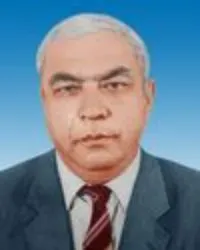
Mathematician and public figure, academician of the Academy of Sciences of Uzbekistan and rector of Tashkent State University, a leader of the Tashkent school of probability theory and mathematical statistics.
Biography
Sa‘di Hasanovich Sirojiddinov (in Russian spelling Sirazhdinov) was a mathematician and public figure, an academician of the Academy of Sciences of Uzbekistan and one of the leaders of the Tashkent school of mathematics. Born in Kokand on 10 May 1920, he finished Central Asian State University in 1942 and received his doctorate in physical and mathematical sciences in 1953. He was a senior researcher at Moscow University in 1953–1956, then a professor at Central Asian University from 1956 and head of a department from 1958.
Later he directed the Institute of Mathematics of the Uzbek Academy of Sciences (1957–1967), was rector of Tashkent State University (1966–1970 and again 1983–1987) and vice-president of the Academy (1970–1983). He was elected an academician in 1966 and given the title Honoured Scientist of Uzbekistan in 1971.
His early scientific papers examined significant properties of classical polynomials in several variables. His studies of generalised limit theorems for Markov chains and of asymptotic expansions carried the Tashkent mathematical school to a higher level in the 1950s. He used results from probability theory in mathematical statistics. In the 1960s, together with his students, he settled important questions concerning limit theorems for sums of independent random variables and of variables that form a Markov chain. He additionally worked widely on queueing theory, several branches of statistics and the theory of stationary processes.
The scholar contributed much to research on the scientific heritage of Central Asian thinkers, to the education of highly qualified mathematicians, to the creation of a school for young mathematicians and to the running of the republican olympiad for young mathematicians. From 1966 he was a full member of the Bernoulli Society for Mathematical Statistics and Probability (Netherlands).
In 1973 he won the Beruniy State Prize of Uzbekistan, and in 2002 he was posthumously given the Order “Buyuk xizmatlari uchun”. He died in Tashkent on 29 April 1988. An academic lyceum attached to the National University of Uzbekistan and a Tashkent street are named after him.
Education
Career
- Academy of Sciences of the Uzbek SSRDirector of the Institute of Mathematics (1957–1967), vice-president (1970–1983) · Tashkent · 1957–1983now Academy of Sciences of Uzbekistan
- First Central Asian State UniversityProfessor, head of department, rector (1966–1970, 1983–1987) · Tashkent · 1956–1987now National University of Uzbekistan
Awards
 Order «For Outstanding Merit»2002, posthumously · Uzbekistan
- Honoured Science Worker of the Uzbek SSR1971 · Uzbek SSR
 Beruni State Prize of the Uzbek SSR1973 · Uzbek SSR
Life path
- 1920Born on 10 May in Kokand
- 1942Graduated from Central Asian State University
- 1953Doctor of Physical and Mathematical Sciences
- 1956Professor at Central Asian University
- 1957–1967Director of the Institute of Mathematics of the Academy of Sciences
- 1966Academician; rector of Tashkent State University (1966–1970)
- 1970–1983Vice-president of the Academy of Sciences of Uzbekistan
- 1983–1987Rector of Tashkent State University (second term)
- 1988Died in Tashkent on 29 April
Works
- Limit theorems for Markov processes (1955)Monograph
- “Theory of Functions of a Complex Variable” (co-authored) (1970)Textbook
- “Additive problems with a growing number of summands” (co-authored) (1975)Monograph