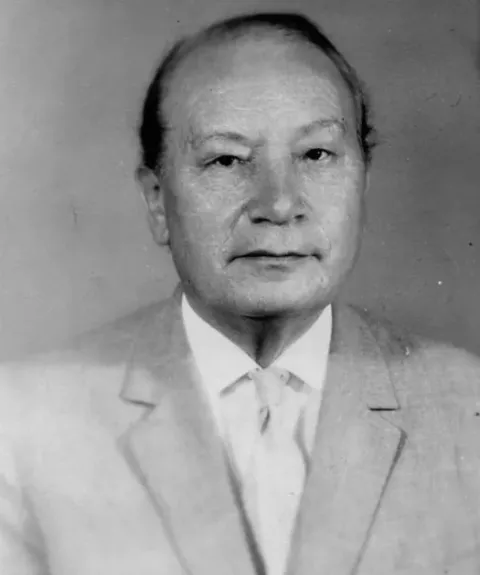
Sergey Borodin
Russian Soviet novelist, author of the historical novels “Dmitry Donskoy” and “Stars over Samarkand”; lived in Tashkent, People's Writer of the Uzbek SSR.
- Occupation:
- Writer, Prose writer
- Stage name:
- Amir Sargidzhan
- Born:
- September 25 1902(71 years old) ♎ — June 22, 1974
- Spouse:
- Rauza Hasanova
Biography
Sergey Petrovich Borodin was born on 25 September 1902 (12 September in the old style) in Moscow, into an intellectual family: his father was a hereditary nobleman and his mother came from a Tatar princely line. From 1913 to 1920 he studied at the real school in Belev, took part in the local Proletkult studio and learned painting from T. I. Katurkin. He published his first essay in 1915, at the age of twelve.
In 1923 the Central Museum of Ethnography sent him to Bukhara to collect ethnographic material, and in 1925–1926 he lived in Samarkand. He was admitted to the All-Russian Union of Writers in 1925 and in 1926 graduated from the Bryusov Higher Institute of Literature and Art, specialising in Russian folklore. Journeys followed to the Far East (1928), the building of the Turksib railway (1929), Tajikistan (1931) and Armenia (1933); in 1933 he walked across the Pamirs. Until 1931 he was close to the literary group Pereval.
He first wrote as Amir Sargidzhan: friends in Central Asia had added the Eastern affectionate suffix “-jan” to Sergey, and the half-joking “Amir” stuck as a pen name. Under it appeared the novel “The Last Bukhara” and the story collection “The Master of Birds”, about the peoples of Central Asia. From 1941 he published under his own name; the historical novel “Dmitry Donskoy”, written in Staraya Russa, brought him the Stalin Prize, second class, for 1941 (awarded in 1942).
In the early 1950s he moved to Tashkent, where he lived for the rest of his life and married the philologist Rauza Hasanova. There he wrote the cycle “Stars over Samarkand” — “Lame Timur”, “Campfires of the March” and “Lightning Bayezid” — a picture of Central Asia and Transcaucasia in the age of Tamerlane. The fourth book, “The White Horse”, remained unfinished apart from a few chapters. The National Encyclopedia of Uzbekistan notes that these novels portray some historical figures one-sidedly.
Borodin received the Hamza State Prize of the Uzbek SSR in 1968 and the title People's Writer of the Uzbek SSR in 1973. He died in Tashkent on 22 June 1974 and was buried in the Chigatay cemetery. Between 1941 and 1994 “Dmitry Donskoy” went through about twenty-five editions with a total print run of over a million copies; the writer's house-museum in Tashkent opened in 1981.
Education
- Bryusov Higher Institute of Literature and ArtUniversity · 1926 · Russian folklore
Awards
- People's Writer of the Uzbek SSR1973 · Uzbek SSR
 Hamza State Prize of the Uzbek SSR1968 · Uzbek SSR


 Stalin Prize1942 · USSR
Life path
- 1902Born
Born in Moscow into an intellectual family.
- 1913–1920Schooling in Belev
Studied at the real school and took part in the local Proletkult studio.
- 1923–1926Expeditions to Bukhara and Samarkand
Went to Bukhara to collect ethnographic material, then lived in Samarkand.
- 1926Graduated from the Bryusov Institute
Finished the Higher Institute of Literature and Art, specialising in Russian folklore.
- 1928–1933Journeys across the country
The Far East, the Turksib railway, Tajikistan, the Pamirs and Armenia; edited the newspaper Udarnik on the Turksib.
- 1941“Dmitry Donskoy”
Published his first historical novel under his own name (before that he wrote as Amir Sargidzhan).
- 1942Stalin Prize
Received the Stalin Prize, second class, for “Dmitry Donskoy”.
- Early 1950sMove to Tashkent
Settled in Tashkent and began work on the cycle “Stars over Samarkand”.
- 1968Hamza Prize
Became a laureate of the Hamza State Prize of the Uzbek SSR.
- 1973People's Writer of the Uzbek SSR
Awarded the title People's Writer of the Uzbek SSR.
- 1974Died
Died in Tashkent on 22 June and was buried in the Chigatay cemetery.
Works
- “The Last Bukhara” (1932)Novel
A novel about life in Bukhara, published under the pen name Amir Sargidzhan.
- “The Master of Birds” (1934)Story collection
Stories about the lives of the peoples of Central Asia.
- “Dmitry Donskoy” (1941)Historical novel
A novel about the Russian lands' struggle against the Golden Horde; Stalin Prize winner and his most reprinted book.
- “Utrenka” (1942)Work
A work published in 1942.
- “Lame Timur” (1955)Historical novel
The first book of the cycle “Stars over Samarkand”.
- “Campfires of the March” (1962)Historical novel
The second book of the cycle “Stars over Samarkand”.
- “Lightning Bayezid” (1973)Historical novel
The third book of the cycle “Stars over Samarkand”.