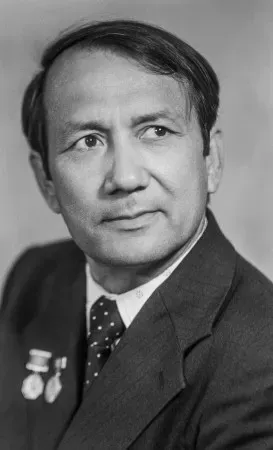
Tolepbergen Qayipbergenov
Karakalpak writer, author of the novel “Daughter of the Karakalpak” and the trilogy “The Karakalpak Dastan”, long-time head of the Karakalpakstan Writers’ Union and Hero of Uzbekistan.
- Occupation:
- Writer, Prose writer
- Born:
- May 7 1929(81 years old) ♉ — September 14, 2010
- Birthplace:
- Kegeyli District, Karakalpakstan
Biography
Tolepbergen Qayipbergenov was born on 7 May 1929 in the village of Shortanbay in the Kegeyli district of Karakalpakstan, into a peasant family. He graduated from the Khojeyli teacher-training school in 1947 and taught in his home village, then in 1955 finished the Russian language and literature faculty of the Karakalpak State Pedagogical Institute.
After the institute he worked on the literary magazine “Amudarya” and at Karakalpak radio, then served as executive secretary of the writers’ society, deputy head of the radio committee, editor of the newspaper “Jas Leninshi” and director of the Karakalpak state publishing house. From 1967 to 1980 he held senior posts in the State Committee for Press, Printing and the Book Trade under the Council of Ministers of the Karakalpak ASSR.
He came to literature through poetry: his first poem, “Tilegim”, appeared in “Jas Leninshi” in 1951, and his first novella, “The Secretary”, followed in 1956. After that he wrote mostly prose, including the novellas “Thank You, Teacher”, “The Ice Drop” and “Sleepless Nights” and the two-book novel “Daughter of the Karakalpak” (1963–1965), on which Uzbekfilm based the 1981 film “Unconquered”. He received the Karakalpak ASSR’s Berdaq State Prize in 1967 and the Uzbek SSR’s Hamza State Prize in 1971 for “Thank You, Teacher”.
His trilogy “The Karakalpak Dastan” (“The Legend of Mamanbiy”, “The Unfortunate”, “The Lost Ones”), set in the 17th–18th-century history of the Karakalpaks, won the USSR State Prize in 1986. Later books turned to the Aral Sea disaster, ecology and the kinship of Turkic peoples; the novel-essay “Karakalpaknama” earned him the international Mahmud Kashgari Prize in 1995, and the book “Letters to Grandfather in the Other World” the international Mikhail Sholokhov Prize in 2004. About a hundred of his books were published in Karakalpak, Uzbek, Russian, Turkish and other languages.
In 1980 he was elected chairman of the Karakalpakstan Writers’ Union and led it until his death; the same year he became deputy chairman of the Writers’ Union of Uzbekistan. He was deputy chairman of the Supreme Council of Karakalpakstan from 1987, a People’s Deputy of the USSR in 1989–1991, and from 1995 chairman of the board of the Assembly of Cultures of the Peoples of Central Asia Foundation; he was repeatedly elected to the Jokargy Kenes and the Nukus city council.
He was named People’s Writer of the Karakalpak ASSR in 1974 and People’s Writer of Uzbekistan in 1993, and became Hero of Uzbekistan in 2003. He also held the Order of the Badge of Honour, the Order of Friendship (Do‘stlik), the Order El-yurt Hurmati and the Shuhrat Medal, and was an honorary citizen of Naberezhnye Chelny (Russia) and Kyzylorda (Kazakhstan). He died on 14 September 2010.
Education
- Khojeyli Teacher-Training SchoolCollege · Xo'jayli District · 1945–1947
- Karakalpak State Pedagogical InstituteUniversity · Nukus · 1955 · Faculty of Russian Language and Literature
Career
- Writers' Union of UzbekistanDeputy chairman · Tashkent · 1980–…
- Amudarya magazineLiterary staff member · Nukus · 1955–1957
- Jas Leninshi newspaperEditor · Nukus · 1959–1960
Awards
 Hero of Uzbekistan2003 · Uzbekistan
 People's Writer of Uzbekistan1993 · Uzbekistan
 Order «El-yurt hurmati»1999 · Uzbekistan
 Order «Do'stlik» (Friendship)1994 · Uzbekistan
 Medal «Shuhrat» (Glory)Uzbekistan
 Hamza State Prize of the Uzbek SSR1971 · Uzbek SSR
 Order of the Badge of Honour1979 · USSR
 USSR State Prize1986 · USSR
Life path
- 1947–1950Teacher-training school and teaching in his home village
Graduated from the Khojeyli teacher-training school and taught at a school in his home village.
- 1955–1957“Amudarya” magazine and Karakalpak radio
After graduating he worked on the literary magazine and as a radio editor.
- 1956First novella “The Secretary”
Having begun with verse in 1951, he turned to prose.
- 1957–1962Writers’ society, radio, newspaper, publishing
Served as executive secretary of the writers’ society, deputy radio head, editor of “Jas Leninshi” and director of the state publishing house.
- 1963–1965Novel “Daughter of the Karakalpak”
A two-book novel about the fate of a Karakalpak woman in the 20th century.
- 1967–1980Senior posts in the press committee
Worked in the State Committee for Press, Printing and the Book Trade of the Karakalpak ASSR.
- 1980Chairman of the Karakalpakstan Writers’ Union
Elected on a competitive basis to succeed Ibroyim Yusupov and led the union until his death.
- 1986USSR State Prize
Awarded for the trilogy “The Karakalpak Dastan”.
- 1989–1991People’s Deputy of the USSR
Member of the Soviet of Nationalities of the USSR Supreme Soviet.
- 1993People’s Writer of Uzbekistan
Republic-level title conferred (in 1974 he had become People’s Writer of the Karakalpak ASSR).
- 2003Hero of Uzbekistan
Awarded the highest title of the Republic of Uzbekistan.
- 2010Death
Died on 14 September 2010.
Books
- “The Secretary”1956 · Novella
His first novella, with which he turned to prose.
- “Thank You, Teacher”1958 · Novella
Won the Hamza State Prize in 1971.
- “The Ice Drop”1964 · Novella
One of his mid-1960s novellas.
- “Sleepless Nights”1965 · Novella
One of his mid-1960s novellas.
- “Daughter of the Karakalpak”1963 · Novel
A two-book novel (1963–1965); awarded the Berdaq State Prize in 1967 and filmed in 1981.
- “The Legend of Mamanbiy”· Novel
First book of the trilogy “The Karakalpak Dastan”.
- “The Unfortunate”· Novel
Second book of the trilogy.
- “The Lost Ones”· Novel
Third book of the trilogy, which won the USSR State Prize in 1986.
- “Karakalpaknama”1978 · Novel-essay
Won the international Mahmud Kashgari Prize in 1995.
- “Letters to Grandfather in the Other World”· Novel-essay
Won the international Mikhail Sholokhov Prize in 2004; deals with the Aral disaster and ecology.
- “I Am a Karakalpak, I Take Risks”2003 · Book
One of his later books.
- “Berdaq” (“The Nightingale of the Desert”)· Play
A play about the poet Berdaq, staged in Uzbek, Kazakh, Russian and Karakalpak.