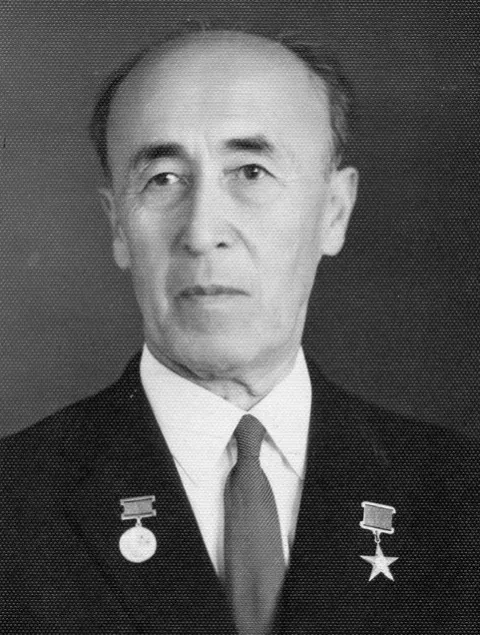
Toshmuhammad Qori-Niyoziy
Uzbek Soviet mathematician and historian of science, first president of the Academy of Sciences of the Uzbek SSR (1943–1947), Hero of Socialist Labour (1967).
- Occupation:
- Scientist, Politician, Educator, Mathematician
- Born:
- September 2 1897(72 years old) ♍ — March 17, 1970
- Spouse:
- Oysha xonim Urazayeva
Biography
Toshmuhammad Niyozovich Qori-Niyoziy was born on 2 September 1897 (21 August in the Old Style calendar) in Khujand, into a shoemaker's family; some sources give 1896 as the year. He first went to a traditional maktab but attended for less than a year. After the family moved to Skobelev (now Fergana), he studied at a Russian-native school and finished it around 1916 with excellent marks.
He began as a teacher: in 1917 he set up a school with Uzbek as the language of instruction in the Fergana Valley. From 1920 to 1925 he directed the pedagogical technical school in Kokand, whose first graduating class in 1924 numbered thirteen. While still a student at Central Asian State University in Tashkent he taught higher mathematics in Uzbek there, and he graduated from its physics and mathematics faculty in 1929 (1930 in some sources).
In 1931 he became the first Uzbek to hold the title of professor, and from 1931 to 1933 he served as rector of the same university. He received his doctorate in physical and mathematical sciences in 1939. From 1937 to 1940 he chaired the Committee of Sciences under the Council of People's Commissars of the Uzbek SSR, from 1940 he headed the Uzbek branch of the USSR Academy of Sciences, and from 1939 to 1943 he was the republic's deputy head of government for science, culture and the arts. In 1939–1943 he also led the preparation of the new Uzbek alphabet based on Cyrillic.
In June 1941 he chaired the government expedition that opened the tombs of Timur and the Timurids in the Gur-i Amir mausoleum in Samarkand; its members included the anthropologist Mikhail Gerasimov, Lev Oshanin and the orientalist Aleksandr Semyonov. From 1941 to 1950 he was a deputy of the USSR Supreme Soviet in its first two convocations. Elected an academician in 1943, he became the first president of the Academy of Sciences of the Uzbek SSR and held the post until 1947.
From 1946 he headed the department of higher mathematics at the Tashkent Institute of Irrigation Engineers and Agricultural Mechanization. He developed Uzbek mathematical terminology, wrote the first Uzbek-language mathematics textbooks for universities and schools, and authored several hundred works on the history of science. His monograph “Ulugh Beg's Astronomical School”, based on nearly ten years of work with manuscript sources, appeared in Russian in Moscow in 1950 and won a Stalin Prize in 1952. He was editor-in-chief of the journal Fan va turmush, a member of the International Astronomical Union from 1954 and a corresponding member of the International Academy of the History of Science from 1967, and he travelled to Japan, India, Italy, Bulgaria, Afghanistan and other countries.
He was named Hero of Socialist Labour on 1 September 1967, received three Orders of Lenin and three Orders of the Red Banner of Labour, and had been Honoured Science Worker of the Uzbek SSR since 1939. Toshmuhammad Qori-Niyoziy died in Tashkent on 17 March 1970 and was buried in the Chigatoy cemetery. The Beruni State Prize of the Uzbek SSR was awarded to him posthumously that year, and the Order «Buyuk xizmatlari uchun» in 2002.
Education
- Central Asian State UniversityUniversity · Tashkent · 1929 · Faculty of Physics and Mathematics
Career
- Academy of Sciences of UzbekistanAcademician, first president · Tashkent · 1943–1947Everyone who held this post →
- Supreme Soviet of the USSRDeputy of the 1st and 2nd convocations · 1941–1950
- Council of People’s Commissars of the Uzbek SSRDeputy chairman for science, culture and the arts · 1939–1943
- Committee of Sciences under the Council of People's Commissars of the Uzbek SSRChairman · Tashkent · 1937–1940Everyone who held this post →
- Tashkent Institute of Irrigation and Agricultural Mechanization EngineersHead of the department of higher mathematics · Tashkent · 1946–…
Awards
 Order «For Outstanding Merit»2002, posthumously · Uzbekistan
- Honoured Science Worker of the Uzbek SSR1939 · Uzbek SSR
 Beruni State Prize of the Uzbek SSR1970, posthumously · Uzbek SSR
 Hero of Socialist Labour1967 · USSR
 Order of Lenin1944 · USSR
- Order of Lenin1965 · USSR
- Order of Lenin1967 · USSR
 Order of the Red Banner of Labour1946 · USSR
- Order of the Red Banner of Labour1950 · USSR
- Order of the Red Banner of Labour1953 · USSR
 Stalin Prize1952 · USSR
Life path
- 1917School in the Fergana Valley
Founded a school taught in Uzbek.
- 1920–1925Pedagogical technical school in Kokand
Directed the school; its first graduating class in 1924 had thirteen students.
- 1929Central Asian State University
Graduated from the physics and mathematics faculty (1930 in some sources).
- 1931–1933Rector of the university
In 1931 he became the first Uzbek to be named professor.
- 1937–1940Chairman of the Committee of Sciences
Headed the Committee of Sciences under the Council of People's Commissars of the Uzbek SSR.
- 1939–1943Deputy head of government
Deputy for science, culture and the arts; led the preparation of the new Uzbek alphabet based on Cyrillic.
- 1940Uzbek branch of the USSR Academy of Sciences
Became head of the branch's presidium.
- 1941Gur-i Amir expedition
Chaired the government expedition that opened the tombs of Timur and the Timurids in the Samarkand mausoleum.
- 1943–1947First president of the Academy of Sciences
Elected academician in 1943; headed the Academy of Sciences of the Uzbek SSR.
- 1946Tashkent engineering institute
Headed the department of higher mathematics at the institute of irrigation and agricultural mechanization engineers.
- 1967Hero of Socialist Labour
Title conferred on 1 September; also elected a corresponding member of the International Academy of the History of Science that year.
- 1970Death
Died on 17 March in Tashkent and was buried in the Chigatoy cemetery.
Works
- “Basic Course of Mathematical Analysis” (1937)Textbook
One of the first higher-mathematics courses in Uzbek.
- “Foundations of Analytic Geometry” (1937)Textbook
A university textbook in Uzbek.
- “Ulugh Beg's Astronomical School” (1950)Monograph
Based on the works of Ulugh Beg and other scholars of the 15th–17th centuries; awarded a Stalin Prize in 1952.
- “Essays on the History of the Culture of Soviet Uzbekistan” (1955)Essays
One of his main works on the history of culture and education in Uzbekistan.
- “Reflections on the Path Travelled” (1970)Memoir
A memoir looking back over his life.