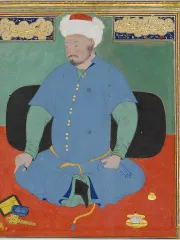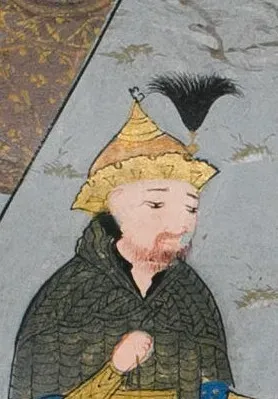
Ubaydullah Khan
Shaybanid khan of Bukhara (1533–1539), nephew of Muhammad Shaybani; wrote poetry in three languages as Ubaydi and built the Mir-i Arab madrasa in Bukhara.
- Occupation:
- Historical figure, Politician, Writer, Ruler, Poet
- Nickname:
- Ubaidi
- Lived:
- c. 1486 — c. 1539
- Father:
- Mahmud Sultan
- Children:
Biography
Ubaydullah Khan (Ubaydulla Sultan, pen name Ubaydi) was a Shaybanid khan of Bukhara who ruled from 1533/1534 until 1539. A nephew of Muhammad Shaybani and son of Mahmud Sultan, he bore the full name Abu'l-Ghazi Ubaydullah Bahadur Khan ibn Mahmud Sultan. Statesman and commander, he was also a poet writing in Uzbek, Persian and Arabic. He was born in 1486–1487 at Tirsak in Khwarazm.
At his father's request he was given the name by Khwaja Ubaydullah Ahrar. His first Sufi lessons came from Mawlana Muhammad Qazi, his father's spiritual guide, and his teachers also included the scholars Fazlullah ibn Ruzbihan and Makhdumi A'zam. The emir Abdullah Yamani, known in Bukhara as Mir Arab, taught him the military arts. After his father died at Kunduz in 1504, Urus Beg Durman was appointed his atalik. Ubaydullah took part in his uncle's campaigns against Khwarazm (1505), Balkh (1506), Herat and Mashhad (1507).
After Shaybani's death in 1510 he governed Bukhara (since 1504) and acted as chief deputy of Kuchkunji Khan, leading the resistance to the Safavids. Beaten in 1511 and forced back to Turkestan, he won the battle of Kul-i Malik on 28 April 1512 and recovered Bukhara and Samarkand. When Babur and the Safavid army seized Qarshi and Ghuzar that autumn, the force under Ubaydullah prevailed at Ghijduvan (November). In 1513 he marched into Khorasan, took Merv and won Khwarazm, installing his son Abdulaziz as governor. He fought Shah Tahmasp and led several campaigns in Khorasan; he lost at Jam in 1528, and Herat was captured in 1529.
After Abu Sa'id died in 1533 Ubaydullah, as the eldest of the Shaybanid sultans, took the khan's throne, the capital moved from Samarkand to Bukhara, and the state became known as the Khanate of Bukhara. Under him Bukhara grew stronger as a political, economic and cultural centre: the Mir-i Arab madrasa (1535–1536), the Mirak Sa'id Ghiyas garden, the Mehtar Qasim bridge over the Zarafshan (Kuhak) and other buildings were raised. During his 1538 campaign against Khwarazm he killed its ruler Avanish, but Din Muhammad soon drove him out.
Ubaydullah followed the Yasawi and Naqshbandi orders and trained disciples. Under the pen names Ubaydi, Qul Ubaydi and Ubaydullah he wrote verse in three languages; his Turkic divan holds 310 ghazals, 430 quatrains, 11 tuyuqs and other forms, and a Persian divan also survives. Continuing the hikmat tradition of Ahmad Yasawi, he composed over 220 hikmats, and the poems Omonatnoma, Shavqnoma, G'ayratnoma and Sabrnoma are credited to him. His collected works were copied in 1583 by Mir Husayn al-Husayni; the only copy is kept at the Institute of Oriental Studies of the Uzbek Academy of Sciences.
Ubaydullah Khan died in Bukhara in 1539 or 1540 (some sources give 17 March 1540) and was buried in the city, in the Shaybanid mausoleum. Abdullah I succeeded him.
Career
- Khanate of BukharaKhan of Bukhara · Bukhara · 1533–1539
Life path
- 1486–1487Birth
Born at Tirsak in Khwarazm to Mahmud Sultan.
- 1504Governor of Bukhara
Took over Bukhara after his father died at Kunduz.
- 1505–1507Shaybani's campaigns
Took part in the campaigns on Khwarazm, Balkh, Herat and Mashhad.
- 1512Battle of Kul-i Malik
Won on 28 April, regaining Bukhara and Samarkand; victory at Ghijduvan in November.
- 1513Merv and Khwarazm
Merv taken; his son Abdulaziz made governor of Khwarazm.
- 1528–1529Jam and Herat
Lost to the Safavids at Jam; Herat captured in 1529.
- 1533Became khan
Became khan after Abu Sa'id's death; the capital moved to Bukhara.
- 1535–1536Mir-i Arab madrasa
The Mir-i Arab madrasa was built in Bukhara.
- 1538Khwarazm campaign
Avanish was killed, but Din Muhammad drove him out.
- 1539–1540Death
Died in Bukhara and was buried in the Shaybanid mausoleum.