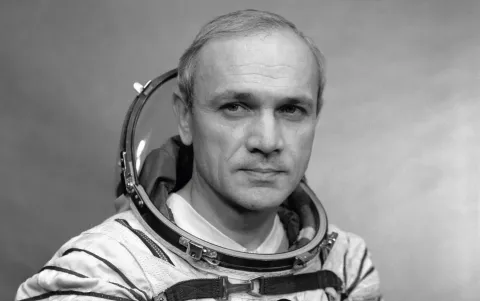
Vladimir Dzhanibekov
Soviet pilot-cosmonaut and major general of aviation: flew five space missions, commanding the ship on each, and twice Hero of the Soviet Union.
- Occupation:
- Cosmonaut, Military officer
- Born:
- May 13 1942(84 years old) ♉
- Birthplace:
- Bo'stonliq District, Tashkent Region
Biography
Vladimir Dzhanibekov was born on 13 May 1942 in the settlement of Iskandar (now an urban-type settlement in the Bostanliq district of the Tashkent region). He was born with the surname Krysin and later, after marrying, took the surname of his wife’s family, Dzhanibekov. He grew up and studied in Tashkent, graduating from the Tashkent Suvorov school in 1960.
He entered the physics faculty of Leningrad State University, but after a year transferred to the Yeysk Higher Military Aviation School of Pilots, from which he graduated in 1965. He then served as a flight instructor in the Air Force. From 1970 he was a member of the cosmonaut detachment, training at the Gagarin Cosmonaut Training Center.
His first spaceflight took place on 10–16 January 1978 aboard Soyuz 27 with flight engineer Oleg Makarov: the ship docked with the Salyut 6 station, creating the first orbital complex with two docked spacecraft. The crew came back on Soyuz 26. By a decree of the Presidium of the Supreme Soviet of the USSR of 16 March 1978 he was made a Hero of the Soviet Union.
On 22–30 March 1981 he made his second flight, aboard Soyuz 39 with the Mongolian cosmonaut Jügderdemidiin Gürragchaa under the Intercosmos programme, and by a decree of 30 March he became a Hero of the Soviet Union for the second time. On 24 June – 2 July 1982 he commanded the Soviet-French crew of Soyuz T-6 (Alexander Ivanchenkov and the Frenchman Jean-Loup Chrétien). On 17–29 July 1984 he flew on Soyuz T-12 with Svetlana Savitskaya and Igor Volk, and on 25 July he made a spacewalk with Savitskaya.
His fifth flight, the Soyuz T-13 expedition of 6 June – 26 September 1985, was the most difficult: with Viktor Savinykh he manually docked with the uncontrolled Salyut 7 station, and the crew restored it to working order; on 2 August they went out into open space and installed additional solar panels. Dzhanibekov returned to Earth with Georgy Grechko aboard Soyuz T-13. On the 1985 flight he observed the unstable rotation of a spinning wing nut, which later became known as the “Dzhanibekov effect”. He was the commander in all five flights and spent more than 145 days in space in total.
On 27 September 1985 he was promoted to major general of aviation. In 1985–1988 he commanded the cosmonaut detachment, and from 1988 he headed the Directorate of Theoretical and Research Training at the Cosmonaut Training Center; in 1985–1990 he was a deputy of the Supreme Soviet of the Uzbek SSR. In the early 1990s he took part in attempts at a non-stop round-the-world balloon flight. Since 1997 he has been a professor-consultant at Tomsk State University, which made him an honorary doctor in 2011. He paints and was a member of the Union of Artists of the USSR. A bust of him was erected in Tashkent in 1984, minor planet 3170 is named after him, and in 2022 he received Uzbekistan’s Order of “Do‘stlik”.
Education
- Leningrad State UniversityUniversity · 1960–1961
- Yeysk Higher Military Aviation School of PilotsUniversity · 1961–1965 · Pilot
- Tashkent Suvorov Military SchoolSchool · Tashkent · 1960
Career
- Supreme Soviet of the Uzbek SSRDeputy (11th convocation) · Tashkent · 1985–1990
- Communist Party of the Soviet UnionMember · 1970–1991
- Yuri Gagarin Cosmonaut Training CenterCosmonaut; commander of the cosmonaut detachment in 1985–1988, head of a directorate from 1988 · 1970–1997
Awards
 Order «Do'stlik» (Friendship)2022 · Uzbekistan
 Hero of the Soviet Union1978 · USSR
- Hero of the Soviet Union1981 · USSR
 Order of Lenin1978 · USSR
- Order of Lenin1981 · USSR
- Order of Lenin1982 · USSR
- Order of Lenin1984 · USSR
- Order of Lenin1985 · USSR
 Order of the Red Star1976 · USSR
 Order of Friendship (Russia)1996 · Russia
Life path
- 1942Birth
Born in the settlement of Iskandar (now the Bostanliq district of the Tashkent region).
- 1960Finished Suvorov school
Graduated from the Tashkent Suvorov school and entered the physics faculty of Leningrad University.
- 1961–1965Yeysk pilots’ school
Studied at the Yeysk Higher Military Aviation School of Pilots, graduated and became a flight instructor.
- 1970Joined the cosmonaut detachment
Began training for spaceflight.
- 1978Soyuz 27 and the first Hero title
Flew to the Salyut 6 station on 10–16 January; made a Hero of the Soviet Union on 16 March.
- 1981Soyuz 39 and the second Gold Star
Flew on 22–30 March with a Mongolian cosmonaut under Intercosmos; made a Hero for the second time on 30 March.
- 1982Soyuz T-6
Commanded the Soviet-French crew flying to Salyut 7.
- 1984Soyuz T-12
Commanded the expedition during which he made a spacewalk with Svetlana Savitskaya.
- 1985Soyuz T-13 and the rescue of Salyut 7
Manually docked with the uncontrolled station and restored it to work; promoted to major general of aviation.
- 1985–1990Deputy of the Supreme Soviet
Served as a deputy of the Supreme Soviet of the Uzbek SSR.
- 1988Head of directorate
Became head of the Directorate of Theoretical and Research Training at the Cosmonaut Training Center.
- 2022Order of “Do‘stlik”
Awarded Uzbekistan’s Order of “Do‘stlik”.