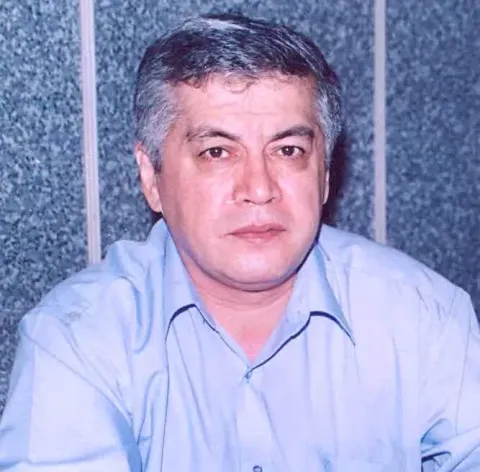
Khurshid Davron
Uzbek poet, prose writer, playwright and translator; People’s Poet of Uzbekistan (1999), author of verse collections and historical novellas.
- Occupation:
- Writer, Poet, Prose writer, Playwright
- Born:
- January 20 1952(74 years old) ♒
- Birthplace:
- Samarqand District, Samarkand
Biography
Khurshid Davron was born on 20 January 1952 in the village of Chordara in the Samarkand district of the Samarkand region, into a white-collar family. Some sources say that on his mother’s side he descends from Makhdum-i A’zam, a leading master of the Naqshbandi order.
After school he enrolled in 1969 in the evening department of the journalism faculty of Tashkent State University, working on Tashkent building sites by day. He did military service in 1971–1973, then resumed his studies and graduated in 1977. From 1974 to 1989 he worked at the Yosh Gvardiya publishing house as an editor and head of an editorial department, and from 1989 to 1991 at the Kamalak publishing house as deputy director and director.
His first poems appeared in district and regional newspapers in 1976–1977. In 1979 two collections came out, “Qadrdon quyosh” and “Shahardagi olma daraxti”, followed by “Tungi bog‘lar” (1981), “Uchib boraman qushlar bilan” (1983), “To‘marisning ko‘zlari” (1984), “Bolalikning ovozi” (1986), “Qaqnus” (1987) and “Bahordan bir kun oldin” (1997). He has been a member of the Writers’ Union of Uzbekistan since 1979.
In the 1990s he worked mainly in prose, writing the historical stories “Samarqand xayoli” (1991), “Sohibqiron nabirasi” (1995) and “Shahidlar shohi” (1998), the last about Sheikh Najmiddin Kubro. As a dramatist he wrote plays about Babur and Mirzo Ulugbek. He translated Japanese, Russian and Latvian poets into Uzbek, among them the anthologies “Dengiz yaproqlari” (1988) and “Qirq oshiq daftari” (1989). He wrote the script of the television series “Temurnoma” (1996) and of the musical spectacle “The Great Silk Road”, staged at the Odéon theatre in Paris (1997).
From 1994 to 1996 he was deputy head of the Republican “Spirituality and Enlightenment” Centre; from 1996 he held senior posts at the National Television and Radio Company of Uzbekistan, and in 1998–2005 he was chief director of the Yoshlar television channel. He was a deputy of the Oliy Majlis in 2000–2004.
He received the Order of Friendship (“Do‘stlik”) in 1997 and the title People’s Poet of Uzbekistan in 1999. His prizes include the Mahmud Kashgari International Prize (1989), the international Golden Pen (2009), Azerbaijan’s Mikayil Mushfig Prize (2013) and Turkey’s Niyazi Misri Prize (2022). His poems have been translated into more than forty languages.
Education
- National University of UzbekistanUniversity · Tashkent · 1969–1977 · Journalism (evening department)
Career
- Yosh Gvardiya publishing houseEditor, head of an editorial department · Tashkent · 1974–1989
- Writers' Union of UzbekistanMember · Tashkent · 1979–present
- Oliy Majlis of the Republic of UzbekistanDeputy · Tashkent · 2000–2004
- National Television and Radio Company of UzbekistanSenior posts; chief director of the Yoshlar channel (1998–2005) · Tashkent · 1996–…
- Republican “Spirituality and Enlightenment” CentreDeputy head · Tashkent · 1994–1996
- Kamalak publishing and printing associationDeputy director, director · Tashkent · 1989–1991
Awards
 People's Poet of Uzbekistan1999 · Uzbekistan
Life path
- 1952Birth
Born in the village of Chordara in the Samarkand district.
- 1969–1977Tashkent State University
Studied in the evening department of the journalism faculty; served in the army in 1971–1973.
- 1974–1989Yosh Gvardiya publishing house
Worked as an editor and head of an editorial department.
- 1979First books
The collections “Qadrdon quyosh” and “Shahardagi olma daraxti” appeared; joined the Writers’ Union.
- 1989–1991Kamalak publishing house
Deputy director, then director.
- 1989International prize
Received the Mahmud Kashgari International Prize.
- 1991–1998Historical prose
The stories “Samarqand xayoli”, “Sohibqiron nabirasi” and “Shahidlar shohi” were published.
- 1994–1996“Spirituality and Enlightenment” Centre
Deputy head of the republican centre.
- 1996–2005Television and radio company
Held senior posts at the National Television and Radio Company of Uzbekistan; chief director of the Yoshlar channel in 1998–2005.
- 1999People’s Poet
Given the title People’s Poet of Uzbekistan.
- 2000–2004Oliy Majlis
Deputy of the Oliy Majlis.
- 2009–2022International prizes
The Golden Pen (2009), the Mushfig Prize (2013) and the Niyazi Misri Prize (2022).
Books
- “Qadrdon quyosh” (Dear Sun)1979 · Poetry collection
The poet’s first book, published in 1979 alongside “Shahardagi olma daraxti”.
- “Tungi bog‘lar” (Gardens of the Night)1981 · Poetry collection
The poet’s third collection of verse.
- “To‘marisning ko‘zlari” (Eyes of Tomiris)1984 · Poems and a dastan
Poems, legends and a long poem about Tomiris, queen of the Massagetae.
- “Qaqnus” (Phoenix)1987 · Poems and a dastan
A collection of poems and a long poem.
- “Bahordan bir kun oldin” (A Day before Spring)1997 · Poetry collection
A book of new poems celebrating independence.
- “Samarqand xayoli” (Dreams of Samarkand)1991 · Historical stories
Historical stories and essays on the history of the Uzbek people.
- “Sohibqiron nabirasi” (Tamerlane’s Grandson)1995 · Historical stories
A collection of historical tales and stories.
- “Shahidlar shohi” (King of Martyrs)1998 · Historical novella
A novella on the life of Sheikh Najmiddin Kubro and the history of Sufism; also titled “Shayx Kubro tushlari”.
- “Alg‘ul”1995 · Historical play
A play about the life of Mirzo Ulugbek.
- “Dengiz yaproqlari” (Leaves of the Sea)1988 · Translations
An anthology of Japanese poetry in Uzbek translation.
- “Qirq oshiq daftari” (Notebook of Forty Lovers)1989 · Translations
Translations of love poems by poets of the East and the West.
Filmography
| Title | Year |
|---|---|
| Jaloliddin Xorazmshoh | 1998 |
Followers
- YouTube41,000