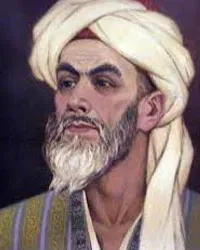
Biography
Yusuf Khass Hajib is remembered for Kutadgu Bilig ("The Knowledge That Brings Happiness"), one of the oldest long works of Turkic written literature. Little is known about the poet himself, and nearly all of it comes from the preface of this poem.
He was born in Balasagun, the northern capital of the Karakhanid state (in present-day Kyrgyzstan), hence the name al-Balasaguni. His birth year is uncertain: the ziyouz.uz article gives 1020, Wikipedia about 1019. He knew Arabic and Persian and the religious, scientific and literary writing of his age, and the poem shows familiarity with Turkic oral tradition and Sufi ideas.
He finished the poem in Kashgar in AH 462 (1069/70), at about fifty, and dedicated it to Tavghach Khan — Nasir al-Din Abu Ali Hasan Harun Khan, who headed the Karakhanids in 1075–1103. The ruler received the book warmly and gave the author the court post of khass hajib (chamberlain), which became his epithet.
Kutadgu Bilig is a masnavi of roughly 6,500 couplets built on conversations among four figures who stand for Justice (the ruler Kuntughdi), Fortune (the vizier Aytoldi), Intellect and Knowledge (the vizier's son Ogdulmish) and Contentment (the ascetic Ozghurmish). It deals with just government, the manners of rulers and nobles, and the duties of each social group. The author himself called it a "Shahnama of the Turks"; other titles are Adab al-Muluk and Ayin al-Mamlakat.
The three-part preface, the 68-chapter main body, and two qasidas with a final masnavi chapter at the end seem to come from a later revision. No other work of Yusuf survives. His death year is unknown: ziyouz.uz gives 1070, some reference works 1077.
Life path
- 1020Born in Balasagun
The year is approximate; some sources give 1019.
- 1069Finishes Kutadgu Bilig
Completed the poem in Kashgar and presented it to the Karakhanid ruler Tavghach Khan (AH 462).
- Made khass hajib
The ruler granted him the court post of chamberlain.
- 1070Death
Approximate date; some sources give 1077.
Works
- Kutadgu Bilig (1070)
A poem in masnavi form, completed in Kashgar.