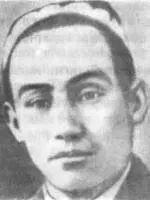
Zafar Diyor
Uzbek children’s poet and playwright, author of the collections “Songs” and “Flower Garden”, the narrative poem “The Engine Driver” and the plays “Happy Youth” and “Three Brothers”; a pioneer of the narrative poem for Uzbek children.
- Occupation:
- Writer, Poet, Playwright, Children's writer
- Born:
- 1912 — April 14, 1946
- Birthplace:
- Chust District, Namangan
Biography
Zafar Diyor was born in 1912 into a peasant family in the village of Samsoqtepa, in what is now the Chust District of Namangan Region. In 1916 the family moved to Tashkent, where his father worked in the fields and his mother at a printing house. From 1923 the boy attended an old-style school, and from 1925 he was brought up in a children’s home.
In 1927 he entered the Narimanov Pedagogical College (Sobir Mirvaliyev calls it the Narimanov Uzbek men’s college), which was later moved to Samarkand. His first poems appeared in the college’s wall newspaper, and his first poem in print was included in “Songs of Construction” (“Qurilish kuylari”), a collection by young poets. In the late 1920s and early 1930s his verse appeared regularly in the magazine “Yosh kuch” and other children’s and youth periodicals. He graduated with honours in 1933 and stayed on at the college to teach literature. That same year his first collection, “Songs” (“Qo'shiqlar”), was published.
In 1934 he returned to Tashkent and joined the children’s newspaper “Lenin uchquni” (today’s “Tong yulduzi”) as a literary staff member; in 1936–1941 he was its executive secretary. At the same time he studied at the Faculty of Language and Literature of the Tashkent State Pedagogical Institute, graduating in 1941. The narrative poem “The Engine Driver” (“Mashinist”, 1935) was one of his first well-known works; it was followed by the collections “Celebration” (1938), “Poems” (1939) and “Muborak” (1940). Scholars regard Zafar Diyor as one of the first to bring the narrative poem into Uzbek children’s literature: he wrote the poems “The Engine Driver”, “Kazbek” and “A Guest from Madrid” and the fairy-tale poems “The Eagle” and “A New Tale”.
Most of his verse was written for preschoolers and young schoolchildren: poems such as “The Butterfly”, “The Ball”, “Our Kindergarten” and “The Violet” are built of short, playful lines of five or six syllables that are easy to learn by heart. The writer Hakim Nazir, who worked with him at the newspaper, recalled that Zafar Diyor often visited schools, children’s homes and kindergartens, read his new poems to the children and watched which ones they liked best.
From 1941 until his death he worked as a literary staff member and head of department at the newspaper “Qizil O'zbekiston” (today’s “O'zbekiston ovozi”). During the war he published the collections “Our Weapon” (1941), “Our Family” (1942) and “The Gift” (1944). His poem “Give Me a Weapon Too!” echoes Hamid Olimjon’s “Take Up Arms!”, while the poems “The Little Soldier” and “Dad Will Be Home Soon” and the song “Mother’s Lullaby” (1942) describe the life and hopes of children on the home front.
Zafar Diyor also wrote for the children’s stage: his plays “Happy Youth”, “Three Brothers”, “Young Patriots” and “Omonat” deal with friendship and brotherhood among children. He wrote short stories, among them “The Shepherd’s Daughter”, and critical articles such as one on Abai’s songs, and worked as a literary translator.
Zafar Diyor died in Tashkent on 14 April 1946. After his death came “A Poem about the Little Gardener” (1947), “Flower Garden” (1948), a collection of poems, tales and narrative poems for preschool children, “The Violet” (1952), “Works” (1954), “Winged Friends” (1958) and “A Talk with Water” (1976). In 1954 N. V. Vladimirova wrote a critical and biographical study of him, and his poems are included in textbooks and readers of children’s literature.
Education
- Narimanov Pedagogical CollegeCollege · 1927–1933
- Nizami Tashkent State Pedagogical UniversityUniversity · Tashkent · 1938–1941 · Faculty of Language and Literature
Career
- Qizil O'zbekiston newspaperLiterary staff member, head of department · Tashkent · 1941–1946
- Lenin uchquni newspaperLiterary staff member, executive secretary · Tashkent · 1934–1941
Life path
- 1912Birth
Born into a peasant family in the village of Samsoqtepa, now in the Chust District of Namangan Region.
- 1916–1927Childhood in Tashkent
The family moved to Tashkent; he attended an old-style school and from 1925 was brought up in a children’s home.
- 1927–1933Pedagogical college
Studied at the Narimanov Pedagogical College; his first poems were printed in the young poets’ collection “Songs of Construction”.
- 1933“Songs”
His first poetry collection came out; he graduated from the college with honours and taught literature there.
- 1934–1941“Lenin uchquni” newspaper
Literary staff member of the children’s newspaper, executive secretary from 1936.
- 1935“The Engine Driver”
His first well-known narrative poem for children.
- 1938–1941Pedagogical institute
Studied at the Faculty of Language and Literature of the Tashkent State Pedagogical Institute.
- 1941–1946“Qizil O'zbekiston” newspaper
Literary staff member and head of department.
- 1941–1944War years
Published the collections “Our Weapon”, “Our Family” and “The Gift”.
- 1946Death
Died in Tashkent on 14 April.
- 1947–1976Posthumous editions
“A Poem about the Little Gardener”, “Flower Garden”, “Works” and “A Talk with Water” were published.
Works
- “Songs” (1933)Poetry collection
The poet’s first collection: poems about the homeland, a happy childhood and learning.
- “The Engine Driver” (1935)Narrative poem
About young Ashur, eager for knowledge and a trade; one of the poet’s first well-known works.
- “Celebration” (1938)Poetry collection
Poems of the late 1930s.
- “Poems” (1939)Poetry collection
A collection of poems for children.
- “Our Weapon” (1941)Poetry collection
A collection from the first year of the war.
- “Our Family” (1942)Poetry collection
Poems of the war years.
- “The Gift” (1944)Poetry collection
One of the last collections published in his lifetime.
- “Happy Youth”Play
A play about friendship among children.
- “Three Brothers”Play
A play about brotherly feeling among children.
- “A Poem about the Little Gardener” (1947)Narrative poem
About planting and tending a garden; published posthumously.
- “Flower Garden” (1948)Collection
Poems, tales and narrative poems for preschool children.
- “A Talk with Water” (1976)Poetry collection
Named after a poem about a boy who talks with the water in an irrigation ditch.
Legacy
Textbooks and guides to the history of Uzbek children’s literature treat Zafar Diyor as one of the leading children’s poets and playwrights to emerge in the 1930s. He wrote short, playful poems for preschoolers and was among the first to write narrative poems for children. His poems “The Butterfly”, “The Ball” and “The Violet” have been reprinted many times in collections and school readers for children.
Era: Uzbek children’s literature of the 1930s and 1940s- “A Poem about the Little Gardener” was published (1947)
- The collection for preschoolers “Flower Garden” came out (1948)
- The collection “Works” and N. V. Vladimirova’s critical and biographical study came out (1954)
- The book “A Talk with Water” was published (1976)