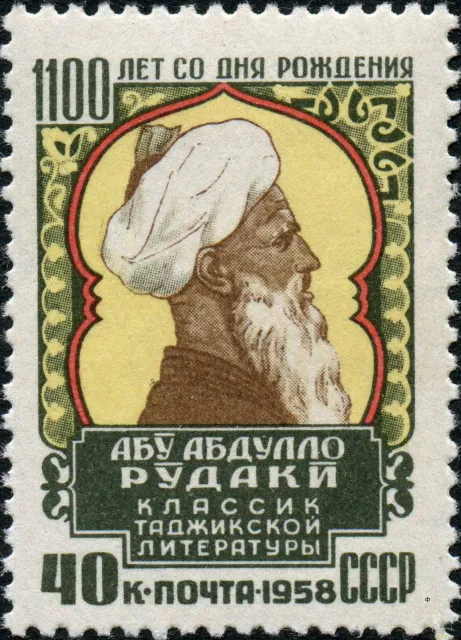
Rudaki
Poet, singer and musician at the Samanid court in Bukhara (c. 858–941), the first major poet of New Persian, whom Iran reveres as the founder of its new poetry and Tajikistan as the father of its literature.
Biography
Abu Abd Allah Ja'far ibn Muhammad Rudaki was born around 858. The twelfth-century biographer al-Sam'ani names Rudak, a district under Samarkand, as his home and adds the epithet “al-Samarqandi” to his name. In a book on the poet published in 1940, the Tajik writer Sadriddin Ayni placed his birthplace at the village of Panjrud in the upper Zarafshan valley near Panjakent, in what is now Tajikistan. Rudaki lived under the Samanids, when a literature in New Persian (Dari) was just taking shape in Transoxiana and Khorasan.
Little is known of his youth, and nearly all of it comes from the anthology compiled by Awfi in the thirteenth century. By that account, Rudaki knew the Quran by heart and was composing verse by the age of eight, and he learned to play the chang, a kind of harp, from the renowned musician Abu'l-Abak Bakhtiyar. Poet, singer and instrumentalist at once, he sang his own verses to the chang and was famous while still young. Al-Sam'ani notes that he transmitted hadith from a qadi of Samarkand, which has led scholars to conclude that he studied there before moving to Bukhara.
Most of his life was spent at the Samanid court in Bukhara. When Ismail Samani died in 907, Rudaki wrote an elegy consoling his son, Emir Ahmad, so he was already at court by then. He reached the height of his career under Nasr II (914–943), becoming his panegyrist and boon companion, under the patronage of the vizier Abu'l-Fadl Bal'ami, who ranked him above every Arab and Persian poet. Nizami Aruzi's “Chahar Maqala” (twelfth century) tells how the emir, who had lingered for years in the pastures of Badghis near Herat, leapt onto his horse and rode for Bukhara as soon as he heard Rudaki's “The Scent of the Muliyan Stream”. The story is partly legend, but it shows how highly the poet was regarded; Awfi even credits him with two hundred slaves and a caravan of four hundred camels.
Tradition credits Rudaki with more than a hundred thousand couplets; about a thousand survive — single lines quoted in dictionaries, above all Asadi Tusi's “Lughat-i Furs”, and in anthologies, together with a few complete poems. He wrote qasidas, ghazals, quatrains, elegies, didactic verse and masnavis, and is counted among the first to write the Persian ruba'i. At Nasr II's order he versified “Kalila wa-Dimna”, the book of Indian fables translated into Persian at Bal'ami's behest; only about a hundred couplets of it remain. “The Mother of Wine”, a qasida that survives in “Tarikh-i Sistan”, a chronicle by an unknown author, praises the governor of Sistan, Abu Ja'far Ahmad ibn Muhammad, and, according to the same chronicle, earned the poet ten thousand dinars. Wine and love, spring landscapes, reflections on a passing world and a plain, lucid language made his verse the model of the so-called Khorasani style.
When Bal'ami lost the vizierate in 937–938, after a movement against the Ismailis at court, Rudaki lost his patron and was sent away from the court. He spent his old age in poverty and blindness, the subject of his qasida “Complaint of Old Age”. Awfi claimed that he was blind from birth, but the vivid colours of his nature poetry lead scholars to doubt it; the anthropologist Mikhail Gerasimov, who examined the remains from the grave at Panjrud in the 1950s, concluded that the poet had been blinded as an adult. Rudaki died in his native village in AH 329 (AD 940/941).
Later poets such as Unsuri, Farrukhi and Mu'izzi acknowledged his primacy, and tradition has named him the father of Persian poetry. In 1958 Iran and the Tajik SSR jointly marked the 1,100th anniversary of his birth; a mausoleum was built over his grave at Panjrud and the Soviet post issued a stamp. An avenue and the central park of Dushanbe, Tajikistan's State Prize and a crater on Mercury bear his name, and Samarkand, the city of his epithet, has a Rudaki street and a monument to him. His poems were translated into Uzbek by Munirxon Muinzoda and Shoislom Shomuhamedov.
Career
- Samanid court in BukharaCourt poet and boon companion of Emir Nasr II · Bukhara · …–937
Life path
- c. 858Birth
Born in the Rudak district of Samarkand — at the village of Panjrud near Panjakent, according to Sadriddin Ayni.
- ChildhoodLearning and music
By Awfi's account he knew the Quran by heart and wrote verse by the age of eight; he learned the chang from the musician Abu'l-Abak Bakhtiyar.
- 907At the Samanid court
Wrote an elegy consoling Emir Ahmad on the death of Ismail Samani, the earliest dated evidence of his service in Bukhara.
- 914–937Poet of Nasr II
Panegyrist and boon companion of Emir Nasr II under the patronage of the vizier Abu'l-Fadl Bal'ami.
- Under Nasr II“Kalila wa-Dimna”
Put the book of Indian fables into Persian verse at the emir's order.
- 936/937Elegy for Shahid Balkhi
Mourned the death of his friend, the poet and scholar Shahid Balkhi.
- 937–938Loss of favour
Lost his patron when the vizier Bal'ami was dismissed, and left the court.
- 940/941Death
Died blind and in poverty in his native village.
- 1940“Ustad Rudaki”
Sadriddin Ayni's book on the poet gathered 804 of his couplets; Ayni's research also pointed to his birthplace and grave.
- 19581,100th anniversary
Marked jointly by Iran and the Tajik SSR; a mausoleum was built over his grave at Panjrud.
- 20081,150th anniversary
Celebrated at the United Nations and in the Persian-speaking countries; the central park of Dushanbe was named after him.
Works
- “Kalila wa-Dimna”Narrative poem (masnavi)
A verse rendering of the book of Indian fables, made at Nasr II's order from the Persian translation prepared under Bal'ami. Ferdowsi records that the text was read aloud to the poet; about a hundred scattered couplets survive.
- “The Mother of Wine”Qasida
Nearly a hundred couplets preserved in the “Tarikh-i Sistan”: an account of winemaking and a feast leads into praise of the governor of Sistan, Abu Ja'far Ahmad ibn Muhammad.
- “The Scent of the Muliyan Stream”Lyric poem
A short poem that, as Nizami Aruzi tells it, brought Emir Nasr II home from Badghis to Bukhara; in the 20th century Ruhollah Khaleqi composed a melody for it.
- “Complaint of Old Age”Qasida
An autobiographical poem that opens with the loss of all his teeth and sets the happy days of the past against present poverty.
- “Elegy on the Death of Ismail Samani” (907)Elegy (marsiya)
Consolation for Emir Ahmad ibn Ismail on his father's death; the earliest dated evidence of Rudaki's service to the Samanids.
- “Elegy on the Death of Shahid Balkhi”Elegy (marsiya)
A lament for his friend, the poet and scholar Shahid Balkhi (d. 936/937), in which grief for a friend turns into reflection on his own fate.
- “Sindbad-nama”Masnavi
A verse version of the tale of Sindbad and the seven viziers; only a few couplets are known.
- “Quatrains”Ruba'is
About forty quatrains survive; Rudaki is counted among the first to write the ruba'i in Persian.
Legacy
Rudaki is the first poet of New Persian whose work has survived as more than scattered lines: of his predecessors, such as Abu Hafs Sughdi, almost nothing remains. He established the qasida, ghazal, ruba'i and masnavi in Persian poetry, and the clarity of his language, his images of wine, love and spring and his reflections on a passing world became the hallmarks of the Khorasani style. Unsuri conceded that his own ghazals could not match Rudaki's. In the Mongol period, when ornate styles were in fashion, his fame faded, to revive in the nineteenth century; meanwhile a spurious “Divan of Rudaki”, compiled largely from the poems of Qatran Tabrizi, circulated under his name. Iranians regard him as the one who began their new poetry; for Tajiks he is the father of their national literature.
Era: The Samanid era, late 9th to mid-10th century- Hermann Ethé published the first Western study of Rudaki (1873)
- Sadriddin Ayni's book “Ustad Rudaki” appeared (1940)
- A collection of Rudaki's poems in Munirxon Muinzoda's Uzbek translation was published in Tashkent (1957)
- Iran and the Tajik SSR marked the 1,100th anniversary of his birth; a mausoleum was built at Panjrud (1958)
- His complete surviving poems were published in Moscow with Russian verse translations (1964)
- The 1,150th anniversary was marked at the United Nations and in Tajikistan, Iran, Afghanistan and Kazakhstan (2008)