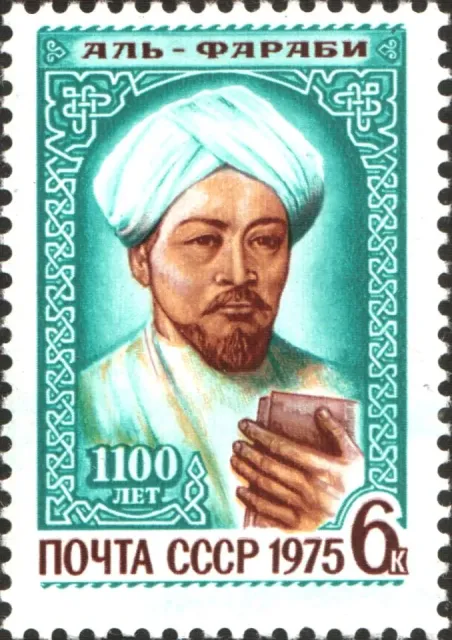
Al-Farabi
Philosopher and polymath known in the East as the “Second Teacher” after Aristotle, author of “The Virtuous City” and “The Great Book of Music”.
- Occupation:
- Scientist, Philosopher
- Real name:
- Abu Nasr Muhammad ibn Muhammad al-Farabi
- Nickname:
- The Second Teacher
- Born:
- c. 870 — c. 951
- Father:
- Muhammad
Biography
Abu Nasr Muhammad ibn Muhammad al-Farabi was born around 870 (Uzbek sources usually give 873). Most sources name his birthplace as Farab — Otrar on the Syr Darya, in present-day Kazakhstan — or the nearby village of Wasij, while some scholars connect him with Faryab in Khorasan. The accounts of his life were written down long after his death, so the year and place of his birth and his origins are still debated.
As a young man he went to Baghdad, the capital of the Abbasid Caliphate. There he studied logic with the Christian cleric Yuhanna ibn Haylan and worked through the whole of Aristotle’s logical corpus. In Baghdad he joined the circle of logicians devoted to Greek philosophy, whose most prominent figure was Abu Bishr Matta ibn Yunus; one of his own students was the later well-known philosopher Yahya ibn Adi.
Al-Farabi wrote commentaries on Aristotle, above all on his logical works, and presented logic as the instrument that opens the way to every science. In “The Enumeration of the Sciences” he arranged the knowledge of his time — the science of language, logic, mathematics, physics and metaphysics, politics, jurisprudence and theology — and defined the subject of each. Since Aristotle was regarded as the “First Teacher”, al-Farabi came to be known in the East as the “Second Teacher”.
He lived in Baghdad until at least September 942 and then moved to Syria. His best-known work, “The Opinions of the People of the Virtuous City”, begun in Baghdad, was completed in Damascus in 942–943. It likens society to a living body whose parts complement one another: such a city is led by a wise ruler, and its aim is to bring people to happiness through reason and virtue. He developed the same theme in “The Political Regime”.
Al-Farabi also made a major contribution to music theory. In “The Great Book of Music” he analysed sounds and intervals, the construction of instruments and the building of melodies on a mathematical basis; the book is regarded as one of the chief sources for the musical science of the Near and Middle East. In “The Book of Letters” he explored the links between language, logic and philosophy.
In 948–949 he visited Egypt and then returned to Syria; according to medieval biographers, in his last years he enjoyed the patronage of Sayf al-Dawla, the Hamdanid ruler of Aleppo. He died in Damascus in Rajab 339 of the Hijra, that is, in December 950 or January 951.
Al-Farabi is regarded as the founder of political philosophy in the Islamic world. Ibn Sina wrote that he understood Aristotle’s “Metaphysics” only after reading al-Farabi’s short treatise on its aims, and his ideas also influenced Ibn Rushd (Averroes) and Maimonides. “The Enumeration of the Sciences” was translated into Latin in the 12th century and read in Europe. His works have also been translated into Uzbek.
Life path
- 870Birth
Born around this year in Farab (Otrar) on the Syr Darya or in nearby Wasij; sources differ on the year and the place.
- early 10th centuryMove to Baghdad
In the Abbasid capital studied logic with the Christian cleric Yuhanna ibn Haylan.
- until 942The Baghdad years
Worked in the circle of logicians devoted to Greek philosophy, wrote commentaries on Aristotle and taught students, among them Yahya ibn Adi.
- 942Move to Syria
Stayed in Baghdad until at least September, then left for Syria.
- 943“The Virtuous City”
Completed in Damascus his best-known work, begun in Baghdad.
- 948–949Journey to Egypt
In Egypt divided the contents of “The Virtuous City” into chapters, then returned to Syria.
- 949Under Sayf al-Dawla’s patronage
According to medieval authors, in his last years enjoyed the patronage of Sayf al-Dawla, the ruler of Aleppo.
- 950–951Death
Died in Damascus in Rajab 339 of the Hijra.
Works
- “The Opinions of the People of the Virtuous City” (943)Political philosophy
His best-known work: a doctrine of the ideal society, led by a wise ruler and aimed at the happiness of its people.
- “The Political Regime”Political philosophy
A work on the order of being and the structure of society that develops the ideas of “The Virtuous City”.
- “The Enumeration of the Sciences”Classification of the sciences
A treatise ordering the sciences of his time — language, logic, mathematics, physics, metaphysics, politics, jurisprudence and theology; translated into Latin in the 12th century.
- “The Great Book of Music”Music theory
A large work analysing sounds, intervals, the construction of instruments and the building of melodies on a mathematical basis.
- “The Book of Letters”Philosophy of language and metaphysics
A work on the links between language, logic and philosophy and on the origin of philosophical terms.
- “The Attainment of Happiness”Philosophical treatise
On the theoretical and practical virtues, and on instruction and upbringing as the way to happiness.
- “Epistle on the Intellect”Philosophical treatise
On the different meanings of the word “intellect” and the stages of human knowledge.
- “On the Aims of the Metaphysics”Philosophical treatise
A short work on the content and purpose of Aristotle’s “Metaphysics”; Ibn Sina wrote that it was this treatise that made the book clear to him.
- Commentaries on AristotleLogical commentaries
Commentaries on and short paraphrases of Aristotle’s logical works.
Legacy
By bringing Greek philosophy together with Islamic culture, al-Farabi laid the foundations of political philosophy in the Islamic world. Ibn Sina, Ibn Bajja, Ibn Rushd and Maimonides learned from his books, and the Latin translation of “The Enumeration of the Sciences” influenced medieval European writing on the classification of knowledge. The Kazakh National University and the asteroid 7057 Al-Farabi are named after him.
Era: The Abbasid Caliphate, 9th–10th centuries- “The Enumeration of the Sciences” was translated into Latin (12th century)
- The 1100th anniversary of his birth was marked in Moscow, Alma-Ata and Baghdad, and a Soviet postage stamp was issued (1975)
- The Kazakh State University was named after al-Farabi (1991)