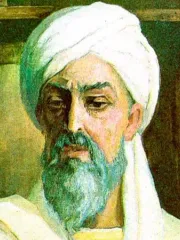
Al-Biruni
Khwarazmian polymath — astronomer, mathematician, geographer and historian — author of “India”, “The Mas’udic Canon” and “The Chronology of Ancient Nations”.
- Occupation:
- Scientist, Historian, Mathematician, Astronomer, Geographer or geologist
- Real name:
- Abu Rayhan Muhammad ibn Ahmad al-Biruni
- Born:
- September 4 973 ♍ — 1048
- Birthplace:
- Beruniy District, Karakalpakstan
Biography
Abu Rayhan Muhammad ibn Ahmad al-Biruni was born on 4 September 973 in the outer quarter of Kath, then the capital of Khwarazm. His nisba comes from the Persian word birun, “outside”, and refers to that suburb; the town of Beruniy in Karakalpakstan now stands on the site of ancient Kath. His mother tongue was Khwarazmian, but he wrote mostly in Arabic, and some of his works in Persian.
As a young man he studied under the mathematician and astronomer Abu Nasr Mansur ibn Iraq, a prince of the Afrighid house. In 990, aged seventeen, he determined the latitude of Kath from the Sun’s midday altitude. In 995 the emir of Gurganj, Ma’mun ibn Muhammad, seized Kath and ended Afrighid rule, and al-Biruni had to leave his homeland; for a time he lived in Rayy, where he discussed observations with the astronomer Abu Mahmud al-Khujandi.
In 997 he observed a lunar eclipse at Kath and, by comparing his timings with those of Abu al-Wafa al-Buzjani in Baghdad, worked out the difference in longitude between the two cities. In the same years he carried on a well-known exchange of questions and answers with the young Ibn Sina on Aristotelian physics and the structure of the cosmos. Around 1000 he lived in Gurgan under the patronage of the Ziyarid ruler Qabus ibn Wushmgir, to whom he dedicated “The Chronology of Ancient Nations”, a comparative account of the calendars, eras and festivals of many peoples.
In 1004 he returned to Khwarazm and served at Gurganj at the court of the Khwarazmshah Abu al-Abbas Ma’mun ibn Ma’mun. The circle of scholars gathered there, which included Abu Nasr ibn Iraq and, for several years, Ibn Sina, is known in Uzbek historiography as the “Ma’mun Academy”. When Sultan Mahmud of Ghazni conquered Khwarazm in 1017, al-Biruni was taken to Ghazna with other Khwarazmian scholars and spent the rest of his life there.
Accompanying Mahmud on his campaigns in India, he learned Sanskrit and fixed the latitudes of a number of towns in the Punjab and Kashmir. Near the fort of Nandana he measured the dip of the horizon from a mountain top and calculated the radius of the Earth, arriving at a figure within a few per cent of the modern value. In 1025 he completed “The Determination of the Coordinates of Cities”, on the methods of mathematical geography, and in 1029 wrote “The Book of Instruction in the Elements of the Art of Astrology” in both Arabic and Persian.
In 1030 he finished “India”, an impartial account of the religion, philosophy, sciences, calendar and customs of the Indians. In it he also discussed the hypothesis that the Earth turns on its axis, noting that the phenomena of the heavens could be explained on that assumption as well. To Sultan Mas’ud, who came to the throne that year, he dedicated his principal astronomical work, “The Mas’udic Canon”. Under Sultan Mawdud he wrote a book on precious stones and metals, and in old age, with his eyesight failing, a work on medicinal substances, the “Kitab al-Saydana”.
In a list of his writings drawn up around 1036 he named 113 titles; scholars estimate his total output at about 146 works, most of which are lost. He died in Ghazna in 1048 (some scholars place his death after 1050). In 1957 the town of Shabbaz in Karakalpakstan was renamed Beruniy in his honour, and the Institute of Oriental Studies of the Academy of Sciences of Uzbekistan bears his name.
Career
- Court of Emir Qabus ibn Wushmgir in GurganCourt scholar
- Court of Khwarazmshah Ma’mun in Gurganj (“Ma’mun Academy”)Court scholar · 1004–1017
- Ghaznavid court in GhaznaCourt scholar · 1017–1048
Life path
- 973Birth
Born in the outer quarter of Kath, the capital of Khwarazm; the nisba al-Biruni refers to this suburb.
- 990First measurements
While studying astronomy under Abu Nasr ibn Iraq, determined the latitude of Kath at the age of seventeen.
- 995Leaving Khwarazm
After the emir of Gurganj seized Kath and overthrew the Afrighids, went to Rayy and met the astronomer Abu Mahmud al-Khujandi.
- 997Lunar eclipse and letters to Ibn Sina
Compared his observation at Kath with Abu al-Wafa’s in Baghdad to find the difference in longitude; exchanged scientific questions and answers with Ibn Sina.
- 1000At the court of Qabus in Gurgan
Lived around this time under the patronage of the Ziyarid ruler Qabus ibn Wushmgir and dedicated “The Chronology of Ancient Nations” to him.
- 1004–1017At the court of Ma’mun in Gurganj
In the circle of scholars of the Khwarazmshah Ma’mun ibn Ma’mun, the “Ma’mun Academy”, made astronomical observations with his teacher Abu Nasr ibn Iraq.
- 1017Taken to Ghazna
After Sultan Mahmud conquered Khwarazm, was brought to Ghazna together with other Khwarazmian scholars.
- 1020sJourneys in India
Accompanying the sultan’s campaigns, learned Sanskrit, fixed the latitudes of towns in the Punjab and measured the Earth’s radius near the fort of Nandana.
- 1025Mathematical geography
Completed his work on methods of determining the coordinates of cities.
- 1030“India” and Sultan Mas’ud
Finished his book on the religion, science and customs of the Indians; dedicated “The Mas’udic Canon” to the new sultan, Mas’ud.
- 1048Death
Died in Ghazna; some scholars believe he was still alive after 1050.
Works
- “The Chronology of Ancient Nations” (1000)History and chronology
A comparative account of the calendars, eras, festivals and memorable dates of many peoples, dedicated to Qabus ibn Wushmgir.
- “The Determination of the Coordinates of Cities” (1025)Mathematical geography
A work on methods of finding the latitude and longitude of cities and the distances between them.
- “The Book of Instruction in the Elements of the Art of Astrology” (1029)Astronomy manual
An introduction to geometry, astronomy and astrology in questions and answers, written in both Arabic and Persian.
- “India” (1030)History and ethnography
An impartial account of the religion, philosophy, sciences, calendar and customs of the Indians, based on Sanskrit sources.
- “The Mas’udic Canon”Astronomical encyclopaedia
His principal astronomical work, dedicated to Sultan Mas’ud: trigonometry, the motions of the heavens, geographical coordinates and tables.
- “The Book on Precious Stones”Mineralogy
A book on the properties, sources and specific gravity of precious stones and metals, written in the reign of Sultan Mawdud.
- “Kitab al-Saydana”Pharmacognosy
His last work, on the names and properties of medicinal plants and substances, written in old age.
- “Questions and Answers”Scientific correspondence
His exchange with the young Ibn Sina on Aristotelian physics and the structure of the cosmos.
Legacy
Through a method grounded in measurement and observation, al-Biruni made a major contribution to medieval astronomy, geodesy and mathematical geography, and determined the specific gravity of many minerals and metals with great accuracy. His “India” makes him one of the founders of Indology and of the comparative study of cultures. Uzbekistan’s State Prize for science and technology, a lunar crater and the asteroid 9936 Al-Biruni are named after him.
Era: The scholarly courts of Khwarazm, Gurgan and Ghazna, 10th–11th centuries- The town of Shabbaz in Karakalpakstan was renamed Beruniy (1957)
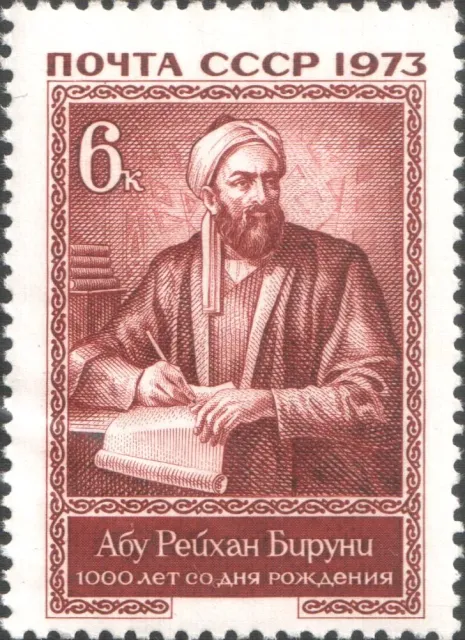
- The millennium of his birth was marked, with postage stamps issued in the USSR, Iran and Afghanistan (1973)
- The 1050th anniversary of his birth was celebrated internationally with UNESCO’s participation (2023)
- An international al-Biruni prize for research in the ethics of artificial intelligence was established together with UNESCO (2023)