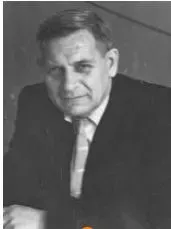
Aleksandr Domoryad
Tashkent mathematician and teacher who taught at Tashkent University for 45 years, headed its chair of computational mathematics in 1959–1967 and wrote “Mathematical Games and Pastimes”.
Biography
Aleksandr Petrovich Domoryad was born on 13 July 1907 in Tashkent. He graduated from Central Asian State University in 1930. He began teaching at Tashkent higher-education institutions while still a student, and from 1931 he worked at Tashkent University, where he taught for forty-five years in the faculty of physics and mathematics (later the faculty of mechanics and mathematics).
He gave general and advanced courses in higher algebra, group theory, mathematical analysis, number theory, the theory of geometric constructions, the calculus of finite differences, probability theory and various courses on approximate computation, as well as descriptive geometry, nomography and elementary geometry.
When several Soviet universities began training computational mathematicians, Domoryad did much of the organisational work of creating the specialisation “computational mathematics” in the faculty of mechanics and mathematics at Tashkent State University. From 1959 to 1967 he headed the chair of computational mathematics; by the accounts available, about a hundred computational mathematicians were trained there in those years.
Part of his writing was addressed to mathematics teachers. In the second book of the “Encyclopaedia of Elementary Mathematics” (1951) he wrote the section on numerical and graphical methods of solving equations; the encyclopaedia appeared in German in 1952. His book “Mathematical Games and Pastimes” (1961) became a handbook for organisers of extracurricular mathematics work and was translated into English, German, French, Lithuanian and other languages.
Domoryad paid particular attention to working with schoolchildren. In 1934 he founded a school mathematics circle at the university, led the school section of the Tashkent Physical and Mathematical Society for ten years (he was the society’s secretary in 1940–1955), and was one of the initiators of mathematics olympiads in Tashkent: he represented the organising committees of 24 olympiads and was deputy chairman of the first and second republican olympiads.
He received a medal for labour in the Great Patriotic War and the badge “Excellent Worker of Public Education of the Uzbek SSR”. Aleksandr Domoryad died in Tashkent on 23 July 1975.
Education
- Central Asian State UniversityUniversity · Tashkent · 1930
Career
- National University of UzbekistanLecturer; head of the chair of computational mathematics (1959–1967) · Tashkent · 1931–1975
- Tashkent Physical and Mathematical SocietySecretary · Tashkent · 1940–1955
Awards
Life path
- 1907Born in Tashkent
Born on 13 July in Tashkent.
- 1930Graduated from university
Graduated from Central Asian State University; he had started teaching while still a student.
- 1931Joined Tashkent University
Took up permanent work at Tashkent University, where he taught for forty-five years.
- 1934School mathematics circle
Founded a mathematics circle for schoolchildren at the university.
- 1940–1955Secretary of the Physical and Mathematical Society
Served as secretary of the Tashkent Physical and Mathematical Society and directed its scholarly and methodological work.
- 1951“Encyclopaedia of Elementary Mathematics”
Wrote the section on methods of solving equations in its second book.
- 1959–1967Head of the chair of computational mathematics
Headed the chair of computational mathematics at Tashkent State University.
- 1961“Mathematical Games and Pastimes”
His book on recreational mathematics was published.
- 1975Death
Died in Tashkent on 23 July.
Works
- “Mathematical Games and Pastimes” (1961)Book
A book on recreational mathematics and a handbook for organisers of extracurricular work; translated into English, German, French, Lithuanian and other languages.
- “Numerical and Graphical Methods of Solving Equations” (1951)Encyclopaedia section
A section in the second book of the “Encyclopaedia of Elementary Mathematics”, which appeared in German in 1952.
- “Counting Devices”Encyclopaedia article
An article in volume 3 of the Children’s Encyclopaedia.
- “Mathematical Games”Encyclopaedia article
An article in the Great Soviet Encyclopaedia.