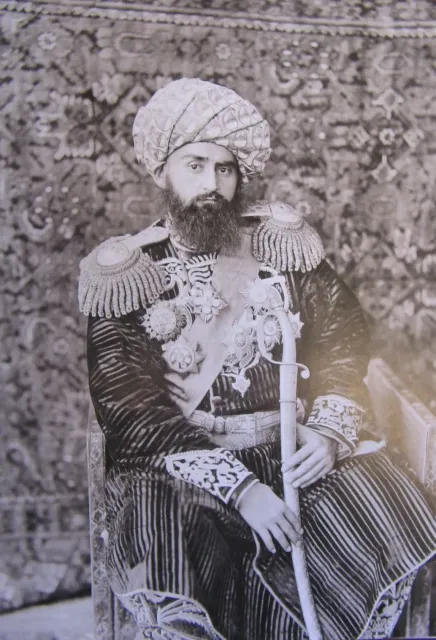
Abd al-Ahad Khan
Emir of Bukhara of the Mangit dynasty (1885–1910), under whom a Russian political agency opened in Bukhara and a bridge over the Amu Darya and the Chardzhou–Samarkand railway were built.
- Occupation:
- Historical figure, Politician, Ruler
- Real name:
- Sayyid Abdulahad Khan
- Lived:
- 1859 — 1910
- Birthplace:
- Navoi
- Father:
- Muzaffar bin Nasrullah
- Children:
Biography
Abd al-Ahad Khan ruled the Emirate of Bukhara from 1885 to 1910. A member of the Mangit dynasty, he was the son of Emir Muzaffar and the father of Emir Alim Khan. His birth year is usually given as 1859 (some sources say 1857), and his birthplace as Kermine (Karmana). Exact days and months differ between sources, so only years are given here. As a young man he governed Kermine and was known as a keen horseman and falconer.
His reign was the period when the emirate's dependence on the Russian Empire deepened. In 1886 a Russian political agency was established in Bukhara. To turn Turkestan, Bukhara included, into a raw-material base and carry its wealth away, Russia built a bridge over the Amu Darya and laid the Chardzhou–Samarkand railway in 1900–1901. Beside the railway station grew the settlement of New Bukhara (now Kagan), where the emir also built a palace.
Abd al-Ahad was close to the Russian court: he was made a general of cavalry and general-adjutant, and received the Order of St Andrew in 1906. He spent summers in the Crimea and the Caucasus and was an honorary citizen of Yalta and Pyatigorsk. According to the available accounts, he paid for palaces in Yalta, Zheleznovodsk and New Bukhara, a mosque in St Petersburg and repairs to the Yasawi mausoleum in Turkestan. He founded the Order of the Crown of Bukhara in 1886, reorganised the army in 1895 and, after a dispute with the clergy in 1894, moved permanently to Kermine. He formally abolished slavery, though it reportedly persisted in secret until 1920. He also wrote poetry under the pen name Ojiz.
The Jadid movement grew stronger under his rule. He died in Kermine at the end of 1910 (early January 1911 in the new style) and was buried there; his son Alim Khan succeeded him. Birth and death dates differ in the sources (Wikidata: 27 March 1859 and 10 December 1910; the Uzbek encyclopedic article: 16 March 1859 and 6 January 1911), so only the years are given.
Life path
- 1871Beg of Kermine
Appointed beg of Kermine and held the post until he took the throne.
- 1885Accession
Became emir of Bukhara after the death of his father, Emir Muzaffar.
- 1886Russian political agency
A Russian political agency was set up in Bukhara; the Order of the Crown of Bukhara was founded the same year.
- 1894Move to Kermine
Moved permanently to Kermine after a dispute with the clergy.
- 1895Army reorganisation
The emirate's army was reorganised.
- 1900–1901Chardzhou–Samarkand railway
Russia built a bridge over the Amu Darya and ran a railway across the emirate.
- 1906Order of St Andrew
Awarded the Russian Order of St Andrew.
- 1910Death
Died in Kermine; his son Alim Khan took the throne.