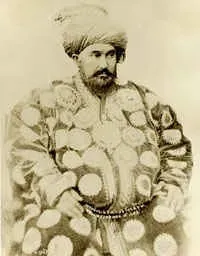
Muzaffar bin Nasrullah
Emir of Bukhara of the Mangit dynasty (1860–1885), under whom Russian troops defeated the emirate’s army and Bukhara became a Russian dependency in 1868.
- Occupation:
- Historical figure, Politician, Ruler
- Real name:
- Muzaffar ibn Nasrullah
- Lived:
- c. 1824 — 1885
- Birthplace:
- Bukhara
- Father:
- Nasrullah Khan
- Children:
- AbdulahadxonAbdulmalik (Katta to'ra)
Biography
Emir Muzaffar ruled the Emirate of Bukhara from 1860 to 1885, a little over a quarter of a century. He was a Mangit and the son of Emir Nasrullah. Sources disagree about his birth: the Uzbek encyclopedia article gives 1819, English Wikipedia 1824 or 1825, and Wikidata 1834. He was born in Bukhara and, in his father’s time, governed Karmana.
On coming to the throne he brought back to Bukhara the men his father had exiled to Karmana and gave them high posts. In 1863–1865 he marched against the begs of Hisar, Shahrisabz, Darband, Kulab and Baljuvan, who refused to obey the centre, and broke their resistance, although Shahrisabz later became independent again. When the Kokand khan Khudayar Khan was overthrown and fled to Bukhara in 1861, the emir gave him military help to recover his throne.
His reign coincided with a sharp increase in Russian military pressure on the Central Asian khanates. In July 1865 he sent an embassy under Najmiddin Khoja to St Petersburg in the hope of settling the dispute peacefully, but the talks led nowhere. On 8 May 1866 General Romanovsky’s force beat the emir’s army at Irjar (Maydayulgun), between Jizzakh and Ura-Tyube. Muzaffar sent the mufti Muhammad Porso on an embassy to Istanbul by way of Afghanistan and India to ask for help, but was refused. After the defeat at Zirabulak on 2–3 June 1868, a peace treaty with Russia was signed in Samarkand, and the emirate became dependent on Russia.
When his heir Abdulmalik (Katta Tora) rose in revolt at Shahrisabz and Kitab in 1870 against the Russian invasion and his father’s policy, Muzaffar put the rising down with the help of Russian troops. Under Russian pressure he banned the slave trade in Bukhara in 1873, and in 1883 he promised to abolish slavery altogether but did not do so. Shia influence also grew in Bukhara in his time. In 1872 he presented a manuscript of Navoi’s divan to Queen Victoria.
Muzaffar died in 1885 and was buried in the Ishan Imlo cemetery in Bukhara, which was destroyed in the Soviet period. His son Abdulahad succeeded him. Sources give him thirteen sons; one of them, Nasir al-Din ibn Amir Muzaffar, is known as a historian.
Life path
- 1860Accession in Bukhara
Became emir of Bukhara after the death of his father Nasrullah.
- 1861Help for Khudayar Khan
Gave military help to Khudayar Khan, driven out of Kokand, to regain his throne.
- 1863–1865Campaigns against the begdoms
Subdued the begs of Hisar, Shahrisabz, Darband, Kulab and Baljuvan.
- 1865Embassy to St Petersburg
An embassy under Najmiddin Khoja was sent; the talks produced nothing.
- 1866Battle of Irjar
On 8 May the Bukharan army was defeated by General Romanovsky’s force.
- 1868Zirabulak and the peace treaty
After the June defeat a treaty with Russia was signed in Samarkand and the emirate became dependent.
- 1870Revolt of Abdulmalik
Put down his son’s revolt at Shahrisabz and Kitab with Russian help.
- 1873Ban on the slave trade
Banned the slave trade in Bukhara under Russian pressure.
- 1885Death
Died and was buried in the Ishan Imlo cemetery in Bukhara; his son Abdulahad succeeded.