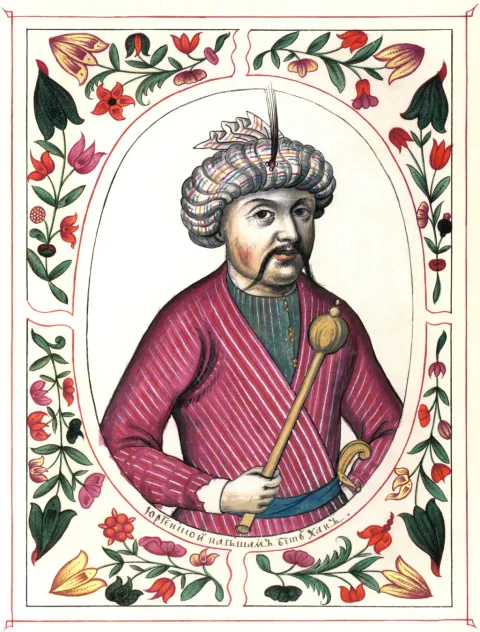
Anusha Khan
Khan of Khiva (1663–1685/86) and son of Abu al-Ghazi: he waged a long war against the Khanate of Bukhara, briefly held Samarkand, and oversaw the building of a bath, a madrasa and canals in Khiva.
- Occupation:
- Historical figure, Politician
- Real name:
- Abu'l-Muzaffar Muhammad Anusha Khan
- Born:
- c. 1640 — c. 1686
- Birthplace:
- Khorezm
- Father:
- Abu al-Ghazi Bahadur Khan
Biography
Anusha Khan (full name Abu’l-Muzaffar Muhammad Anusha Khan) was a ruler of the Khanate of Khiva from the Shaybanid dynasty. The son and successor of Abu al-Ghazi Bahadur, he held the throne from 1663 until 1685–1686. His birth year is not known exactly: sources point to the early 1640s, since he was still an adolescent at the battle of 1657.
His name first appears in connection with the battle near Karmana in 1657. When Abu al-Ghazi’s army was suddenly surrounded by a much larger force of Abd al-Aziz, the Khan of Bukhara, Anusha showed courage, helped turn the battle in Khiva’s favour and saved his father. As a reward his father gave him an army and the town of Hazarasp, and in honour of the victory had a bath built in Khiva beside the White Mosque in the Ichan Kala; it is known as the Anusha Khan bath.
After Abu al-Ghazi died in 1663, Anusha became khan and continued his father’s policy of strengthening the khan’s power. The war with the Khanate of Bukhara resumed under him: sources speak of fighting in 1664–1680 and 1683–1687, and the cause was the struggle for trade routes. In 1685 (according to some sources 1686) he briefly occupied Samarkand but soon had to leave it.
To defend the frontiers the fortresses of Yangi Kot and Shahabad were built, and two large canals, the Shahabad and the Yarmysh, were dug. In Khiva a bath and a madrasa bearing the khan’s name were built; the mausoleums of Sultan Vays Baba (in Karakalpakstan) and of Pahlavon Mahmud in Khiva, and the White Mosque, were repaired. His reign also saw the completion of the historical work “Shajara-i Turk” (“Genealogy of the Turks”), begun by his father.
In foreign policy Anusha tried to restore trade and diplomatic ties with Russia: in 1668 he sent a letter to Tsar Alexis Mikhailovich and in 1669 and 1675 tried again to establish relations. He also improved relations with the Turkmen tribes, which helped reopen a trade route toward the Caspian.
Towards the end of his reign a court conspiracy overthrew Anusha, and he was blinded. He died in 1686 or 1687. According to some accounts he was buried in the Pahlavon Mahmud mausoleum in Khiva.
Career
Life path
- 1640sBirth
Born into the family of Abu al-Ghazi Khan; the exact date is unknown, and in 1657 he was still an adolescent.
- 1657Battle near Karmana
Saved his father’s encircled army from the troops of Abd al-Aziz, Khan of Bukhara, and helped turn the battle in Khiva’s favour.
- 1657–1664Anusha Khan bath
His father gave him an army and Hazarasp, and a bath was built in Khiva beside the White Mosque in honour of the victory.
- 1663Accession
Became Khan of Khiva after Abu al-Ghazi’s death and continued the war with the Khanate of Bukhara.
- 1668Letter to Russia
Sent a letter to Tsar Alexis Mikhailovich seeking trade and diplomatic ties; the attempts were repeated in 1669 and 1675.
- 1664–1680War with Bukhara
Clashes with the Khanate of Bukhara over trade routes, which flared up again in 1683–1687.
- 1685Samarkand
Briefly occupied Samarkand but soon had to leave (in 1686 according to some sources).
- 1685–1686Overthrow
Deposed in a court conspiracy and blinded.
- 1686–1687Death
Died; sources give 1686 or 1687.
Legacy
Under Anusha Khan a bath and a madrasa bearing his name were built in Khiva, the Shahabad and Yarmysh canals were dug, and the mausoleums of Pahlavon Mahmud and Sultan Vays Baba were repaired. The Anusha Khan bath is regarded as the earliest monument of its type in Khiva and was in use until 2012. The khan fought a long war with the Khanate of Bukhara; his success at Samarkand proved temporary.
Era: The Khanate of Khiva under the Arabshahid dynasty, late 17th century- Battle near Karmana (1657)
- Anusha Khan accedes to the throne (1663)
- Brief occupation of Samarkand (1685)