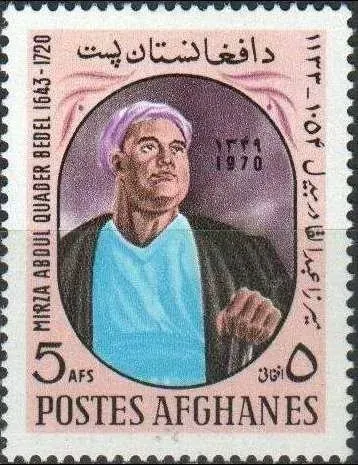
Bedil
Persian-language poet and thinker, a leading figure of the Indian style; born and living in India, his works found their widest audience in Afghanistan and Transoxiana.
- Occupation:
- Writer, Scientist, Poet
- Real name:
- Mirza Abdul-Qadir Bedil
- Nickname:
- Bedil Dehlavi
- Born:
- 1644 — December 5, 1720
- Father:
- Mirzo Abdulxoliq
- Children:
- Abdulxoliq
Biography
Mirza Abdul-Qadir Bedil was born in 1644 in Azimabad (present-day Patna) in the Indian province of Bihar. His ancestors came from Central Asia, from the Arlat (Barlas) tribe of the Chagatai, and had settled in India in the Mughal period, serving in its army. His father, Mirza Abdul-Khaliq, belonged to the Qadiriyya Sufi order and named his son after its founder, Abd al-Qadir Gilani. Bedil’s mother tongue was Bengali; he also knew Urdu (then called Rekhta), Sanskrit and Turkic, and learned Persian and Arabic at elementary school.
His father died when he was about four and a half, around 1648. He was raised first by Mirza Qalandar, his father’s disciple and a distant relative, and later by his maternal uncle Mirza Zarif, a merchant and jurist. He wrote his first poem at ten. He began under the pen name Ramzi and, on the advice of his spiritual guide Mawlana Kamal, took the name Bedil. In 1659–60 he travelled through the cities of Bengal and spent three years in Orissa (Cuttack), where he came to know the Sufi Shah Qasim Huwallahi.
In 1664 Bedil moved to Delhi, then called Shahjahanabad. For the next twenty years he travelled between Delhi, Agra, Mathura, Lahore and Attock. For a time he served in the army of Aurangzeb’s son Prince Muhammad Azam, but left rather than compose panegyrics to the prince. The Mughal nobleman Nawab Shukrullah Khan became his lasting patron and close friend; in 1687–88, while staying with him in the Bairat hills, Bedil wrote the poem “Tur-i marifat”.
Bedil wrote in Persian. His poetic legacy runs to some 147,000 couplets: ghazals, quatrains, qasidas and four Sufi mathnawis — “Muhit-i azam”, “Tilism-i hayrat”, “Tur-i marifat” and “Irfan”. His prose includes the autobiographical “Chahar unsur”, the philosophical “Nukat” and the collected letters “Ruqaat”. His work was shaped by the Sufi doctrine of the unity of being and by Indian philosophy.
The death of his son Abdul-Khaliq in 1711 shook him deeply, and he wrote an elegy for him. In 1712 he finished the mathnawi “Irfan”, on which he had worked for many years. He spent his last years in Delhi and died there on 5 December 1720 (4 Safar 1133 AH); he was buried in the courtyard of his own house. The grave was destroyed during Nadir Shah’s invasion and later incursions, and the tomb known today is of recent date.
Bedil found his widest audience in Afghanistan and Transoxiana: by the end of the 18th century imitating him had become commonplace among the poets of the region, his works entered school curricula and his verses passed into folk song. In Afghanistan the tradition of “Bedil-khani”, reading and discussing his poems in groups, survives to this day. Sadriddin Ayni wrote ghazals in Bedil’s manner at the start of his career and later devoted a book to him; his influence is visible in Mirza Ghalib and Muhammad Iqbal.
Life path
- 1644Birth
Born in Azimabad (Patna) into a Turkic family of the Arlat tribe.
- c. 1648Death of his father
After his father’s death he was raised by Mirza Qalandar and then by his maternal uncle Mirza Zarif.
- c. 1654First poem
Wrote his first poem at the age of ten.
- 1659–1662Bengal and Orissa
Travelled through the cities of Bengal and spent three years in Orissa (Cuttack).
- 1664Move to Delhi
Moved to Delhi (Shahjahanabad); his poetry increasingly took on the Indian style.
- 1667“Muhit-i azam”
Wrote his first Sufi mathnawi at the age of twenty-three.
- 1669“Tilism-i hayrat”
Wrote an allegorical mathnawi in the vein of Attar’s “The Conference of the Birds”.
- 1687–1688“Tur-i marifat”
Wrote a poem of 1,100 couplets in the Bairat hills while staying with Nawab Shukrullah Khan.
- 1680–1694“Chahar unsur”
Wrote his autobiographical prose work.
- 1711Death of his son
Wrote an elegy on the death of his son Abdul-Khaliq.
- 1712“Irfan”
Finished the longest and most famous of his mathnawis, written over many years.
- 1720Death
Died in Delhi on 5 December and was buried in the courtyard of his own house.
Works
- “Kulliyat”Collection
The collected works: some 147,000 couplets of ghazals, quatrains, qasidas and mathnawis.
- “Muhit-i azam” (“The Greatest Ocean”) (1667)Mathnawi
A Sufi mathnawi in eight chapters describing the unfolding of the created world in the spirit of the doctrine of the unity of being.
- “Tilism-i hayrat” (“The Talisman of Bewilderment”) (1669)Mathnawi
An allegorical mathnawi on the essence and attributes of God and the relationship of soul and body.
- “Tur-i marifat” (“The Sinai of Gnosis”) (1688)Mathnawi
A poem of 1,100 couplets vividly depicting the Bairat hills in the monsoon season.
- “Irfan” (1712)Mathnawi
Bedil’s longest and most celebrated mathnawi, the gist of his philosophy, with stories drawn from Indian tradition.
- “Chahar unsur”Autobiographical prose
An autobiography in rhymed prose in four chapters, one for each element: air, water, fire and earth.
- “Nukat”Philosophical prose
A work in rhymed prose on questions of philosophy and Sufism.
- “Ruqaat”Letters
Collected letters of Bedil to his patron Shukrullah Khan, his teacher and his students.
Legacy
Bedil is regarded as the foremost representative of the later phase of the Indian style (sabk-i hindi) of Persian poetry. His influence was especially wide in Afghanistan and Transoxiana, including Bukhara, and can be seen in Sadriddin Ayni, Mirza Ghalib and Muhammad Iqbal.
Era: The Mughal Empire under Aurangzeb and his successors, 17th–18th centuries- Nadir Shah’s invasion of Delhi; Bedil’s tomb destroyed (1739)
- Sadriddin Ayni’s book “Mirza Abdul-Qadir Bedil” published (1954)