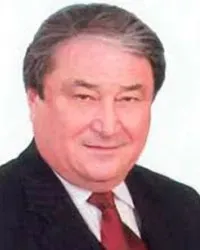
Nuclear physicist and academician, director of the Institute of Nuclear Physics (1990–2006) and President of the Academy of Sciences of Uzbekistan (2000–2005 and from 2017 until his death), a specialist in high-energy physics.
Biography
Behzod Yuldashev (Behzod Sodiqovich Yo'ldoshev) was born on 9 May 1945 in Tashkent. In 1968 he graduated with distinction from the physics faculty of Tashkent State University, specialising in nuclear physics; as a student he was a pupil of the head of the department, Academician Sodiq Azimov.
In 1968–1971 he worked as a junior researcher at the Institute of Nuclear Physics of the Academy of Sciences and was seconded to the Joint Institute for Nuclear Research in Dubna, where he defended his candidate's dissertation in 1971. He became a Doctor of Physical and Mathematical Sciences in 1981, headed a laboratory at the Physical-Technical Institute in 1984–1990 and became a professor in 1987.
From June 1990 until 2006 he was director of the Institute of Nuclear Physics. Under his leadership the institute set up large-scale production and export of radioisotopes meeting world standards and developed a technology for extracting precious and rare metals from local mining waste. He was elected a corresponding member of the Academy in 1994 and an academician in 2000.
In 2000 he was elected President of the Academy of Sciences of Uzbekistan and was relieved of the post in November 2005. In 2000–2005 he was also a deputy of the Oliy Majlis of the 2nd convocation. In 2006–2017 he headed a laboratory at the Institute of Nuclear Physics; on 10 January 2017 he was again elected President of the Academy and held the post until his death.
His research covered high-energy physics, nuclear physics and elementary-particle physics. He experimentally demonstrated a single mechanism of quark hadronisation in the interaction of high-energy leptons and hadrons with nuclei, obtained experimental evidence for a new kind of hadronic matter — narrow dibaryon resonances — and found local properties within nuclear matter. He wrote more than three hundred scientific works, including three monographs and twenty inventions, and trained dozens of candidates and doctors of science.
Yuldashev was a professor at the University of Washington (1977–1978, 1980–1981, 1989–1990), where he studied nuclear effects in high-energy neutrino interactions, later a visiting professor at Stanford University (2007–2008, 2010–2011), and for about four years an adviser at the IAEA in Vienna. He led international experiments at the TRIUMF accelerator centre in Canada and at Fermilab in the USA. In 2022 he was elected a foreign member of the Russian Academy of Sciences.
He was a laureate of the Beruni State Prize of the Uzbek SSR (1983), holder of the orders Mehnat shuhrati (2003) and El-yurt hurmati (2011), Honoured Scientist of Uzbekistan (2018) and honorary doctor of the Joint Institute for Nuclear Research (2005). Behzod Yuldashev died on 28 August 2024 at the age of 79.
Education
Career
- Academy of Sciences of UzbekistanAcademician (2000), president (2000–2005, 2017–2024) · Tashkent · 1994–2024
- Физико-технический институт АН Узбекской ССРHead of a laboratory · Tashkent · 1984–1990now Physical-Technical Institute of the Academy of Sciences of the Uzbek SSR
- Institute of Nuclear Physics of the Academy of Sciences of the Uzbek SSRResearcher, director (1990–2006), head of a laboratory · Tashkent · 1968–…now Institute of Nuclear Physics
Awards
 Honoured Science Worker of Uzbekistan2018 · Uzbekistan
 Order «El-yurt hurmati»2011 · Uzbekistan
 Order of Labor Glory2003 · Uzbekistan
 Beruni State Prize of the Uzbek SSR1983 · Uzbek SSR
Life path
- 1945Born in Tashkent on 9 May
- 1968Graduated from Tashkent State University; junior researcher at the Institute of Nuclear Physics
- 1971Defended his candidate's dissertation at JINR (Dubna)
- 1981Doctor of Physical and Mathematical Sciences
- 1983Beruni State Prize
- 1984–1990Head of a laboratory at the Physical-Technical Institute
- 1990–2006Director of the Institute of Nuclear Physics
- 1994Corresponding member of the Academy of Sciences
- 2000Academician; President of the Academy of Sciences
- 2005Relieved of the post of Academy president (November)
- 2017Re-elected President of the Academy of Sciences (10 January)
- 2022Foreign member of the Russian Academy of Sciences
- 2024Died on 28 August