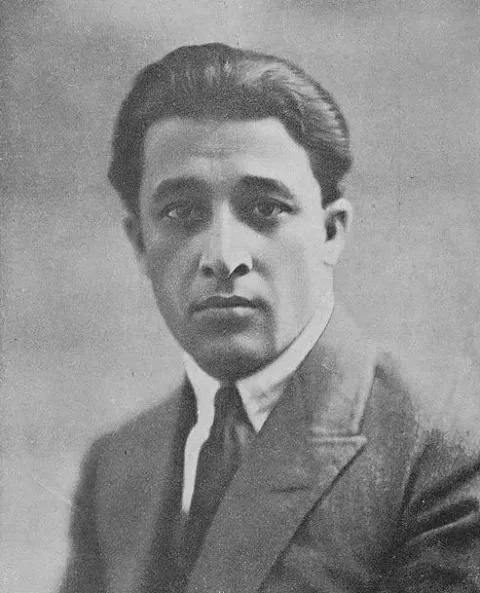
Fayzulla Khodzhayev
Bukharan Jadid and Young Bukharan leader, head of government of the Bukharan People’s Soviet Republic (1920–1924) and first chairman of the Council of People’s Commissars of the Uzbek SSR (1925–1937).
- Occupation:
- Politician, Minister
- Born:
- 1896 — March 15, 1938
- Birthplace:
- Bukhara
- Father:
- Ubaydullakhoja Kasymkhodzhayev
- Mother:
- Rayhonbibi
- Spouse:
- Malika Khodzhayeva
- Children:
- Viloyat Xo'jayeva
Biography
Fayzulla Khodzhayev was born in Bukhara in 1896 into the family of Ubaydullakhoja Kasymkhodzhayev, one of the wealthiest merchants of the Emirate of Bukhara; sources give his birthday as either 1 June or 1 July. His father traded in karakul pelts in Moscow and other Russian cities. After two years at a Bukharan madrasa, Fayzulla was taken to Moscow by his father in 1907 and studied Russian and secular subjects there with private tutors until 1912. When his father died that year, he returned to Bukhara as heir to a large fortune.
From 1913 he took part in the Jadid movement, spending his inheritance on new-method schools and on the work of the Young Bukharans; according to the National Encyclopedia of Uzbekistan, he joined their central committee in the same year. In April 1917, after Emir Said Alim Khan announced a manifesto of reforms, the Young Bukharans staged a demonstration in its support; when it was broken up, Khodzhayev had to flee Bukhara for Kagan (New Bukhara). Together with Abdurauf Fitrat he led the movement’s left wing, which demanded first a constitutional monarchy and later a republic.
In March 1918 he represented the Young Bukharans in the march on Bukhara by an armed detachment under Fyodor Kolesov, chairman of the Council of People’s Commissars of the Turkestan Territory. When the campaign failed, the emir’s government sentenced him to death in absentia, and he left for Turkestan and then Moscow. In January 1920 in Tashkent he became chairman of the Turkestan Central Bureau of the Party of Revolutionary Young Bukharans, edited its newspaper Uchqun from April to September and kept in touch with the underground in Bukhara. The same year he joined the Russian Communist Party (Bolsheviks).
On 2 September 1920 the Red Army under Mikhail Frunze took Bukhara, the emir fled and the Bukharan People’s Soviet Republic was proclaimed. On 14 September its government, the Council of People’s Nazirs, was formed with the 24-year-old Khodzhayev as chairman. He led it for four years, serving at the same time as nazir for foreign affairs (1920–1922) and for military affairs (1921–1924) and as chairman of the Council of Labour and Defence. The National Encyclopedia of Uzbekistan notes his efforts to give Bukhara a foreign policy of its own: diplomatic ties were established with Afghanistan, Iran, Turkey and other countries, and young people were sent to study abroad. From 1922 he sat on the Central Asian Bureau of the party’s Central Committee, and that year he was awarded the Order of the Red Banner.
After the national delimitation of 1924 the Bukharan republic was dissolved and the Uzbek SSR created. At the end of 1924 Khodzhayev became chairman of its Revolutionary Committee, the provisional government; on 17 February 1925 the First Congress of Soviets of Uzbekistan confirmed him as chairman of the Council of People’s Commissars, and on 21 May he was elected one of the chairmen of the Central Executive Committee of the USSR. He headed the republic’s government until 1937. The National Encyclopedia of Uzbekistan calls him one of the initiators of modern industrial construction and writes that he did not support the liquidation of the “kulaks” as a class and believed that sowing cotton everywhere would lead to a monoculture. In 1935 he received the Order of Lenin. Khodzhayev also wrote history: his books on the Bukharan revolution appeared in 1926 and 1932.
In June 1937, after the Seventh Congress of the Communist Party of Uzbekistan, Khodzhayev was removed from all his posts and expelled from the party, and on 9 July he was arrested. From 2 to 13 March 1938 the Military Collegium of the USSR Supreme Court heard the case of the “Anti-Soviet Bloc of Rights and Trotskyites” in Moscow — the Third Moscow Trial — where he was one of 21 defendants, alongside Nikolai Bukharin, Alexei Rykov, Akmal Ikramov and others. He was charged with taking part in a conspiracy to overthrow Soviet power in Uzbekistan, with espionage for foreign states and with leading the organisation Milli Ittihad; like most of the defendants, he admitted the charges. Sentenced to death on 13 March, he was shot on 15 March 1938 at the Kommunarka shooting ground near Moscow and buried there. His family was also repressed: his wife Malika and daughter Viloyat spent many years in exile.
On 6 March 1965 the Military Collegium of the USSR Supreme Court found the charges against Khodzhayev groundless and fully rehabilitated him, and his party membership was restored. In 1988, rehabilitating the remaining defendants of the trial, the Plenum of the USSR Supreme Court stated that the prosecution had rested solely on testimony obtained in gross violation of the law. In 1967 the republic’s leadership adopted a resolution to perpetuate his memory; the Bukhara Pedagogical Institute (now Bukhara State University) was named after him, and in Soviet times streets in Bukhara, Samarkand and Tashkent bore his name. His selected works were published in three volumes in Russian (1970–1973) and in Uzbek (1976–1980). His father’s house in Bukhara has been a museum since 1991, and in 1996 Uzbekistan marked the centenary of his birth with a postage stamp bearing his portrait.
Career
- Communist Party of the Soviet UnionMember (Russian Communist Party (Bolsheviks), from 1920); member of the Central Committee’s Central Asian Bureau (from 1922) · 1920–1937
- Young Bukharans partyMember of the central committee and one of its leaders; in 1920 chairman of the Turkestan Central Bureau of the Revolutionary Young Bukharans · Bukhara · 1913–1920
- Uchqun newspaperEditor · Tashkent · 1920–1920
- Council of People’s Nazirs of the Bukharan People’s Soviet RepublicChairman; nazir for foreign affairs (1920–1922) and for military affairs (1921–1924) · Bukhara · 1920–1924Everyone who held this post →
- Council of People’s Commissars of the Uzbek SSRChairman (in 1924–1925 chairman of the Revolutionary Committee, the provisional government) · 1924–1937Everyone who held this post →
- Central Executive Committee of the USSROne of the chairmen (for the Uzbek SSR) · 1925–1937Everyone who held this post →
Awards
 Order of Lenin1935 · USSR
 Order of the Red Banner1920 · USSR
- Order of the Red Banner1922 · USSR
Life path
- 1896Birth
Born in Bukhara into the family of the wealthy merchant Ubaydullakhoja Kasymkhodzhayev.
- 1907–1912Studies in Moscow
After two years at a Bukharan madrasa, studied Russian and secular subjects with private tutors in Moscow.
- 1913Among the Jadids
Joined the Jadid movement and funded new-method schools and the Young Bukharans from his own means.
- 1917April demonstration
Fled Bukhara for Kagan after a demonstration in support of the emir’s reform manifesto was broken up.
- 1918Kolesov’s march
Took part in an armed detachment’s failed march on Bukhara; the emir’s government sentenced him to death in absentia.
- 1920Bureau in Tashkent and Uchqun
Chairman of the Turkestan Central Bureau of the Party of Revolutionary Young Bukharans and editor of Uchqun; joined the Bolshevik party.
- 1920–1924Head of the Bukharan government
Chairman of the Council of People’s Nazirs of the Bukharan People’s Soviet Republic, nazir for foreign and for military affairs.
- 1924–1925Revolutionary Committee of the Uzbek SSR
Chairman of the Revolutionary Committee, the provisional government of the new republic.
- 1925–1937Chairman of the Council of People’s Commissars
Headed the government of the Uzbek SSR; from 1925 one of the chairmen of the Central Executive Committee of the USSR.
- 1937Arrest
Removed from all posts and expelled from the party in June, arrested on 9 July.
- 1938Third Moscow Trial
Sentenced to death on 13 March and shot at the Kommunarka shooting ground on 15 March.
- 1965Rehabilitation
Fully rehabilitated by the Military Collegium of the USSR Supreme Court on 6 March.
Works
- “Materials on the History of the Bukharan Revolution” (1926)Book
A history of the Bukharan revolution and the Young Bukharan movement, in which the author himself took part.
- “On the Young Bukharans” (1926)Article
On the origins and aims of the Young Bukharan movement.
- “The Jadids” (1926)Article
On the history of Jadidism in Bukhara.
- “Basmachism” (1930)Article
On the armed resistance movement in Central Asia.
- “On the History of the Revolution in Bukhara and the National Delimitation of Central Asia” (1932)Book
A history of the Bukharan revolution and of the national delimitation of 1924.
- “Uzbekistan on the Rise” (1936)Book
On the state of the republic’s agriculture, industry, transport, education and health care in 1935.
- Selected works in three volumes (1970)Collected works
Published after his rehabilitation in Russian (1970–1973) and in Uzbek (1976–1980).
Legacy
Khodzhayev was one of the political leaders of Bukharan Jadidism and the principal leader of the Bukharan People’s Soviet Republic, and then headed the government of the Uzbek SSR for twelve years. Views of him have changed with the times: shot as an “enemy of the people” in 1938 and rehabilitated in 1965, he is studied in independent Uzbekistan as a figure of Jadidism and national statehood. At the same time, his cooperation with the Bolsheviks and his part in the Sovietisation of Bukhara keep his record contested. His writings on the Bukharan revolution remain an important source for the history of the period.
Era: The last years of the Emirate of Bukhara, the Bukharan People’s Soviet Republic and Soviet Uzbekistan, 1913–1937- The Bukharan People’s Soviet Republic was founded, with Khodzhayev as head of government (1920)
- National delimitation; the Uzbek SSR was created (1924)
- Sentenced to death at the Third Moscow Trial (1938)
- Fully rehabilitated by the Military Collegium of the USSR Supreme Court (1965)
- A resolution to perpetuate his memory was adopted (1967)
- His father’s house in Bukhara opened as a museum (1991)
- The centenary of his birth was marked with a postage stamp (1996)