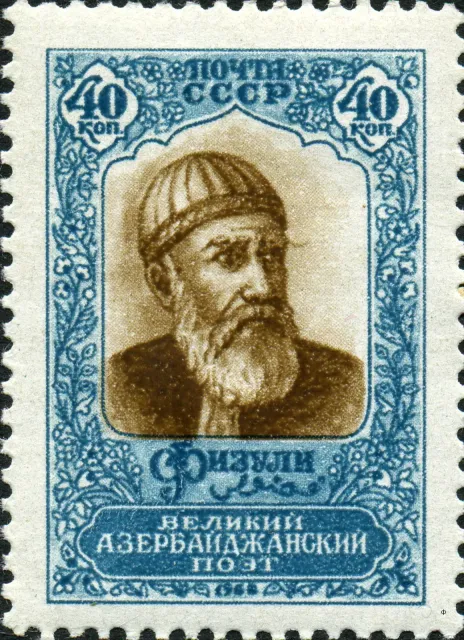
Fuzuli
Azerbaijani-Turkic poet from Iraq (c. 1480–1556) who wrote in Turkic, Persian and Arabic; his poem «Leyli and Majnun» and his ghazals make him one of the greatest lyric poets of Turkic literature.
Biography
The poet's given name was Muhammad and his father's name Suleyman; Fuzuli is his pen name (takhallus). The word carries two senses, «meddlesome, given to idle talk» and «exalted, virtuous». In the preface to his Persian divan he explains that he chose it to avoid sharing a pen name with other poets, expecting that nobody would care to take such a word. He was born in Arab Iraq during the Aq Qoyunlu period. Karbala is most often given as his birthplace, with Najaf, Hilla, Baghdad and Kirkuk also proposed. The year of his birth is unknown: modern scholarship puts it around the 1480s, while older reference works give 1494–1498. He came from the Bayat Turkmens who lived in Iraq under the Aq Qoyunlu; little is known of his family, and the tradition that his father was the mufti of Hilla is unverified.
Fuzuli learned Arabic and Persian well enough to write verse and treatises in both. In the prefaces to his divans he says that he first studied the rational and transmitted sciences, geometry and philosophy, and then Qur'anic commentary and hadith. When the Safavid shah Ismail I took Baghdad in 1508, Fuzuli was already a known young poet. His first known poem is a Persian qasida for the Aq Qoyunlu prince Alvand Mirza, and he dedicated his first known Turkic masnavi, «Bang va Bada», to Shah Ismail.
He then found a patron in the Safavid governor of Baghdad, Ibrahim Khan Mawsillu, whom he met at Karbala and Najaf; he went with him to Baghdad and presented him with qasidas and a tarji'band. After Ibrahim Khan was killed by his nephew in 1527, Fuzuli was left without a patron and, scholars suppose, went back to Hilla. Almost nothing is known of the years 1527–1534.
In 1534 Sultan Suleiman the Magnificent captured Baghdad. Fuzuli presented him with five qasidas and wrote others to Ottoman officials, and was granted a stipend of nine akçe a day from waqf revenues. Finding the sum too small, he sent the chancellor Celalzade Mustafa Çelebi a satirical letter, «Shikayatnama» («The Complaint»), after which the payments were put in order. In Baghdad he met the Turkish poets Hayali and Yahya Bey, who had come with the sultan's army, and at their request wrote the poem «Leyli and Majnun» in 1535–1536.
Fuzuli wrote in three languages: his native Azerbaijani Turkic, Persian and Arabic. About fifteen of his works in verse and prose survive; the best known are his Turkic divan, «Leyli and Majnun», «Hadiqat al-Su'ada», his Persian divan and «Haft Jam». Although he longed to see Tabriz, Anatolia and India, he never left Iraq; his life was spent in Karbala, Hilla, Najaf and Baghdad. In his ghazals and in «Leyli and Majnun», earthly love merges with mystical longing.
Fuzuli died in 1556 (963 AH) during a plague epidemic that swept Baghdad and its surroundings, by the most reliable tradition in Karbala. His son Fazli also became a poet. From the sixteenth century onward poets wrote replies in the manner of his ghazals; his books have been published many times in Turkey, Azerbaijan and Iran, as well as in Tashkent and Bukhara, and in 1908 the Azerbaijani composer Uzeyir Hajibeyov based his opera «Leyli and Majnun» on Fuzuli's poem.
Life path
- c. 1480Birth
Born in Arab Iraq, probably in Karbala; the exact year is unknown, usually put in the 1480s.
- 1508Shah Ismail in Baghdad
The Safavids took Baghdad; Fuzuli was already a known young poet. He dedicated the masnavi «Bang va Bada» to Shah Ismail.
- 1510s – 1527Under Ibrahim Khan Mawsillu
Presented qasidas and a tarji'band to the governor of Baghdad, Ibrahim Khan Mawsillu; after his murder in 1527 he seems to have returned to Hilla.
- 1527–1534Unknown years
Nothing is recorded of where or how he lived in this period.
- 1534Sultan Suleiman the Magnificent in Baghdad
Presented the sultan with five qasidas and was granted a stipend of nine akçe a day from waqf revenues.
- 1535–1536«Leyli and Majnun»
At the request of Turkish poets who had come with the sultan's army, he finished the poem within a year.
- before 1546«Hadiqat al-Su'ada»
A Turkic prose work on the martyrs of Karbala; its oldest copy is dated 1546.
- 1556Death
Died during a plague epidemic in Baghdad and its surroundings, by the more reliable tradition in Karbala.
Works
- «Turkic Divan»Collection of poems
His largest collection in his native language: tawhids, na'ts, qasidas, ghazals, musammats, qit'as and rubais. The ghazals brought him his main fame; the na'ts with the refrains «Breeze», «Water», «Rose» and «Dagger» and the qasida on the capture of Baghdad stand out.
- «Leyli and Majnun» (1536)Poem (masnavi)
A Turkic version of the story reworked by Nizami Ganjavi and many others: in Fuzuli the lovers are reunited in paradise and their graves become shrines. It is counted among the finest Turkic masnavis.
- «Bang va Bada»Masnavi
A satirical allegory of about four hundred and forty couplets in which hashish and wine argue over their merits and wine wins. Dedicated to Shah Ismail.
- «Hadiqat al-Su'ada» («The Garden of the Blessed»)Prose maqtal
Based on Husayn Va'iz Kashifi's Persian «Rawdat al-Shuhada», it tells the events at Karbala in a Turkic language, with verse passages interspersed.
- «Shikayatnama» («The Complaint»)Letter
A letter to the chancellor Celalzade Mustafa Çelebi complaining that his stipend was small and late.
- «Persian Divan»Collection of poems
Qasidas, ghazals, rubais and qit'as, larger than the Turkic divan; the influence of Hafez and Jami is felt.
- «Haft Jam» («Seven Goblets»)Masnavi
A mystical work of three hundred and twenty-seven couplets in which the poet argues with seven musical instruments: the reed flute, tambourine, harp, oud, tanbur, qanun and the entertainer. Also known as «Saqinama».
- «Sihhat va Maraz» («Health and Sickness»)Masnavi
An allegory of the relation between soul and body that shows the author's acquaintance with older medicine. Also called «Husn va Ishq».
- «Rind va Zahid»Prose work
A mystical work built on a dispute between an ascetic father (zahid) and his free-spirited son (rind); the rind stands for the poet's heart, the zahid for his reason.
- «Anis al-Qalb» («Close to the Heart»)Qasida
A Persian qasida of one hundred and thirty-four couplets, a reply to Khaqani Shirvani's qasida, written as counsel to a ruler.
- «Matla' al-I'tiqad» («The Beginning of Belief»)Prose treatise
A treatise on theology and philosophy in Arabic on the origin of the universe and the nature of man, setting out the views of Greek and Muslim philosophers.
Legacy
Fuzuli is one of the most influential poets of Azerbaijani and Ottoman literature. His ghazals have drawn replies in verse since the sixteenth century, his works were copied and printed in Turkey, Azerbaijan, Iran, India and Central Asia, and later poets in Chagatai literature took him as a model. His poems have been set to music more than a hundred times in Turkish classical music. Azerbaijani literature honours him as one of its principal classics; in Turkic poetry he is recognised as the poet who joined a plain, sincere language to the Persian and Arabic literary tradition. Some sources call him an Ottoman or Turkish poet: Britannica describes him as a Turkish poet, while the Encyclopaedia Iranica calls him the greatest lyric poet in Azerbaijani Turkish.
Era: 16th century, the era of the Aq Qoyunlu, Safavids and Ottomans- Uzeyir Hajibeyov created the opera «Leyli and Majnun» (1908)
- The USSR issued a postage stamp with the poet's portrait (1958)
- Jahangir Jahangirov composed the «Fuzuli Cantata» (1959)
- The 500th anniversary of the poet's birth was marked in Azerbaijan and Turkey (1994)