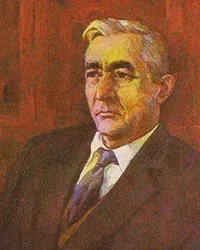
Biography
Hodi Zarif (Hodi Tillayevich Zarifov) was the founder of Uzbek folklore studies and a collector of oral folk literature. He was born in Tashkent on 20 March 1900 (sources following the Uzbek National Encyclopedia give 1905). His first schooling was in schools of the old and new type, and in 1923–1926 he attended the teachers' seminary in Baku. He became a doctor of philology in 1965 and a professor in 1967.
From 1926 to 1930 he worked in educational and cultural bodies in Uzbekistan; in 1930–1931 he was a researcher at the Central Museum of the Peoples of the USSR in Moscow, and in 1931–1934 he headed the ethnography section of the Uzbek research institute of cultural construction. He then moved to the Institute of Language and Literature of the Uzbek Academy of Sciences, where he ran the folklore department, served as the institute's director (1944–1948) and later as deputy director. He was the first director of the Navoi exhibition (the Navoi Literary Museum) in 1939–1956 and, in 1957–1972, scientific secretary of the committee for the study of Navoi's work.
From folk bakhshis he took down famous epics, among them «Ravshan» and «Yodgor», «Rustamxon» and «Ochildov», and «Yusuf bilan Ahmad». He also gathered tales, songs and proverbs, dialectological and ethnographic material, and historical documents, and wrote scholarly articles about performers such as Ergash Jumanbulbul ugli, Fozil Yuldosh ugli, Nurmon Abduvoy ugli, Abdulla Nurali ugli, Kholyor Abdukarim ugli, Ahmad bakhshi Matnazar ugli and Bola bakhshi.
His research dealt with the Uzbek epic, the bakhshi's art, the epic repertoire of folk poets and the course of folklore studies' development, and out of it grew his own school. «The Uzbek Folk Heroic Epic» (1947), co-written with V. M. Zhirmunsky, counts among the principal works of Uzbek folklore scholarship.
Zarif died in Tashkent on 13 January 1972. The Beruni State Prize of Uzbekistan was awarded to him posthumously in 1973. A memorial bust stands in the Uzbek folklore department of the Navoi Literary Museum (sculptor A. Shoymurodov, 1984), and a street in Tashkent carries his name.
Education
- Baku Teachers’ Seminary (Darulmuallimin)College · 1923–1926
Career
- Institute of Language and LiteratureHead of the folklore department, director · Tashkent · 1934–1972
- Alisher Navoi State Museum of LiteratureFirst director · Tashkent · 1939–1956
Awards
- Honoured Science Worker of the Uzbek SSR1967 · Uzbek SSR
 Beruni State Prize of the Uzbek SSR1973, posthumously · Uzbek SSR
Life path
- 1900Birth
Tashkent, 20 March (1905 in some sources).
- 1923–1926Baku teachers' seminary
- 1930–1931Central Museum of the Peoples of the USSR, Moscow
Researcher.
- 1931–1934Head of the ethnography department
Research institute of cultural construction.
- 1934Folklore department of the Institute of Language and Literature
Head in 1934–1939, 1956–1965 and 1960–1972.
- 1939–1956First director of the Navoi exhibition (Literary Museum)
- 1944–1948Director of the institute
- 1957–1972Scientific secretary of the Navoi studies committee
- 1965Doctor of philology
- 1967Professor; Honoured Science Worker
- 1972Death
Tashkent, 13 January.
- 1973Beruni State Prize
Posthumously.
Works
- «Lug'at ham termin to'plovchilarga qo'llanma» (1934)
- «The Uzbek Folk Heroic Epic» (1947)
Co-authored with V. M. Zhirmunsky.
- «Lutfiy and Navoi» (1948)
- «On the comparative study of folklore and archaeological materials» (1958)