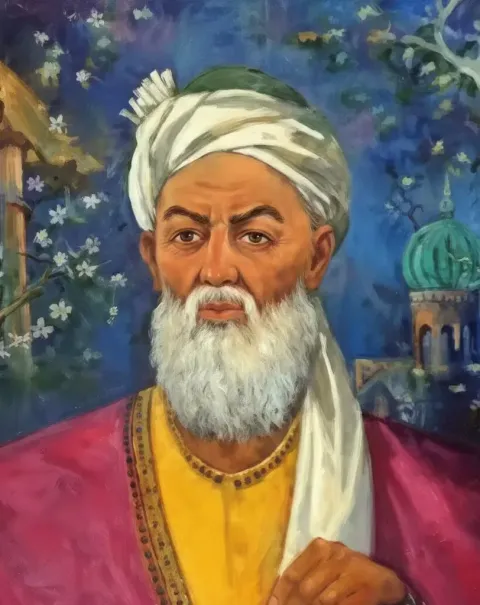
Imam al-Bukhari
Theologian and hadith scholar, compiler of “Sahih al-Bukhari”, the most authoritative collection of hadith for Sunni Muslims.
- Occupation:
- Religious figure
- Born:
- July 20 810(60 years old) ♋ — September 1, 870
- Birthplace:
- Bukhara
- Father:
- Ismoil ibn Ibrohim
Biography
Abu Abdullah Muhammad ibn Ismail al-Bukhari was born on 20 July 810 in Bukhara into a family of Persian origin. According to tradition, he knew the Quran by heart by the age of seven and thousands of hadiths by the age of ten.
At sixteen he set out on a journey through the great centres of Islamic learning — Mecca, Medina, Baghdad, Damascus, Basra, Nishapur and Egypt — where he studied under more than 1,800 teachers and recorded the traditions of the sayings and deeds of the Prophet Muhammad.
Over sixteen years he selected the most reliable of the roughly 200,000 hadiths he had heard, applying strict criteria to the chain of transmitters. The result was “Sahih al-Bukhari”, a collection of 7,275 hadiths (counting repetitions), the first work to be arranged by subject, which Sunni Muslims regard as the most authoritative book after the Quran.
Besides the “Sahih”, al-Bukhari left “Al-Adab al-Mufrad”, on ethics, and “Al-Tarikh al-Kabir”, a compendium of biographies of hadith transmitters. Theological disputes forced him to leave Bukhara more than once, and he spent his last years in exile.
He died on 1 September 870 in the village of Khartank near Samarkand, where he is buried. In 1998 a memorial complex with a mosque, a library and a madrasa was built over his grave.
Works
- “Sahih al-Bukhari”Hadith collection
His principal work — a collection of 7,275 hadiths (counting repetitions), selected over sixteen years from about 200,000 he had heard; Sunni Muslims regard it as the most authoritative book after the Quran.
- “Al-Adab al-Mufrad”Hadith collection
Hadiths on morals and good conduct.
- “Al-Tarikh al-Kabir”Biographical compendium
A compendium of biographies of hadith transmitters.
- “Khalq Af‘al al-‘Ibad”Theological work
On the createdness of human acts — a theological question disputed in his time.
Life path
- 810Birth
Born in Bukhara into the family of the hadith scholar Ismail ibn Ibrahim; his father died when he was young.
- 826Beginning of his travels
At sixteen he went on the hajj with his mother and elder brother and stayed in the Hijaz for several years, beginning to record hadith from teachers in Mecca and Medina.
- 828Study under Ishaq ibn Rahwayh
Studied in Nishapur under the renowned hadith scholar Ishaq ibn Rahwayh, who according to tradition was the first to advise him to compile a collection of only authentic hadith.
- 833Baghdad and Basra
Studied under leading hadith scholars of the day, including Ahmad ibn Hanbal; Ali ibn al-Madini became his main teacher in the critique of chains of transmission.
- 846Completion of the «Sahih al-Bukhari»
After sixteen years of selection he completed his main work — a collection of 7,275 hadith that had passed strict criteria of reliability of the chain of transmission.
- 856Conflict in Nishapur
After moving there to teach, he clashed with the theologian Muhammad ibn Yahya al-Dhuhli in the dispute over whether the recitation of the Quran is created; some of his students, such as Muslim ibn al-Hajjaj, the future author of the «Sahih Muslim», went over to his lessons, which led to his expulsion from the city.
- 864Expulsion from Bukhara
After returning to his homeland he was expelled from the city on the order of the governor of Bukhara, Khalid ibn Ahmad al-Dhuhli, for refusing to give a separate hadith lesson to his children.
- 870Death
Died in the village of Khartang near Samarkand, where his relatives had given him shelter, and was buried there.
Legacy
«Sahih al-Bukhari» is regarded by Sunnis as the most authentic book after the Quran; together with «Sahih Muslim» it forms the «as-Sahihayn» — the two collections on which classical Islamic law rests. The method of strict verification of the chain of transmission (isnad) developed by al-Bukhari became the foundation of the science of hadith and a model for all later collections; the scholar was given the honorary title «Amir al-Mu'minin fi'l-hadith» («Commander of the Faithful in Hadith»). In 2017 the Imam al-Bukhari International Research Centre was opened beside his mausoleum in Khartang.
Era: The flowering of the science of hadith in Islam, 9th century- A memorial complex built over his mausoleum in Khartang for the 1,225th anniversary of his birth (1998)
- The Imam al-Bukhari International Research Centre opened beside the mausoleum (2017)