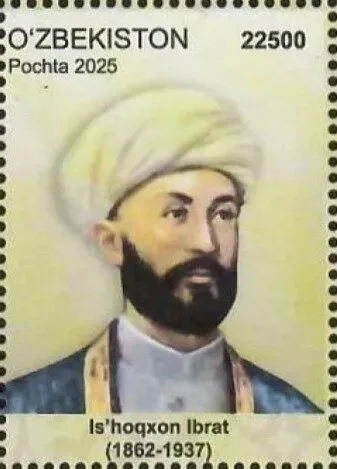
Ishokhon Tura Ibrat
Jadid educator, poet, linguist and historian from Turakurgan near Namangan, author of a six-language dictionary and of a history of the world’s scripts, and one of the first Uzbek publishers.
Biography
Ishokhon Tura Ibrat was born in 1862 in the village of Turakurgan near Namangan, into an educated family. His given name was Is’hoqxon; “tura” marks his descent, and “Ibrat” (“example”, “lesson”) was his pen name. His father, Junaydullakhoja, was a lover of poetry, and his mother, Huribibi, kept a school for girls at home where she taught reading and calligraphy. By his own account, five years at the neighbourhood school left him still unable to read, and it was his mother who taught him; in his writings he often honoured her as his teacher.
In 1878 he entered the Muhammad Siddiq Tunqator madrasa in Kokand, where he studied until 1886. In Kokand he moved in the circle of the poets Muqimi, Furqat and Zavqi, learned Arabic, Persian and Russian, and first came across the “Turkestan Native Newspaper” and Ismail Gasprinski’s “Tercüman”; it was then that he began to write verse under the name Ibrat. Back in Turakurgan he opened a school that taught reading by the sounds of the letters (usul-i savtiya), but conservatives soon had it closed.
In 1887 Ibrat took his mother on the pilgrimage to Mecca; she died in Jeddah. He then spent nearly nine years travelling: he lived in the cities of Arabia, saw Istanbul, Sofia, Athens and Rome, spent time in Afghanistan, and from 1892 to 1896 lived in Bombay and Calcutta. He earned his living by ornamental painting, cutting seals and carving inscriptions on gravestones. In these years he mastered Arabic, Persian, Hindi-Urdu and English and studied French and ancient scripts. In 1896 he returned home by way of Kashgar.
From the late 1890s into the 1920s Ibrat served as qadi (judge) of Turakurgan. His “Lughat-i sitta alsina”, a dictionary setting side by side words in Arabic, Persian, Hindi, Turkish, Uzbek and Russian (the Russian written in Arabic script), could be published in Tashkent only in 1901 because of the censors. In 1907 he opened a new-method school for thirty village children in his house and, at Munavvar Qori’s invitation, spent several months in Tashkent; that year the Governor-General of Turkestan awarded him a robe of honour for a work of calligraphy in seventeen scripts.
In 1908 he bought a lithographic press in Orenburg on ten years’ credit, brought it by train to Kokand and from there by camel to Turakurgan, and set up the Matbaa-i Is’hoqiya printing house in place of a bathhouse he had built. Its first book was the literacy and calligraphy manual “San’at-i Ibrat” (1908); in 1910 the press moved to Namangan. It printed his collection of poems “Ilm-i Ibrat” (1909) and his history of writing systems, “Jome’ ul-xutut” (1912). In 1910 he laid out a park for the people of Turakurgan; in 1913 he applied for permission to publish a newspaper, “Al-Tijor al-Namangan”, and was refused, and that year he opened the Kutubkhona-i Is’hoqiya library in his house.
As a historian Ibrat wrote “Tarikh-i Farghona” (“The History of Fergana”), a chronicle of the Kokand Khanate, as well as “Tarikh-i madaniyat” (“The History of Culture”) and “Mezon uz-zamon”. He wrote poetry in Uzbek, Persian and Arabic: in poems such as “Qarz” (“Debt”), “Bo’lubdur” and “Qalaysizlar” he attacked colonial rule and the vices of society, and in a mukhammas on the railway carriage he welcomed the coming of the railway to Namangan. His poems and articles appeared in the “Turkestan Native Newspaper”, “Sadoyi Farg’ona” and Behbudiy’s magazine “Oyina”. He gathered thirty years of verse into the “Divan-i Ibrat”, but the manuscript has not been found.
Under Soviet rule his printing house was confiscated and most of his library was plundered. In 1935 Ibrat was removed from all his posts and was not even granted a pension. In the spring of 1937 he was arrested on a charge of “anti-Soviet propaganda” and sent to the prison in Andijan, where he died that April without having been tried. His burial place is unknown. In independent Uzbekistan his writings have been republished; in 2018 the Ishokhon Ibrat memorial complex opened in Turakurgan, and in 2022 the Namangan State Institute of Foreign Languages was named after him.
Education
- Muhammad Siddiq Tunqator Madrasa (Kokand)Madrasa · Kokand · 1878–1886
Career
- Matbaa-i Is’hoqiya printing houseFounder and owner · To'raqo'rg'on District · 1908–…
Life path
- 1878–1886Studies in Kokand
Studied at the Muhammad Siddiq Tunqator madrasa and joined the circle of Kokand’s poets.
- 1886First school
Opened a school in Turakurgan that taught reading by the phonetic method; conservatives had it closed.
- 1887–1896Pilgrimage and travels
Made the hajj with his mother, then travelled through Arabia, Turkey, Europe and Afghanistan and lived in India from 1892 to 1896.
- late 1890s–1920sQadi of Turakurgan
Served as the judge of his home village.
- 1901“Lughat-i sitta alsina”
His six-language dictionary was published in Tashkent.
- 1907New-method school
Opened a school for thirty children in his house; the Governor-General gave him a robe of honour for a work of calligraphy.
- 1908Matbaa-i Is’hoqiya
Brought a lithographic press from Orenburg and opened a printing house in Turakurgan; it moved to Namangan in 1910.
- 1912“Jome’ ul-xutut”
Printed his history of writing systems at his own press.
- 1913Newspaper and library
Was refused permission for the newspaper “Al-Tijor al-Namangan”; opened the Kutubkhona-i Is’hoqiya library.
- 1935Dismissal
Removed from all his posts and left without a pension.
- 1937Arrest and death
Arrested in the spring; died in the Andijan prison in April without trial.
Works
- “Dictionary of Six Languages” (“Lughat-i sitta alsina”) (1901)Dictionary
Sets side by side more than a thousand words in Arabic, Persian, Hindi, Turkish, Uzbek and Russian, the Russian written in Arabic script. Written in the 1890s and published in Tashkent.
- “San’at-i Ibrat” (1908)Literacy and calligraphy manual
Copied by the calligrapher Mirrajab Bandi; the first book of the Matbaa-i Is’hoqiya, also used as a primer in Jadid schools.
- “Ilm-i Ibrat” (1909)Collection of poems
A small collection of reformist poems in Uzbek, Persian and Arabic, printed at his own press.
- “Collection of Scripts” (“Jome’ ul-xutut”) (1912)Scholarly work
A history of writing from pictography to the early 20th century, covering some forty writing systems and the styles of Arabic calligraphy; 132 pages.
- “Who Will Reform the Nation?” (1914)Article
Published in Behbudiy’s magazine “Oyina”; urges the ulama to fight customs contrary to the sharia by preaching in words the people understand.
- “The History of Fergana” (“Tarikh-i Farghona”)History
A history of the Kokand Khanate, with accounts of the Bukharan invasion of 1842 and of Nodira; unpublished in the author’s lifetime and printed in 1991.
- “The History of Culture” (“Tarikh-i madaniyat”)History
A work on the history of culture; the manuscript is kept at the Institute of Oriental Studies of the Uzbek Academy of Sciences.
- “Mezon uz-zamon”Treatise
Written in the Soviet years; calls for learning modern science and technology and for more new-method schools.
- “The Verse History of the Railway Carriage” (“Tarikh-i manzuma-i vagon”)Poem (mukhammas)
On the building of the Kokand–Namangan railway and the first train to Namangan; published in the “Turkestan Native Newspaper”.
- “Debt” (“Qarz”)Poem (musaddas)
On peasants who borrowed against the coming cotton harvest and lost their land.
Legacy
Ibrat is regarded as one of the first Jadids of the Fergana Valley: his new-method school, six-language dictionary, printing house and public library made him one of the region’s leading educators. “Jome’ ul-xutut” is one of the first studies of the history of writing in Uzbek, and “Tarikh-i Farghona” remains an important source on the history of the Kokand Khanate. A memorial complex and a foreign-language school in Turakurgan and an institute of foreign languages in Namangan bear his name.
Era: Turkestan Jadidism, late 19th to early 20th century- “Tarikh-i Farghona” was published as a book in Tashkent (1991)
- His “Selected Works”, edited by U. Dolimov and N. Jabborov, were published (2005)
- The Cabinet of Ministers decided to create the Ishokhon Ibrat memorial complex in Turakurgan (2017)
- The memorial complex, with a museum, park, printing house and school, opened in Turakurgan (2018)
- The feature film “Ibrat”, about his life, had its premiere (2020)
- The Ishokhon Ibrat Namangan State Institute of Foreign Languages was founded (2022)
- Uzbekistan Post issued a stamp with his portrait in the series “Jadids — Heroes of the Nation” (2026)