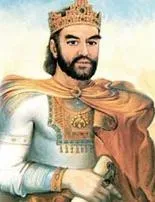
Ismail Samani
Samanid emir (892–907) who united Transoxiana under his rule, made Bukhara his capital and, after defeating the Saffarids near Balkh in 900, added Khorasan to his realm.
- Occupation:
- Historical figure, Politician, Military officer
- Real name:
- Abu Ibrahim Isma'il ibn Ahmad
- Nickname:
- Amir-i Adil
- Born:
- 849 — November 24, 907
- Birthplace:
- Fergana
- Father:
- Ahmad ibn Asad
- Children:
- Ahmad ibn Ismoil
Biography
Abu Ibrahim Isma'il ibn Ahmad Samani was born in 849. He belonged to the Samanid dynasty, which traced its line to Saman Khuda, a landowner from the Balkh region who converted to Islam in the 8th century. In 819 Saman Khuda’s grandsons, the sons of Asad, were given authority over provinces of Transoxiana by Caliph al-Ma’mun’s governor of Khorasan; Ismail’s father, Ahmad ibn Asad, received Fergana. Most sources name Fergana as Ismail’s birthplace, while some scholars also mention Balkh. His elder brother Nasr inherited Samarkand and most of Transoxiana after their father’s death.
In 874 Bukhara, left without firm rule after the fall of the Tahirids and plundered by raiders from Khwarazm, asked Nasr for a governor. Nasr sent his younger brother, and the city welcomed Ismail, who governed it from 874 to 892. A quarrel over taxes soon broke out between the brothers when Ismail stopped sending the annual tribute to Samarkand. Nasr marched on Bukhara twice, in 885 and 888. In 888 Ismail won and took his brother prisoner but, according to the sources, treated him with respect and sent him back to Samarkand. Nasr remained the nominal head of the dynasty until his death in August 892.
After his brother’s death Ismail became ruler of all Transoxiana and moved the capital from Samarkand to Bukhara, and Caliph al-Mu’tadid confirmed him as governor. In 893 he campaigned into the steppe and took Taraz, the centre of the Karluks, returning with enormous booty. In the same years he brought under his authority the Afshins, the local dynasty of Ushrusana on the middle Syr Darya. According to Narshakhi, once the nomad threat had been removed, Ismail abolished the yearly labour of repairing the wall around the Bukhara oasis, saying that as long as he lived, he himself would be the wall of Bukhara.
Ismail’s growing power alarmed both Baghdad and the Saffarids, who ruled Khorasan. The caliph granted Transoxiana to the Saffarid Amr ibn Layth, who invaded the provinces on the Amu Darya. In the spring of 900, in a battle near Balkh, Ismail routed the Saffarid army, captured Amr and sent him to Baghdad. The caliph then appointed Ismail governor of Khorasan, Sistan, Ray, Tabaristan and Isfahan. That same year Ismail’s general Muhammad ibn Harun defeated the Zaydi ruler of Tabaristan, Muhammad ibn Zayd, near Gorgan; Ray and Qazvin were taken next, although the Samanids could not hold these western lands for long. In 904 an invasion by Turkic tribes from the steppe was driven back.
Ismail kept the caliph’s name in the Friday sermon and on his coins, but sent no regular tribute to Baghdad and in practice ruled as an independent sovereign, though he never took a title higher than emir. He strengthened central authority, built a strong army and made Bukhara a city that drew scholars and jurists. Later writers portray him as a just and pious ruler: the 10th-century historian Narshakhi called him wise and fair, and Nizam al-Mulk told stories of his justice in the “Siyasatnama”. The sources also call him Amir-i Mazi (“the late emir”) and Amir-i Adil (“the just emir”).
After a long illness Ismail Samani died in Bukhara on 24 November 907 and was succeeded by his son Ahmad. The Samanid Mausoleum in Bukhara is traditionally regarded as the tomb of Ismail and his descendants. A copy of a 10th-century endowment deed records that Ismail set aside land in the Naukanda cemetery for a tomb for his father Ahmad, while some scholars date the building later, to the reign of Nasr II. Uncovered from under layers of earth during excavations in the 1920s, the mausoleum is one of the oldest surviving monuments of Islamic architecture in Central Asia and is part of the UNESCO World Heritage site “Historic Centre of Bukhara”, inscribed in 1993.
Ismail is remembered as the most powerful ruler of his dynasty; the Encyclopaedia Iranica calls him the greatest of the Samanids. The state he built lasted until the end of the 10th century, and his capital Bukhara became, under his successors, a centre of learning and culture where Rudaki and Ibn Sina worked. In Uzbekistan his name is tied above all to the mausoleum in Bukhara; in Tajikistan he is honoured as the founder of Tajik statehood: the highest peak of the Pamirs was named after him in 1998, the 1100th anniversary of the Samanid state was celebrated in 1999, and the national currency introduced in 2000 is called the somoni.
Career
Life path
- 849Birth
Born to Ahmad ibn Asad; according to most sources, in Fergana, which his father governed.
- 874Governor of Bukhara
Sent by his elder brother Nasr to govern Bukhara.
- 885–888War with Nasr
Nasr twice marched on Bukhara; in 888 Ismail won, captured his brother and sent him back to Samarkand with honour.
- 892Emir of Transoxiana
After Nasr’s death became ruler of all Transoxiana and moved the capital to Bukhara.
- 893Taraz campaign
Took Taraz, the centre of the Karluks, and brought the Afshins of Ushrusana under his authority.
- 900Battle of Balkh
Defeated and captured the Saffarid Amr ibn Layth; the caliph made him governor of Khorasan and other provinces.
- 900–901Campaigns in the west
Tabaristan, Ray and Qazvin were taken.
- 904Steppe invasion repelled
An attack by Turkic tribes was driven back.
- 907Death
Died in Bukhara on 24 November; succeeded by his son Ahmad.
Legacy
Ismail Samani is seen as the first Samanid to unite Transoxiana and Khorasan in a single state and to rule in practice independently of the caliphate; the Encyclopaedia Iranica calls him the greatest member of the dynasty. Bukhara, which he made his capital, became a major centre of learning and culture in Central Asia in the Samanid era. The works of Narshakhi and Nizam al-Mulk carried his image as a just ruler down the centuries. His name is linked with the Samanid Mausoleum in Bukhara, and in Tajikistan a mountain peak, the national currency and a state order are named after him.
Era: The Samanid era, late 9th to early 10th century- Narshakhi wrote his “History of Bukhara”, with a detailed account of Ismail’s reign (943)
- The Samanid Mausoleum was inscribed on the UNESCO World Heritage List as part of the “Historic Centre of Bukhara” (1993)
- The highest peak of the Pamirs was named after Ismail Samani (1998)
- Tajikistan marked the 1100th anniversary of the Samanid state (1999)
- Tajikistan introduced its national currency, the somoni (2000)