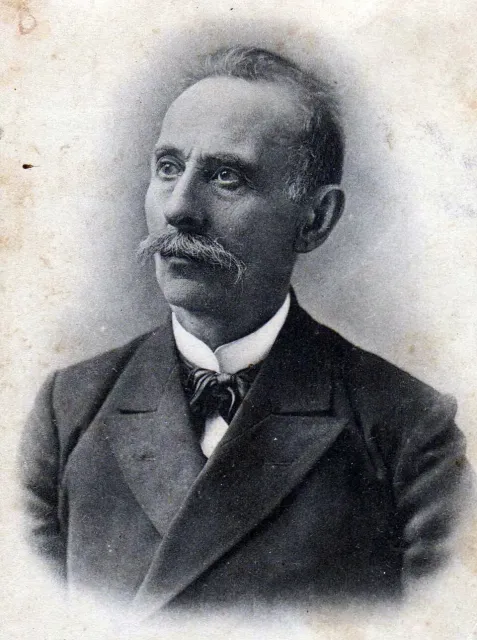
Biography
Ismail Gasprinski (Ismoilbek Gaspirali) was a Crimean Tatar educator, publisher and school reformer, widely regarded as the leader of the Jadid movement among the Muslims of the Russian Empire. From 1883 he issued the newspaper Tercüman (Tarjimon) in Bakhchysarai, which introduced the Turkic peoples from Crimea to Turkestan to one another, and he led the spread of schools using the phonetic method (usul-i savtiya).
He was born in 1851 in the village of Ajikoy near Bakhchysarai (sources give 20 or 21 March as the day). His name derives from Gaspra, the village of his forebears. His father, Mustafa Bey, served as interpreter to Governor-General Vorontsov and was granted noble rank in 1853. Ismail studied at an old Bakhchysarai school, then at the Simferopol gymnasium and a military school in Voronezh, and graduated from the Milyutin gymnasium in Moscow in 1868. Back home he taught Russian at the Zincirli madrasa.
From 1872 he lived in France and visited Vienna, Munich and Stuttgart; in Paris he worked as assistant-secretary to Ivan Turgenev and attended lectures at the Sorbonne. Returning in 1876, he concluded that traditional schooling had fallen behind and pressed for secular subjects in schools and madrasas. The idea met fierce opposition, and he turned to municipal work, serving as mayor of Bakhchysarai in 1878-1884 until the council, angered by spending on street lighting and medical aid, forced him out. In 1882 he married the daughter of the Kazan millionaire Akchurin.
In his programmatic book Russian Muslims (1881) he argued that Russia could treat its subject peoples in one of two ways, assimilation or cooperation, and proposed mother-tongue primary education and schools teaching modern sciences for Muslims. Russian chauvinists attacked it sharply. In 1882 he published the pamphlets Solnomai turkiy and Miroti jadid, and in 1885, in Istanbul, a short essay comparing European civilisation with Islam; his Madaniyati islomiya was later reprinted twice.
Tercüman became his main platform. There he championed the motto of unity in language, thought and deed for all Turkic peoples and the idea of a common literary language based on Ottoman Turkish but drawing on many dialects. In 1906 the question of a common language was debated at a Muslim assembly in Nizhny Novgorod. His book Turkestan Ulema (Baku, 1900) presented more than a hundred scholars, poets, physicians and astronomers connected with Bukhara, Khwarazm, Ferghana and Samarkand.
He visited Turkestan twice. In 1893, after meeting the Emir of Bukhara Abdulahad in Crimea, he came to Samarkand, where the phonetic method was introduced, and went on to Shahrisabz. On his second journey, in 1908, he visited Bukhara and Samarkand and spoke with the heir Sayyid Alimkhan, Mahmudkhoja Behbudi and Abdulqodir Shakuri; his impressions appeared in Tercüman under the title "What did I see in Bukhara?". When Bukhara's Nogais wished to name a new school after him he declined and suggested "Muzaffariya", after the emir's father.
In fiction he spoke through an imagined traveller, Mulla Abbas Fransavi, a Tashkent native educated in Europe: Letters from France (1887), Muslims of Dorur-rohat (serialised from 1887), Letters from Sudan, Land of Women (1890), The Lioness (1893), Dawn Has Broken (1905), Conversation of the Sultans (1906) and A Pilgrimage to Gulbobo (1908). Muslims of Dorur-rohat is counted among the first major works of modern Turkic literature in Russia.
He died in September 1914. In 1910 the French journal Revue du monde musulman nominated him for the Nobel Peace Prize. His name was suppressed in Soviet times and restored from the late 1980s: an international conference marked his 140th anniversary in Simferopol in 1991, and his 150th was celebrated in 2001. Turkestani reformers, Behbudi among them, called him the father of the nation and the leader of Jadidism.
Life path
- 1851Birth
Born in the village of Ajikoy near Bakhchysarai.
- 1868Finished school in Moscow
Graduated from the Milyutin gymnasium, then taught Russian at the Zincirli madrasa in Bakhchysarai.
- 1872–1876Europe
Lived in France and visited Vienna, Munich and Stuttgart; in Paris was Turgenev's assistant-secretary.
- 1878–1884Mayor
Served as mayor of Bakhchysarai.
- 1881Russian Muslims
Published his programmatic book on the education and rights of Russia's Muslims.
- 1883Tercüman
Began publishing a newspaper for the Turkic peoples in Bakhchysarai.
- 1893First trip to Turkestan
Began introducing the phonetic method in Samarkand and Shahrisabz.
- 1900Turkestan Ulema
Book printed in Baku.
- 1906Common literary language
The question was raised at a Muslim assembly in Nizhny Novgorod.
- 1908Second trip to Turkestan
Visited Bukhara and Samarkand and met Behbudi and Shakuri; the 25th anniversary of Tercüman was marked.
- 1910Nobel Peace Prize nomination
A French journal put him forward for the prize.
- 1914Death
Died in Bakhchysarai (24 September 1914, 11 September Old Style).
Works
- «Rus musulmonligi» (1881)
- «Solnomai turkiy» (1882)
- «Miroti jadid» (1882)
- «Ovro'po madaniyatiga bir nazari muvozana» (1885)
- «Farangiston maktublari» (1887)
- «Dorur-rohat musulmonlari» (1887)
- «Sudan maktublari» (1889)
- «Xotinlar o'lkasi» (1890)
- «Arslon qiz» (1893)
- «Ivan va Sulaymon» (1897)
- «Turkiston ulamosi» (1900)
- «Kun tug'di» (1905)
- «Baloyi islom» (1905)
- «Mukolamayi salotin» (1906)
- «Gulbobo ziyorati» (1908)
- «Madaniyati islomiya»