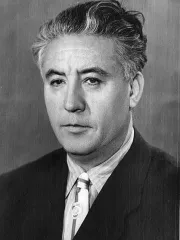
Izzat Sulton
Uzbek literary scholar, playwright and academician, author of the textbook “Theory of Literature” and the book on Navoi “Navoi’s Notebook of the Heart”, co-author of the drama “Alisher Navoi”.
Biography
Izzat Sulton (full name Izzat Otaxon oʻgʻli Sultonov) was born on 29 June 1910 (16 June in the old style) in Osh, now in Kyrgyzstan, into a tailor’s family. He attended a Russian-native school, came to Tashkent as a teenager and studied at the Narimanov (Namuna) school, finishing a teacher-training technical college in 1929. From 1930 to 1934 he studied at the social faculty of the Tashkent Pedagogical Institute, then continued as a postgraduate until 1937.
He began working as a school teacher and in newspapers: in 1931 he was executive secretary of the paper “Batrak”, and his critical articles had been appearing in print since the early 1930s. From 1937 to 1942 he was deputy director of the Institute of Language and Literature.
During and after the war he held government posts: deputy chairman of the Uzbek SSR State Committee for Radio Broadcasting (1942–1943), director of the Tashkent film studio, Uzbekfilm (1943–1945), and deputy chairman of the Council of Ministers of the Uzbek SSR for cultural affairs (1945–1948). He defended his candidate’s dissertation on Navoi’s “Mezon ul-avzon” in 1946 and his doctoral dissertation in 1955.
He directed the Institute of Language and Literature in 1948–1951, taught at Moscow State University in 1950–1953 and from 1955 headed the institute’s sector of literary theory. In 1956–1963 he was a secretary of the board of the Writers’ Union of the Uzbek SSR.
As a playwright he wrote “The Flight of the Eagle” (staged in the early 1940s, about M. V. Frunze’s work in Turkestan), the historical drama “Alisher Navoi” together with Uygun, and the plays “Imon” (“People of Faith”, 1960) and “The Unknown” (1963). He was one of the screenwriters of the film “Alisher Navoi”; the picture, directed by Kamil Yarmatov, received a Stalin Prize, second class, in 1948. He also wrote the libretto of the opera “The Poet’s Heart”, set to music by M. Ashrafi.
In literary scholarship his school textbook “Theory of Literature” (1939) and the university textbook (1980; second edition 1986) were widely used. His most important scholarly book is “Navoi’s Notebook of the Heart” (1969), about the life and work of Alisher Navoi. In 1994 he wrote a monograph on Bahouddin Naqshband and took part in the collective works “History of Uzbek Soviet Literature” and “History of Uzbek Soviet Criticism”.
He was named Honoured Art Worker of the Uzbek SSR in 1964 and Honoured Science Worker of the Uzbek SSR in 1981; he became a corresponding member of the Academy of Sciences in 1966 and an academician in 1995. In 1970 he received the Beruni State Prize of the Uzbek SSR for his part in the collective work “History of Uzbek Soviet Literature”, and in 1992 he was awarded the “Shuhrat” medal.
Izzat Sulton died in Tashkent on 29 July 2001 and was buried at the Chigatay cemetery.
Education
- Nizami Tashkent State Pedagogical UniversityUniversity · Tashkent · 1930–1937 · Social faculty (1934), postgraduate course (1937)
- Narimanov Pedagogical CollegeCollege · 1929 · Teacher-training technical college
Career
- Academy of Sciences of UzbekistanCorresponding member (1966), academician (1995) · Tashkent · 1966–…
- Writers' Union of UzbekistanSecretary of the board (Writers' Union of the Uzbek SSR) · Tashkent · 1956–1963
- Institute of Language and LiteratureDeputy director (1937–1942), director (1948–1951), head of the sector of literary theory (from 1955) · Tashkent · 1937–…
- Uzbekfilm studioDirector of the Tashkent film studio · Tashkent · 1943–1945Everyone who held this post →
- Council of Ministers of the Uzbek SSRDeputy chairman for cultural affairs · Tashkent · 1945–1948
- Moscow State UniversityLecturer at the department of literature of the peoples of the USSR · 1950–1953
Awards
 Medal «Shuhrat» (Glory)1992 · Uzbekistan
- Honoured Art Worker of the Uzbek SSR1964 · Uzbek SSR
- Honoured Science Worker of the Uzbek SSR1981 · Uzbek SSR
 Beruni State Prize of the Uzbek SSR1970 · Uzbek SSR
 Medal «For Labour Distinction»1959 · USSR
Life path
- 1910Birth
Born in Osh into a tailor’s family.
- 1930–1937Tashkent Pedagogical Institute
Studied at the social faculty (graduating in 1934), then as a postgraduate.
- 1937–1942Institute of Language and Literature
Served as deputy director of the institute.
- 1942–1945Radio committee and film studio
Deputy chairman of the State Radio Broadcasting Committee, then director of the Tashkent film studio.
- 1945–1948Council of Ministers of the Uzbek SSR
Deputy chairman of the Council of Ministers for cultural affairs; defended his candidate’s dissertation in 1946.
- 1948–1953The institute and Moscow University
Directed the Institute of Language and Literature in 1948–1951 and taught at Moscow State University in 1950–1953.
- 1955Doctoral dissertation
Became a Doctor of Philological Sciences and head of the sector of literary theory.
- 1956–1963Writers’ Union
Secretary of the board of the Writers’ Union of the Uzbek SSR.
- 1964Honoured Art Worker
Received the title Honoured Art Worker of the Uzbek SSR.
- 1969“Navoi’s Notebook of the Heart”
His main book on the life and work of Alisher Navoi was published.
- 1995Academician
Elected a full member (academician) of the Academy of Sciences of Uzbekistan.
- 2001Death
Died in Tashkent and was buried at the Chigatay cemetery.
Works
- “Theory of Literature” (school textbook) (1939)Textbook
One of the first textbooks of literary theory for schools (“Adabiyot nazariyasi”).
- “The Flight of the Eagle” (1940)Play
A play about M. V. Frunze’s work in Turkestan and the friendship of the Uzbek and Russian peoples; staged at the Hamza Theatre in 1942 (“Burgutning parvozi”).
- “Alisher Navoi” (1940)Historical drama
A drama written with Uygun; a film of the same name was made in 1947.
- “Mezon ul-avzon” and its critical text (1947)Scholarly study
A study of Navoi’s treatise on prosody.
- “Imon” (“People of Faith”) (1960)Play
A play about the lives of scholars of his time, staged at the Hamza Theatre.
- “The Unknown” (1963)Historical drama
A verse drama featuring the popular rebel Namoz the Thief (“Nomaʼlum kishi”).
- “Navoi’s Notebook of the Heart” (1969)Monograph
A book on the life and work of Alisher Navoi (“Navoiyning qalb daftari”); published in Russian in 1979 and 1985.
- “Works” (4 volumes) (1971)Collected works
Selected works in four volumes, published in 1971–1974.
- “Theory of Literature” (for universities) (1980)Textbook
A textbook for philology faculties; the second edition appeared in 1986.
- “The Eternity of Bahouddin Naqshband” (1994)Monograph
A book on the 14th-century Sufi master Bahouddin Naqshband (“Bahouddin Naqshband abadiyati”).
Filmography
| Title | Year |
|---|---|
| Alisher Navoi | 1947 |
| Obsessed | 1965 |